





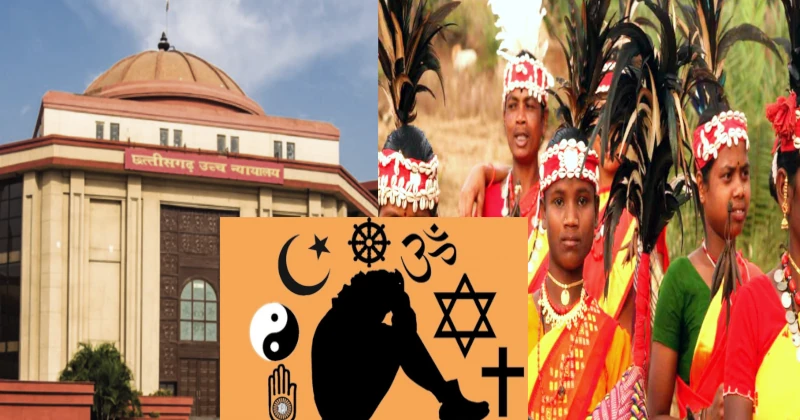
The Chhattisgarh High Court has warned that mass conversions of Scheduled Tribes by Christian missionaries are threatening India’s unity, cultural identity, and social harmony.
Delivering a strongly worded judgment while hearing a batch of petitions related to alleged restrictions on Christian missionaries in vanvasi villages, the Court held that the right to propagate religion under Article 25 of the Constitution does not extend to converting others through inducement, force, or fraud.
“The right to propagate religion does not mean the right to convert by inducement or fraud,” the Court observed, drawing a sharp distinction between voluntary faith and manipulative proselytisation.
The High Court noted that missionary activity in India, originally seen as an instrument of social service and education, has increasingly become a platform for proselytisation, particularly among the most vulnerable and marginalised vanvasi communities.
“Among economically and socially deprived sections, especially Scheduled Tribes and Scheduled Castes, this has led to gradual religious conversion under the promise of better livelihoods, education, or equality,” the Court remarked. What once appeared as social upliftment, the Court said, has in many cases turned into “a subtle instrument of religious expansion.”
The Bench expressed concern that such activities distort the essence of religious freedom and “amount to cultural coercion,” especially when carried out in areas inhabited by illiterate and impoverished families who are offered material benefits money, education, medical care, or jobs in exchange for conversion. “The menace arises when conversion ceases to be a matter of personal faith and becomes a result of inducement, manipulation, or exploitation of vulnerability,” the Court said.
Taking a broader socio-cultural view, the Court highlighted the long-term damage caused to India’s vanvasi heritage by these conversions. It observed that vanvasi communities have for centuries maintained a deep-rooted spiritual and cultural bond with nature, traditions, and local deities a connection now being eroded by organised religious campaigns.
“Conversion disrupts this organic connection. The erosion of vanvasi faiths often results in the loss of indigenous languages, rituals, and customary laws,” the Court noted. The Bench added that newly converted individuals often distance themselves from their traditional cultural practices and festivals, leading to polarisation within villages, social boycotts, and even violent clashes.
Moreover, religious conversion was found to influence political representation and constitutional benefits. The Court explained that since Scheduled Tribe and Scheduled Caste benefits are linked with religion, conversion can alter demographic patterns and political equations, creating new socio-political fault lines.
While upholding the constitutional right to freedom of religion, the Court stated that “India’s secular fabric thrives on coexistence and respect for diversity.” However, it warned that when religion becomes a tool for manipulation or mass conversion, it undermines both faith and freedom.
“When conversion becomes a calculated act of exploitation disguised as charity, it undermines both faith and freedom. The so-called ‘conversion by inducement’ by certain missionary groups is not merely a religious concern it is a social menace that threatens the unity and cultural continuity of India’s indigenous communities,” the Bench stated. The Court added that “the remedy lies not in intolerance but in ensuring that faith remains a matter of conviction, not compulsion.”
The observations came during the hearing of petitions challenging hoardings erected in at least eight villages of Kanker District, which stated that pastors and “converted Christians” were prohibited from entering.
The Court was informed that these hoardings were installed by Gram Sabhas under powers granted by the Panchayat (Extension to Scheduled Areas) Act, 1996 (PESA), following a circular by the State government.
However, after reviewing the facts, the Court clarified that the circular did not authorise discrimination against Christians in general. Instead, it found that the hoardings were intended to restrain entry for conversion-related activities, not to impose a blanket ban on individuals.
Referring to the Chhattisgarh Dharma Swatantrya Adhiniyam, 1968, the Court reiterated that conversion by inducement, force, or fraud is a punishable offence under the law. “The expression ‘right to propagate religion’ under Article 25 does not extend to converting another person through inducement, force, or fraudulent means. Therefore, a general cautionary hoarding intended to prevent illegal conversion activities cannot, per se, be termed unconstitutional,” the Court reasoned.
















Comments