





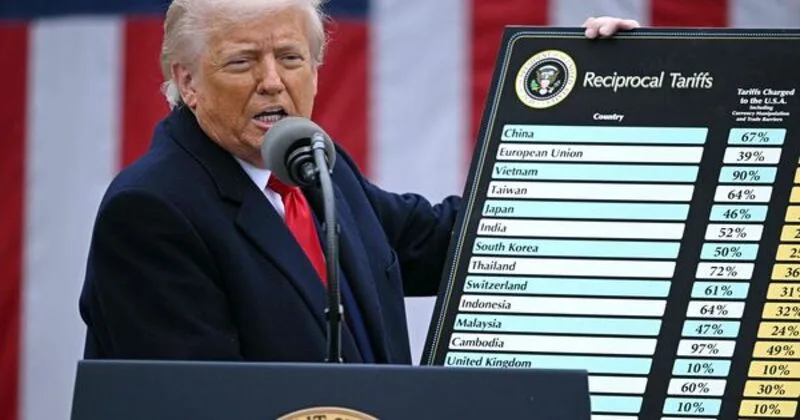
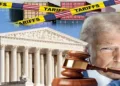
The escalating global trade tension triggered by US President Donald Trump’s aggressive tariff policies has reached a decisive moment. As Trump continues to impose heavy duties on imports from India, Brazil, China, and many other nations, questions have intensified over whether the US President has the unilateral authority to declare such retaliatory measures. India has been targeted for continuing to buy Russian oil, Brazil for imprisoning former President Jair Bolsonaro. These sweeping actions ignore World Trade Organisation (WTO) frameworks and long-standing international diplomatic partnerships. Now, answers may finally emerge as the US Supreme Court is set to hear a key tariff case. The political atmosphere in Washington is already charged, with Trump and his top advisers exerting visible pressure on the judiciary. Initially, Trump had publicly stated that he would attend the court session in person, but he has since reversed that decision.
Supreme court ruling could force billions in tariff refunds
Meanwhile, US Treasury Secretary Scott Bessant and other senior officials have warned that overturning the tariffs would undermine American national security and weaken the country’s negotiating leverage globally. They maintain that scrapping the duties would be deeply humiliating for the United States in front of other nations and strip Washington of its current advantage in trade talks. These arguments are seen as a strategic attempt to influence the court. A number of smaller American companies and a few US state governments initiated legal challenges against the tariffs, urging that they be withdrawn. Both the US Court of International Trade and later the US Court of Appeals for the Federal Circuit concluded that a majority of Trump’s tariff actions were unconstitutional overreaches of presidential power. Trump countered with sharp criticism, calling the judgments arbitrary and claiming that cancelling the tariffs would destroy the American economy. Although the Appeals Court temporarily froze its ruling once Trump escalated the matter to the Supreme Court, the threat remains that if the top court endorses the lower courts’ view, Washington would be forced to return billions of dollars already collected in tariff revenue. Trump has repeatedly warned that such a ruling would lead to a major economic disaster for the United States. Countries hit by high tariffs, including India, Brazil are closely watching the verdict, aware that the ruling will directly shape trade negotiations with Washington.
Administration prepares backup plan to sustain trade barriers
Trump’s aggressive tariff regime was launched with the April 2 declaration of “Liberation Day,” during which he invoked emergency powers under the International Emergency Economic Powers Act (IEEPA). The plan aimed to reduce the US trade deficit, push global manufacturers to shift operations into the US, and compel other countries to lower import duties on American goods. Trump first imposed a 10 per cent basic tariff on all imports entering the United States. On top of this, he introduced additional country-specific duties, some rising as high as 50 per cent. China, Mexico, and Canada faced further tariff layers, described as punitive measures against illegal immigration and narcotics trafficking. The Appeals Court, however, found that these actions exceeded presidential authority, ruling that imposing tariffs as a remedy for immigration and drug-related issues has no legal foundation. The court declared not only the basic 10 per cent tariff but also the special and punitive tariffs on several nations as breaches of constitutional limitations.
Nonetheless, the Trump administration remains adamant that tariffs are fundamentally linked to safeguarding America’s national security. Treasury Secretary Bessant has insisted that even if the Supreme Court rules against the current legal basis, the administration plans to enforce the same level of tariffs through alternative legal routes. One backup option being considered is Section 338 of the Tariff Act of 1930, which he argues grants the President the authority to levy duties up to 50 per cent on any country deemed to have unfair trade practices. Bessant contends that removing the tariffs would greatly weaken the United States during critical trade negotiations. He cited substantial investments and economic advantages that the tariffs have helped extract from several countries, such as new agreements with Vietnam, Malaysia, Thailand, and Cambodia, as well as South Korea’s promise to invest $350 billion in the American economy. Negotiations with China, however, remain highly strained. Officials fear that if trade pressure diminishes, Beijing may retaliate by restricting the export of rare-earth minerals critical to US technology industries. Another major concern for the US Treasury is the massive financial burden of reimbursement. If the tariffs are annulled, more than $100 billion in tariff revenue may need to be refunded immediately, and the long-term tax revenue loss would be significantly larger. A Supreme Court victory would therefore provide Trump with renewed political capital, legitimizing his economic nationalism and expanding his power to shape global trade.
Indian markets await key results from top corporates
As the Supreme Court prepares to weigh in on the future of America’s trade barriers, market volatility is visible across the world. On Wall Street, technology stocks provided a slight cushion to the overall decline. The Nasdaq climbed 0.46 per cent, driven by Amazon’s $38 billion partnership with OpenAI. The S&P 500 posted a moderate gain of 0.17 per cent, while the Dow Jones slipped 0.48 per cent, signaling broader economic uncertainty. Amazon shares surged more than 4 per cent amid optimism over its AI expansion. However, US manufacturing remains a major concern. The manufacturing Purchasing Managers’ Index (PMI) for October fell to 48.7, down from 49.1 in September, indicating contraction and persistent industrial strain. Any PMI below 50 reflects declining business activity and rising economic stress. Asian markets mirrored the cautious sentiment. Japan’s Nikkei dropped 0.39 per cent, South Korea’s KOSPI slipped 0.32 per cent, and Australia’s ASX200 lost 0.36 per cent.
In India, excitement remains high as several major companies are set to announce quarterly results today. State Bank of India (SBI) leads the list, with markets watching closely for performance indicators that could shift investor sentiment. Other prominent companies such as Mahindra & Mahindra, Adani Enterprises, Adani Ports, Paytm, and Suzlon Energy are also expected to disclose financial results. Indian Hotels, IndiGo, Aditya Birla Fashion, Berger Paints, and Nuvuma Wealth are expected to follow. Strong results from Bharti Airtel, showcasing an 89% rise in profit, 25.7 per cent growth in revenue, and a 35.3 per cent jump in EBITDA, could boost its stock. Titan also reported robust growth with profits rising 59.1 per cent, revenues up 28.8 per cent, and EBITDA increasing 51.7 per cent.
Gold and oil slip as investors shift to safe-haven dollar assets
Meanwhile, the US dollar strengthened after the Federal Reserve signaled it was unlikely to cut benchmark interest rates in its next monetary policy meeting. The US dollar index, tracking six major international currencies, climbed above the 100 mark for the first time in months, reflecting rising investor confidence in dollar-denominated assets. Yields on US 10-year Treasury bonds jumped to 4.117 per cent, reinforcing the trend toward capital flowing back into traditional safe-havens. The stronger dollar and higher bond yields pressured gold markets. International gold prices briefly dropped by more than $30 per ounce, plunging to around $3,977 before stabilizing near $3,981. Crude oil prices also showed fluctuations that WTI declined to $60.94 per barrel, while Brent crude eased 0.17% to $64.78.











Comments