





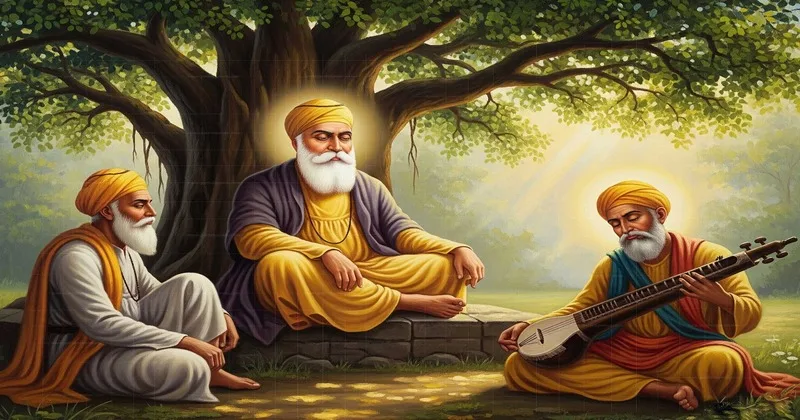
November 5, the sacred dawn of Kartik Purnima, As the first rays of light touch the earth, millions of lamps glow across homes, gurudwaras, and hearts, celebrating the Prakash Purab of Guru Nanak Dev Ji.
It is not merely a Birth anniversary; it is the awakening of human consciousness. Over five centuries ago, when darkness and division clouded Bharat, a divine light emerged from Talwandi, a light that transformed faith into action, devotion into duty, and knowledge into compassion. Today, as the world stands at another moral crossroads, Guru Nanak Dev Ji’s message shines as the eternal guide reminding us that truth, service, and unity are the highest forms of worship.
As Hindus and Sikhs across the world celebrate the Prakash Purab of Guru Nanak Dev Ji on November 5, the message of the first Sikh Guru shines as a guiding light in an age overshadowed by materialism, moral decline, and social unrest. Guru Nanak Dev Ji’s life and teachings were a universal call for humanity to rise above divisions and live by the principles of truth, compassion, and righteousness.
Born in 1469 at Talwandi (now Nankana Sahib, Pakistan), Guru Nanak Dev Ji appeared at a time when Bharat was engulfed in darkness. Social inequalities, caste divisions, and the tyranny of foreign invaders had corroded the moral fabric of society. In that age of ignorance, as Bhai Gurdas Ji beautifully described,
“Satguru Nanak Pragtya, Mitti Dhund Jag Chanan Hoya” when Guru Nanak Dev Ji appeared, the mist cleared, and the world was illuminated.
Reformer Rooted in Bhartiya Wisdom
Guru Nanak Dev Ji revered the eternal truths of the Vedas and Shastras, emphasising that the true essence of religion lies in righteous conduct. He reconnected Bhartiya society to its dharmic roots at a time when its knowledge centres Nalanda, Vikramshila, and Takshashila had been destroyed, and the learned class was either subdued or detached from responsibility.
Voice Against Tyranny and Conversion
Guru Nanak Dev Ji was among the first saints to speak openly against Mughal atrocities. He lamented the horrors unleashed by Babur’s invasion, expressing his pain in the verse: “Khurasan khasmana kiya, Hindustan daraya; Aapai dos na dei karta, jam kar Mugal chharraya, aytee maar pa-ee karlaanay tain kee darad na aa-i-aa”, which means (Having attacked Khuraasaan, Baabar terrified Hindustan. The Creator himself does not make any guilt, but has sent the Mughal as the messenger of death. There was so much slaughter that the people screamed. Didn’t You feel compassion, god?)
Referring to the Mughal atrocities, Guru Nanak Dev Ji spoke of the entire humanity and Bharat, not just one region. However, today’s misguided youth is rejecting the sacred teachings of the Gurus. In such times, only the teachings of the Gurus can show society and youth the right path.
This was not a regional cry but a national lament, the voice of Hindustan itself. Guru Nanak’s message transcended religion; he stood as the spiritual sentinel of the nation, reminding all of their shared destiny under foreign oppression.
He also condemned religious conversions and the misuse of faith for power. His proclamation of “Ik Onkar”: One Supreme Reality signifies both the unity of the divine and the equality of all humanity.
The Udaasis: A Journey for Humanity
To spread his message of truth and unity, Guru Nanak Dev Ji undertook four great journeys (Udaasis) across Bharat and beyond from the Himalayas to Lanka, Mecca to Baghdad. Accompanied by his companion, Bhai Mardana Ji, he exemplified harmony beyond boundaries.
As Bhai Mardana played the rabab, Guru Nanak sang divine hymns, together they embodied the union of faiths, symbolising a world where love triumphed over ego. His teachings of Naam Simran (remembering God), Kirat Karo (honest work), and Vand Chhako (sharing with others) became the foundation of a just and compassionate society.
These journeys were not mere pilgrimages but revolutions of thought. They broke the chains of caste, creed, and orthodoxy, re-establishing spirituality as a living force of moral and social reform.
The Spirit of Seva and Sab Tera
Guru Nanak Dev Ji’s teaching of seva, selfless service remains a cornerstone of Bharatiya spiritual and social life. The institution of Langar, founded by him, continues to symbolise equality and compassion, where all sit together as one human family.
Equally profound is his lesson of Sab Tera, “Everything belongs to You, O god.” When given money by his father for trade, Guru Nanak spent it feeding the hungry, declaring, “This is the true profit, Sab Tera.” Through this act, he taught that wealth and success find meaning only in service to others.
In today’s world, consumed by greed and self-interest, this message is vital. The youth of Bharat can rediscover purpose of life, through Guru Nanak’s way measuring success not by possessions, but by compassion, integrity, and contribution to society.
Truth, Equality, and Dignity for All
Guru Nanak Dev Ji was a revolutionary reformer who rejected casteism, gender discrimination, and social inequality. His immortal words: “So kyo manda aakhiye jit jamme rajan”, which means “Why call her bad, from whom kings are born?” remain a powerful assertion of women’s dignity and equality.
He envisioned a world where no one is high or low, where the divine spark within each being is respected. For the youth today, his message serves as a call to replace arrogance with humility, and discrimination with empathy.
Faith in Action: Kirat Karni and Naam Simran
Guru Nanak Dev Ji’s principle of Kirat Karni earning through honest labour inspires people to live ethically and with dignity. No work, he said, is small or big; what matters is sincerity and fairness.
In an era lured by shortcuts, his call to truthfulness stands as moral armour for the youth. Equally essential is Naam Simran, the remembrance of the Divine amidst life’s chaos. In the restless modern world, his teaching becomes a tool for mindfulness, balance, and peace.
He beautifully summarized this in Japji Sahib: “Changiayiyaan buriayiyaan vache dharam hadoor; Karmee aapo aapni ke nerai ke door,” Which means (Good and bad deeds are judged in the court of Dharma; by one’s actions, one comes nearer or farther from God.)
This timeless wisdom reminds every soul that destiny is shaped by action, and righteousness is the foundation of true progress.
The Path Forward for Today’s Punjab and Bharat
Today, the sacred land of Punjab, the Tapobhumi of the Gurus faces new challenges like drug abuse, divisive politics and erosion of values and for this Guru Nanak Dev Ji’s message holds the antidote.
He taught the youth to reject hatred and rediscover Punjab’s dharmic pride. True strength lies in leading the nation with the spirit of Sarbat da Bhala (welfare of all). The same spirit that guided the Panth to defend Dharma and humanity must now guide it to rebuild harmony, prosperity, and unity.
For the entire nation, Guru Nanak Dev Ji’s life is a model of integrated living where spirituality strengthens society and devotion inspires duty.
On this Kartik Purnima, may every heart light up with his eternal words. Let the youth of Bharat rise as torchbearers of that light living with courage, serving with love, and building a united, compassionate, and dharmic nation, the land that Guru Nanak Dev envisioned.












Comments