





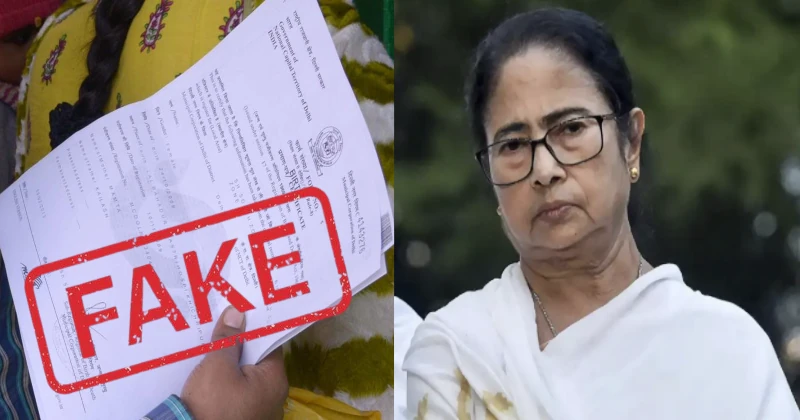
A storm is once again brewing in Mamata Banerjee’s Bengal this time over a massive cross-border identity racket that has struck at the very foundations of India’s internal security. In what is being dubbed as the “Bangladeshi Birth Certificate Scam”, the Pathankhali Village Panchayat in South 24 Parganas has emerged as the epicentre of a sprawling fake document network that allegedly issued over 3,500 forged birth certificates to Bangladeshi nationals in 2024 alone.
The revelations flagged by BJP leader Kirit Somaiya on X, have reignited questions about the Trinamool Congress (TMC) government’s complicity, lax oversight, and alleged patronage of illegal infiltration from across the border. What was once a sleepy panchayat on a Sundarbans island has now become infamous as “India’s Fake Birth Certificate Capital.”
#Bangladeshi Birth Certificates Scam of West Bengal
3500 FAKE birth certificates issued to Bangladeshis in the year 2024 by Pathankhali Village Panchayat of South 24 Parganas District
पश्चिम बंगाल में बांग्लादेशी जन्म प्रमाण पत्र घोटाला
दक्षिण 24 परगना जिले की पठानखाली ग्राम… pic.twitter.com/tAK6bKCcje
— Kirit Somaiya (@KiritSomaiya) November 2, 2025
Pathankhali Gram Panchayat, situated barely a five-minute walk from the local jetty, was known for its modest lives and mangrove-fringed horizons. But behind the mauve-and-green walls of its panchayat office, investigators have uncovered a meticulously organised forgery network that thrived for years under administrative apathy and political protection.
According to a 2025 media report, the passport racket’s trail first led police to Pathankhali revealing that this small panchayat with just 4,000 families had generated thousands of fraudulent birth certificates between 2013 and 2015. The racket has now resurfaced in a more sophisticated avatar, leveraging official government portals to create fake Indian identities for foreign nationals.
The central figure in the ongoing probe is Gautam Sardar, a casual worker at the Pathankhali Panchayat office and notably, a local Trinamool Congress worker. Sardar, who was hired in 2019 for a meagre Rs 3,500 a year, allegedly exploited his access to Janma-Mrityu Tathya, the state’s official birth and death registration portal, by hacking into the Gram Pradhan’s login credentials and diverting OTPs to his personal number.
Arrested on June 7, Sardar is accused of issuing thousands of fake birth certificates to Bangladeshi infiltrators, many of which were later used to forge Indian passports and acquire Aadhaar cards, ration cards, and voter IDs. Kolkata Police have reportedly uncovered “huge financial transactions” linked to Sardar’s accounts between 2022 and 2025, suggesting a deep nexus between the panchayat-level operatives and higher players in the racket.
This is not the first time Pathankhali has made headlines. Back in September 2025, media reports had exposed how this very panchayat had issued hundreds of fake certificates, enabling Bangladeshi nationals to obtain Indian passports. Police back then had arrested several individuals but despite the scandal, no structural reform or digital audit system was implemented by the Mamata Banerjee government.
What could have been an opportunity for systemic cleanup instead turned into an institutionalised pattern of forgery, allowed to flourish for political gain particularly in border-adjacent districts that form a crucial vote bank for the TMC.
Reacting to the revelations, BJP leader Kirit Somaiya posted on X, “#BangladeshiBirthCertificatesScam, Over 3,500 fake birth certificates issued to Bangladeshis by the Pathankhali Panchayat in 2024 alone. Is Mamata Banerjee’s administration turning Bengal’s border villages into passport factories for illegal immigrants?”
Somaiya and other BJP leaders have demanded a CBI probe into the racket, alleging that state agencies are shielding key TMC-linked operatives.
“This isn’t a clerical error it’s a deliberate, systematic subversion of India’s security framework,” said a senior BJP functionary in Kolkata. “From fake birth certificates to forged passports every illegal immigrant regularised through these channels becomes a political pawn.”
With West Bengal sharing a 2,200 km porous border with Bangladesh, the issue of illegal infiltration has long been a contentious one. The NRC-CAA debate, too, has found its fiercest resistance in Bengal a state where document-based citizenship can now evidently be manufactured for a price.













Comments