





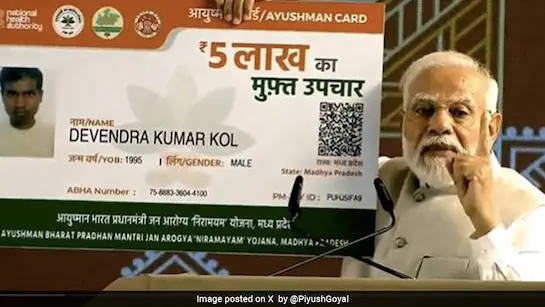
When Prime Minister Narendra Modi launched the Ayushman Bharat-Pradhan Mantri Jan Arogya Yojana (AB-PMJAY) on September 23, 2018, few imagined it would one day become the world’s largest public healthcare scheme. Today, it stands as a model of inclusive healthcare delivery, offering cashless medical treatment worth up to Rs 5 lakh per family per year across both government and private hospitals.
The scheme was built on a simple yet ambitious vision, “No family should suffer financial distress because of medical expenses.” Over the years, it has not only reduced the burden of out-of-pocket spending but has also expanded healthcare access to some of India’s most remote corners.
42 crore cards, Rs 1.52 lakh crore saved
According to official data released in October 2025, more than 42 crore Ayushman cards have been issued since the scheme’s inception. These cards act as the gateway for India’s poorest households to access treatment across 33,000 empanelled hospitals, including 17,685 government and 15,380 private facilities.
The Economic Survey 2024-25 revealed that the scheme has helped beneficiaries save over Rs 1.52 lakh crore in out-of-pocket healthcare costs. This figure highlights the impact of Ayushman Bharat on household financial security, a vital step toward achieving the goal of Universal Health Coverage (UHC).
Furthermore, 86 lakh senior citizens have been enrolled under the scheme, ensuring that elderly individuals, often the most vulnerable to health crises, receive the support they need without worrying about costs.
Covering 12 crore families:
The scheme provides coverage to over 12 crore economically weaker families, roughly translating to more than 50 crore individuals, making it the largest publicly funded health insurance programme in the world. Beneficiaries can avail cashless treatment for both secondary and tertiary care, ranging from cardiac surgeries and cancer therapies to maternity and neonatal care.
The policy ensures that even private hospitals, often inaccessible to the poor due to high costs, are brought within reach through the government’s empanelment system. This approach has created a robust public-private partnership model that strengthens healthcare delivery at all levels.
The AB-PMJAY is one component of the broader Ayushman Bharat Mission, designed as a three-tier healthcare revolution encompassing primary, secondary, and tertiary services. Its four major pillars are:
Ayushman Bharat–Pradhan Mantri Jan Arogya Yojana (AB-PMJAY)
Focused on financial protection through insurance-based coverage.
Ayushman Arogya Mandirs (AAM)
These centres, formerly known as Health and Wellness Centres, bring primary healthcare to the grassroots. As of September 2025, over 1.6 lakh centres are operational, offering services for non-communicable diseases, dental and eye care, maternal health, palliative care, and emergency treatment.
Remarkably, more than 39 crore teleconsultations have been conducted through these centres, linking rural patients with qualified doctors via digital platforms.
Ayushman Bharat Digital Mission (ABDM)
The ABDM is creating a nationwide digital health ecosystem through the Ayushman Bharat Health Account (ABHA), a unique digital health ID assigned to every citizen.
So far, 80 crore ABHA IDs have been generated, with 6.7 crore health records securely linked, enabling seamless sharing of medical data between hospitals and patients.
PM-Ayushman Bharat Health Infrastructure Mission (PM-ABHIM)
Launched on October 25, 2021, PM-ABHIM aims to bridge healthcare infrastructure gaps and prepare India for future pandemics. With an outlay of Rs 64,180 crore (2021–2026), the mission is strengthening hospitals, laboratories, disease surveillance systems, and research facilities.
Of this, Rs 54,205 crore has been allocated for state-level initiatives and ₹9,340 crore for central projects.
The Ayushman Bharat programme reflects strong Centre-State collaboration. The Union Budget 2025-26 allocated Rs 9,406 crore for AB-PMJAY, the highest ever since the scheme’s launch. Between 2022-23 and 2024-25, states and Union Territories collectively invested over Rs 5,000 crore to develop and maintain Ayushman Arogya Mandirs.
While the Centre provides the policy framework and core funding, states handle implementation, ensuring contextual adaptability and localised health solutions. This model has helped balance uniformity in quality standards with flexibility in execution.
Digital health transformation
The success of the Ayushman Bharat Digital Mission marks a turning point in India’s healthcare story. By integrating technology with medical care, it is making the system transparent, accountable, and efficient.
Patients can now store, access, and share their medical records securely using their ABHA IDs, enabling continuity of care across different hospitals and states.
This initiative not only reduces paperwork and duplication but also paves the way for AI-driven healthcare analytics, telemedicine growth, and predictive public health planning, positioning India as a global leader in digital health innovation.
Behind the statistics are millions of stories of families spared from selling land to pay for treatment, of rural women receiving cancer screenings, of elderly patients undergoing free cardiac procedures.
Take the example of Sita Bai from Madhya Pradesh, who was diagnosed with gallbladder disease. Through Ayushman Bharat, she underwent surgery at a private hospital without spending a rupee. “We could never afford such treatment. Ayushman saved my life,” she says.
Such testimonies illustrate the transformative social impact of the scheme, reaffirming that access to healthcare is not a privilege but a fundamental right.
Despite its unprecedented scale, Ayushman Bharat faces challenges, especially in awareness, fraud prevention, and expanding quality tertiary care to underserved districts. Some hospitals have reported delayed claim settlements, and many rural beneficiaries remain unaware of their entitlements.
The government has responded by launching Ayushman Melas and Jan Arogya Campaigns to boost card registration and literacy about scheme benefits. Continuous audits and digital claim tracking are also being deployed to curb misuse.
Global benchmark for inclusive health
As Ayushman Bharat enters its eighth year, it is not just a welfare scheme, it is a global benchmark in public healthcare delivery. It embodies India’s commitment to the UN’s Sustainable Development Goal (SDG) 3, ensuring healthy lives and promoting well-being for all at all ages.
From Ayushman cards to Arogya Mandirs, from digital health records to world-class hospitals, the scheme has built an ecosystem that prioritises affordability, accessibility, and accountability, a trinity that defines the future of healthcare in India.












Comments