





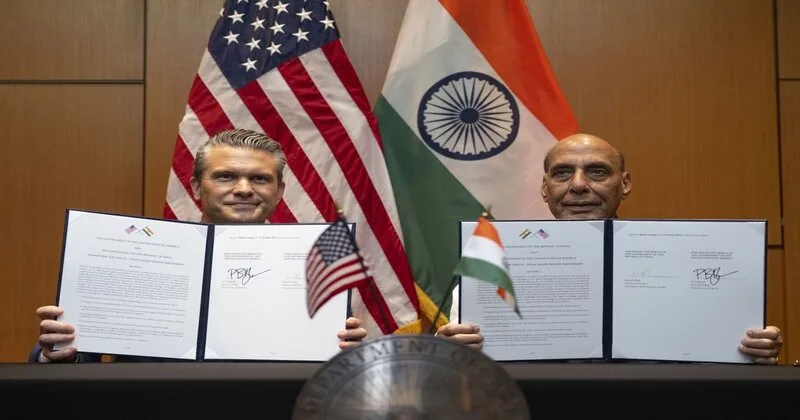
Defence Minister Rajnath Singh and his US counterpart Defence Secretary Pete Hegseth sealed a bilateral 10-year defence framework in Kuala Lumpur, Malaysia on the sidelines of the 12th ASEAN Defence Ministers’ Meeting-Plus(ADMM-Plus). During the signing of the defence agreement both nations resolved to strengthen the India-US defence partnership in order to secure a strong, inclusive and stable security architecture in the region.
Pete Hegseth, Defence Secretary of the United States hailed the 10-year defence framework as the “cornerstone for regional stability and strategic deterrence”. The defence agreement caters to ensuring and enhancing India-US coordination with respect to information sharing, technology cooperation etc., Pete Hegseth further exclaimed. “Our defence ties have never been stronger”, the US Defence Secretary added, thus asserting a hope and confidence in the path of evolving New Delhi-Washington defence cooperation.
I just met with @rajnathsingh to sign a 10-year U.S.-India Defense Framework.
This advances our defense partnership, a cornerstone for regional stability and deterrence.
We're enhancing our coordination, info sharing, and tech cooperation. Our defense ties have never been… pic.twitter.com/hPmkZdMDv2
— Secretary of War Pete Hegseth (@SecWar) October 31, 2025
Post the signing of the defence framework, Defence Minister Rajnath Singh reiterated, “Framework for the US-India Major Defence Partnership will usher in a new era in our already strong defence partnership”. Thus, Rajnath Singh reflected on the solid bilateral defence ties existing between India and the United States, despite hiccups in other areas of bilateral relations, specifically the trade and tariff tussle escalated by the Trump administration.
The defence framework is deemed as a broad strategic vision or policy framework that will guide the path of India-US defence relations in a comprehensive way in the coming days. “It is a signal of our growing strategic convergence and will herald a new decade of partnership”, Rajnath Singh further added. He also characterized the defence relations as a key pillar in the comprehensive strategic partnership between India and the United States.
Had a fruitful meeting with my US counterpart @SecWar Peter Hegseth in Kuala Lumpur. We signed the 10 years ‘Framework for the US-India Major Defence Partnership’. This will usher in a new era in our already strong defence partnership.
This Defence Framework will provide policy… pic.twitter.com/IEP6Udg9Iw
— Rajnath Singh (@rajnathsingh) October 31, 2025
India-US Defence Framework: Pivotal to restore balance of power in Indo-Pacific
The key pillar in the long-term 10-year India-US defence framework is the cooperation across the Indo-Pacific in order to carve a free, open, inclusive and rule-based maritime region that ultimately helps to restore balance of power against any aggressive actions. “Our partnership is critical for ensuring a free, open and rule-based Indo-Pacific region”, reiterated Defence Minister Rajnath Singh.
These statements by the Defence Minister put the spotlight on the vitality of the India-US partnership despite bottlenecks in trade and economic relations. The gridlocks in the trade and energy partnership should not have a spill-over effect on the other sectors of bilateral relations or on the comprehensive strategic partnership and both New Delhi and Washington DC are vigilant of this fact. This strategic prudence is driving the defence cooperation.
The United States has long considered India as a pivotal player in the Indo-Pacific region, especially to counter-weight the aggressive and bully behaviour of other players in the region. It aims to seek the strong footprint of the US in the maritime region and considers India as a prudent partner in this strategic voyage. For India, given its strategic location and centrality in the Indo-Pacific with a vast coastline, ensuring strategic deterrence and restoring balance of power in the region is of paramount importance in terms of national security, maritime solidarity and the regional peace, stability, inclusivity and prosperity at large.
Every state encircling the Indo-Pacific has equal rights and a shared future in terms of freedom of navigation, utilization of critical marine resources etc. In the path of realizing this goal, India and the United States deem each other as a solid defence partner in the Indo-Pacific which is apparently emerging as an ambitious and contentious geopolitical theatre.
In this backdrop, New Delhi and Washington DC are committed to consolidate their defence partnership despite the hiccups in trade and energy relations. This latest deal also symbolizes that comprehensive India-US partnership remains stable and the carefully crafted India-US bilateral ties woven across decades is not completely ruptured due to the irrational and unreasonable tariff tussle heightened by the US President Donald Trump.
Defence pact personifies New Delhi’s strategic maturity
The latest defence framework also signifies New Delhi’s long-term and broad strategic vision coupled with a sense of strategic maturity that ultimately yields the momentum for India’s national security architecture. Though the India-US bilateral relations is undergoing a troublesome phase in terms of trade relations, tariff tussle and energy hustle, New Delhi is prudent of not hampering the entire spectrum of bilateral relations in view of the emerging and challenging geopolitical landscape.
As experts assert, the 21st century geopolitical spectrum demands the strategic tool of multi-alignment and all-alignement. One trade or tariff tussle confined to a particular leader and his transactional style of leadership, cannot redefine decades of foreign policy and bilateral partnership. Trump is temporary, but India-US strategic relations are set to stay given the unpredictable nature of geopolitics. Even many subject experts and political representatives within the US reiterate the same vision.
In this direction, New Delhi is determined to navigate this challenging phase of India-US ties. However, India is also very much determined that the positive phase in bilateral relations will not be at the cost of the country’s strategic autonomy, sovereign decision making credentials and national security. Defence ties will not compel urgency in inking a trade deal. Recently, Commerce and Industry Minister Piyush Goyal asserted that India would not enter into any trade agreement “in haste” or accept conditions from partner nations that could limit India’s trading choices. Piyush Goyal further affirmed that trade agreements are beyond mere tariffs and market access, it’s about building “trust, long-term ties and creating sustainable frameworks for global business cooperation”.
This strategic vision of New Delhi with respect to navigating ties with the United States reciprocates the nation’s way of simultaneously handling national security, economic credibility, strategic autonomy and regional security and prosperity at large.













Comments