





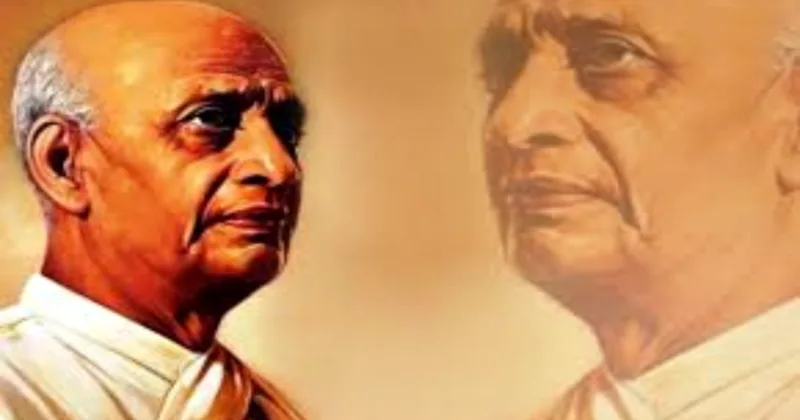
Under Prime Minister Modi’s leadership and Home Minister Amit Shah’s watch, the nation is commemorating 150th birth anniversary of Sardar Vallabhbhai Patel on October 31, in a grand way. Sardar Patel is the architect of the unified India that we see today. He was instrumental in integration of more than 560 princely states into the Indian Union through astute diplomacy, proactive persuasion and decisive action where necessary. As independent India’s first Home Minister, the challenges to the national security were immense but he painstakingly built a solid foundation of governance, with pragmatism and stability as the core values.
The British had established Indian Civil Service (ICS) in 1858 following the 1857 Revolt, also known as India’s first freedom struggle. ICS was dominated by the British officers and the Indians were only eligible for lowly posts. Women were only eligible for the clerical posts. Indian Imperial Police was a colonial era force, which was largely used to quell freedom struggle of India. Thus, at the time of independence, there was no government service that could provide a safe environment for a new independent nation. The problem was further compounded because the forces of princely states which had been amalgamated into the Indian Union were only loyal to the respective royalty.
Sardar Patel had a challenging job at hand which was further compounded by the massive violence at the time of Partition. There was a sense of suspicion and skepticism for any major reforms at that point of time. But Sardar Patel realised the necessity of All India services which could provide an impartial, stable and firm administrative system for the nation. Sardar Patel was instrumental in establishing Indian Administrative Service (IAS) and Indian Police Service (IPS) which till date remains the backbone of India’s administrative machinery. Similar approach was also followed by the states and provinces and they too came up with an effective administrative machinery.
The first challenge to the newly established administrative setup in India was the communal riots. From the Jammu riots in October-November 1947, Delhi riots from August 1947 onwards and communal violence in areas bordering East Pakistan in 1949, the police services were totally stretched then. But Sardar Patel did not shy away requisitioning Indian Army to quell the violence in Delhi and to a lesser extent in Punjab. In Army, we are taught ‘Aid to Civil Authority’ and our Standard Operating Procedure (SOP) is based on past experience of handling such communal violence. But it goes to show that independent India could quickly gear up to meet the emerging internal security challenges.
Sardar Patel had a pragmatic view of how independent India should meet the security challenges. India’s first Prime Minister Nehru had an idealistic view on many world affairs including relations with the neighbours. Sardar Patel always knew the threat from Pakistan. In fact, the integration of Jammu & Kashmir got delayed till October 26, 1947 because PM Nehru was overseeing it being a Kashmiri pandit. In the hands of Sardar Patel, Jammu & Kashmir would have become part of Indian dominion much earlier. Sardar Patel’s foresight was evident when he warned Pandit Nehru about China’s expansionist designs. He also was conscious of the threat to India’s Northeastern states.
With Sardar Patel’s untimely death on December 15, 1950, India lost its most illustrious son who unified Bharat and quickly established a system of governance that has stood the test of time. Had he lived for another five years, India would have become another major power like China much earlier. His towering presence would also have kept Pakistan in check. But in just three years as the Home Minister, Sardar Patel left his indelible rank on the national security architecture. Sardar Vallabhbhai National Police Academy (SVPNPA), Hyderabad which trains IPS officers is a fitting tribute to the lasting memory of the Iron Man of India.
PM Modi paid rich tributes to Sardar Patel from Ekta Nagar overlooking the 182-metre-high statue of the tallest son of India. PM Modi also vowed to end terrorism, Naxalism and illegal immigration from India. It would be interesting to analyse how Sardar Patel would have handled the threat from terrorism and Naxalism. In all likelihood, Sardar Patel would have dealt with the root cause of such menace and crushed any armed rebellion with a decisive blow. Under PM Modi and HM Amit Shah, the country is witnessing the final phase of Naxalism. The end of Naxalism from the Indian soil in the year 2026 would be a fitting tribute to Sardar Patel in the year of his 150th birth anniversary. My homage and grand salute to Lauh Purush Sardar Vallabhbhai Patel. Jai Bharat!












Comments