





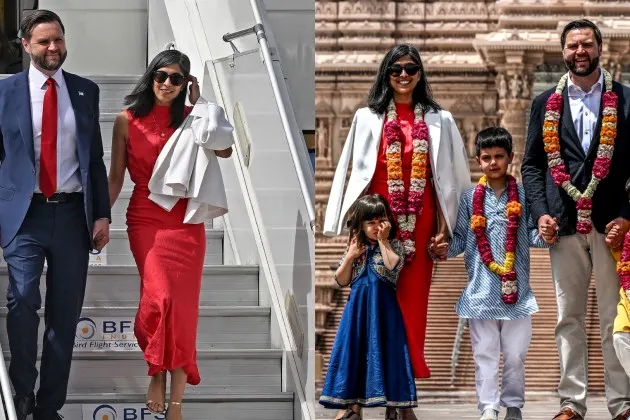
US Vice President JD Vance has landed in a political and cultural storm after publicly expressing his wish that his wife, Usha Vance, a woman of Indian origin and Hindu background, would convert to Christianity. Speaking at a Turning Point USA event at the University of Mississippi, Vance declared that he “honestly does wish” Usha would eventually be “moved” to embrace his faith, given that their children are being raised as Christians and regularly attend church with him.
His comments have ignited a fierce debate across social and political circles in the United States, with Indian Americans accusing him of disrespecting Hinduism and using his wife’s faith for political mileage ahead of the 2028 presidential race.
“I honestly do wish she converts”
Addressing a crowd of over 10,000 at the Mississippi event, Vance said candidly: “Most Sundays, Usha will come with me to church. As I’ve told her and I’ve said publicly, do I hope eventually that she is somehow moved by the same thing that I was moved by the church? Yeah, I honestly do wish that, because I believe in the Christian gospel and I hope eventually my wife comes to see it the same way.”
He added that, while he respected his wife’s free will, he still hoped she would come to accept Christianity: “If she doesn’t, then God says everybody has free will. That doesn’t cause a problem for me. That’s something you work out with your friends, with your family, with the person that you love.”
The remarks were intended to convey religious conviction, but many saw them as a veiled call for conversion, particularly problematic given the couple’s interfaith marriage and Usha’s public Hindu identity.
Backlash: ‘He knew she was a Hindu when he married her’
Within hours of the video circulating online, Indian American communities, liberal commentators, and interfaith advocates sharply criticised Vance. Many accused him of weaponising his wife’s religion to appeal to conservative Christian voters.
One social media user wrote, “He knew she was a Hindu when he married her, why act brand new about her religion now?”
Another commented, “Because he wants to be president now, and he can’t get there without shaming Hindus. This is not faith, it’s politics.”
Some users noted the irony of his statement, pointing out that Vance and Usha had a Hindu wedding ceremony and that they named their eldest son Vivek, a traditional Hindu name meaning “wisdom.”
“He had a Hindu wedding, named his son Vivek, and yet calls his wife’s faith something that needs to be ‘fixed.’ The hypocrisy is staggering,” another commenter wrote.
Accusations of political motive
Many have called Vance’s statement a calculated attempt to appease evangelical and MAGA voters who prioritise Christianity as a cornerstone of American identity.
Several commentators noted that during his 2022 Senate campaign, Vance emphasised his religious conversion story, from an atheist to a devout Catholic, to appeal to conservative Christian voters. However, his latest remarks, they argue, cross a line by suggesting that his wife’s Hindu faith is somehow incomplete or inferior.
Indian diplomat calls out Vance’s silence on wife’s Faith
Former Indian Foreign Secretary Kanwal Sibal also weighed in, criticising Vance for referring to his wife as “agnostic” instead of acknowledging her Hindu background.
In a pointed social media post, Sibal wrote: “He calls her agnostic. Afraid to admit her Hindu origin. Where has all this talk of religious freedom gone? They have a US Commission on International Religious Freedom, charity should begin at home.”
He calls her agnostic. Afraid to admit her Hindu origin.
Where has all this talk of religious freedom gone?
They have this Congressionally mandated US Commission on International Religious Freedom.
Charity should begin at home. https://t.co/zbXqWFiBw7
— Kanwal Sibal (@KanwalSibal) October 30, 2025
Sibal’s remarks resonated widely among Indian observers, many of whom view Vance’s statements as hypocritical given America’s frequent criticism of other nations on religious freedom grounds.
While Indian Americans and interfaith advocates condemned the remarks, some conservative Christian groups and MAGA-aligned voters praised Vance’s openness. They described his comments as a “sincere expression of faith” rather than an act of disrespect.
A prominent Christian publication defended him, stating that “Vance’s hope for his wife’s conversion reflects love and spiritual conviction, not intolerance.”
However, interfaith marriage advocates countered that such framing perpetuates cultural chauvinism, where one partner’s religion is deemed more “complete” or “superior” than the other’s.
One of the most viral posts came from an Indian-origin user who reminded the public that Usha Vance had been instrumental in JD Vance’s rise: “When JD Vance had hit his lowest, it was his Hindu wife and her upbringing that helped him find balance. Today, in power, her religion has become a liability. What a fall from grace.”
Others accused Vance of publicly undermining his wife to pander to a religious audience: “He cast his wife’s Hindu faith as a problem to be fixed, a soul to be moved. She sacrificed her career, raised his children, and stood by him and this is how he thanks her? By questioning her faith in public?”
JD Vance’s Spiritual Journey
JD Vance’s personal religious transformation is well-documented. Raised in a working-class evangelical Christian family in Ohio, Vance drifted toward atheism during his teenage years and early adulthood.
In his 30s, while studying law at Yale, he began exploring religious philosophy, reading the works of Saint Augustine, whose reflections on faith and reason profoundly influenced him.
By 2019, Vance officially converted to Catholicism, describing it as a spiritual home that reconciled faith with intellect. He has since framed his religious journey as a story of redemption, one that resonates strongly with conservative Christian voters.
But many now say his journey seems to have taken an exclusionary turn, where the faith that once saved him is now being used to judge others, including his own spouse.
Usha and JD Vance Story
Usha Chilukuri Vance, a Yale Law graduate like her husband, hails from a South Indian Hindu family with a background in academia and public service. She has largely kept her personal faith private, though friends and family describe her as deeply rooted in Indian traditions.
Their 2014 wedding ceremony reportedly incorporated Hindu customs, and photographs from the event circulated online after Vance’s recent remarks resurfaced. The couple’s decision to name their first child Vivek, followed by Ewan and Mirabel, had been widely celebrated as a gesture of cultural inclusivity.
Now, however, those same details are being cited by critics to highlight what they call Vance’s “selective respect for faith.”
“He took the culture when it was convenient, the rituals, the name, the image of a cross-cultural family. But when ambition called, Hinduism became something his wife needed to ‘overcome’,” wrote a columnist for The Atlantic.
The controversy has also prompted comparisons with India, where calls for religious conversion in interfaith marriages often draw intense scrutiny. Commentators have questioned whether American media would have reacted differently if an Indian leader had expressed similar views about converting a Christian or Muslim spouse to Hinduism.
“Imagine the outrage if an Indian politician said he hoped his Christian wife would one day accept Hinduism. It would dominate global headlines for weeks,” said an Indian-origin professor of comparative politics at Georgetown University.
This perceived double standard has amplified discontent among Indian Americans, who feel that their faith is often misunderstood or marginalised in Western political discourse.
As JD Vance’s political stature grows, he is widely viewed as a potential Republican presidential contender for 2028, every public statement is under heightened scrutiny.
His attempt to align with Christian nationalist rhetoric risks alienating not just Indian Americans, but also a broader section of voters who value interfaith tolerance and pluralism.
Political analysts warn that while his comments may energise his evangelical base, they could erode his credibility among moderates, particularly in an increasingly diverse America where interfaith families are common.
Faith, Family, and the Fragility
The controversy surrounding JD Vance’s remarks goes beyond personal faith, it touches on the deeper fault lines between religion, identity, and politics in contemporary America.
By suggesting that his wife’s Hinduism is something that should “evolve” into Christianity, Vance has inadvertently exposed the cultural hierarchies and insecurities that continue to shape American conservatism.
For many, this is not just about one man’s belief system, but about the erasure of Hindu identity and the political exploitation of religion for electoral gain.
In the end, the episode raises a timeless question in a marriage between two faiths, what should prevail: love and respect, or conversion and conformity?
















Comments