





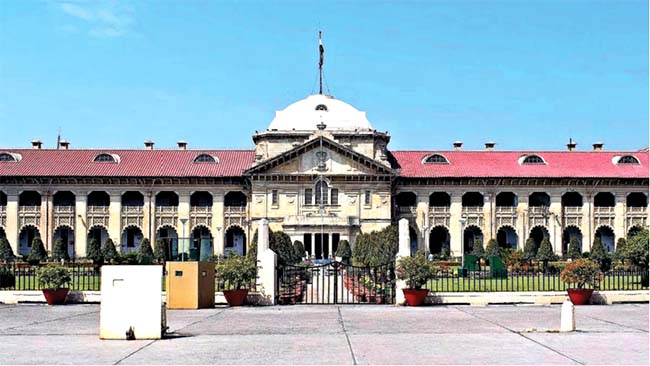
The Allahabad High Court has delivered a landmark judgment reaffirming that minority-run educational institutions in India cannot claim absolute autonomy to bypass government regulations designed to maintain academic integrity and procedural fairness.
Justice Manju Rani Chauhan, hearing a petition filed by the Committee of Management, Madarsa Arabiya Shamshul Uloom, Sikariganj (Ehata Nawab), Gorakhpur, quashed an advertisement issued by the madrassa’s purported manager Sajjad Hussain for the recruitment of teachers and a clerk. The court called the recruitment process “illegal, arbitrary, and contrary to government policy.”
“The right to administer minority institutions under Article 30(1) of the Constitution cannot be stretched to claim immunity from reasonable regulations framed to ensure academic excellence,” the court remarked, sending a strong message against misuse of minority rights as a cover for irregularities.
The controversy erupted when Sajjad Hussain, who identified himself as the Manager of the madrassa, issued an advertisement on April 29, 2025, in the Hindi daily Aaj, inviting applications for six posts, five Assistant Teachers (Tahtaniya) and one Clerk.
The Committee of Management challenged the move, asserting that Hussain was not a legitimate office-bearer of the madrassa’s governing body and had fraudulently assumed charge.
Court records revealed that Hussain’s membership had been struck off in 2019, after the competent authority found the existing committee’s tenure to be time-barred and ordered fresh elections. Despite this, a new list of office-bearers for 2024–2025 was allegedly registered, showing Hussain as the manager, an act the petitioners termed “manipulative, illegal, and devoid of authority.”
Justice Chauhan noted that such procedural manipulation “undermines institutional transparency and violates the very spirit of lawful governance envisaged for minority institutions.”
Adding to the illegality, the advertisement was issued despite a statewide ban on new appointments in madarsas through a Government Order dated May 20, 2025.
The ban followed the Supreme Court’s ruling in Anjuman Kadri v. Union of India (November 2024), which had declared the Kamil and Fazil degrees, traditional Islamic qualifications, as unconstitutional. The apex court had directed the Uttar Pradesh government to establish new qualification standards for teachers and staff in madarsas before allowing any further recruitment.
In compliance, the Director of Minority Welfare, Registrar of the Uttar Pradesh Madarsa Education Board, and the District Minority Welfare Officer had issued repeated circulars instructing all institutions to halt fresh appointments until the new norms were notified.
Despite receiving multiple communications between May and July 2025, the Gorakhpur madrassa went ahead with its recruitment advertisement, disregarding explicit government directions.
“The issuance of advertisement without waiting for the government to frame standards for qualification of teachers in madrasas is bad in the eyes of law,” the court said, holding that Hussain’s actions amounted to a blatant violation of official orders and judicial discipline.
The Allahabad High Court emphasised that while Article 30 of the Constitution grants minorities the right to establish and administer educational institutions, that right is not absolute.
Justice Chauhan drew upon Supreme Court precedents, including P.U. Joshi v. Accountant General (2003) and Chandigarh Administration v. Usha Kheterpal Waie (2011) to reaffirm that “prescribing qualifications, recruitment criteria, and service conditions falls within the policy discretion of the State.”
The court clarified that “administration” does not mean “maladministration.” The purpose of Article 30, it said, is to preserve cultural and educational identity, not to provide immunity from lawful regulation.
“Minority status cannot be converted into a shield to evade accountability or defy government policy. Regulation ensures that standards are met for the benefit of students and staff, not to curb autonomy,” Justice Chauhan observed.
Finding the recruitment process in clear violation of government policy and judicial directions, the High Court quashed the advertisement dated April 29, 2025, in its entirety.
It further declared that any appointments made pursuant to the advertisement were “illegal per se”, adding that those selected through this unlawful process “cannot claim any right to continue in service.”
The verdict serves as a stern warning against self-styled committees or individuals attempting to misuse minority rights to undertake unauthorised recruitments.
The judgment also aligns with the Supreme Court’s ongoing push for reform in madrassa education, including standardised qualifications, curriculum modernisation, and enhanced teacher training mechanisms to align with national education policy goals.
Officials from the Uttar Pradesh Madarsa Education Board welcomed the decision, calling it a “timely intervention” that will help streamline governance across the state’s 16,000+ recognised madarsas.
The ruling also adds weight to the state government’s broader policy of integrating minority educational institutions within the formal education framework, ensuring that quality, transparency, and accountability become central to their administration.
















Comments