





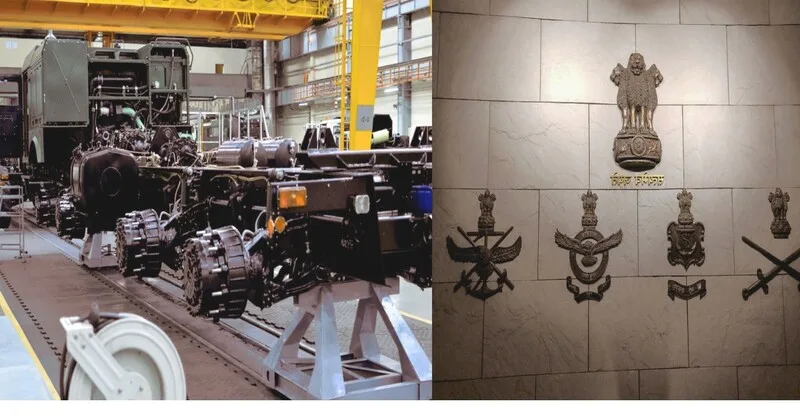
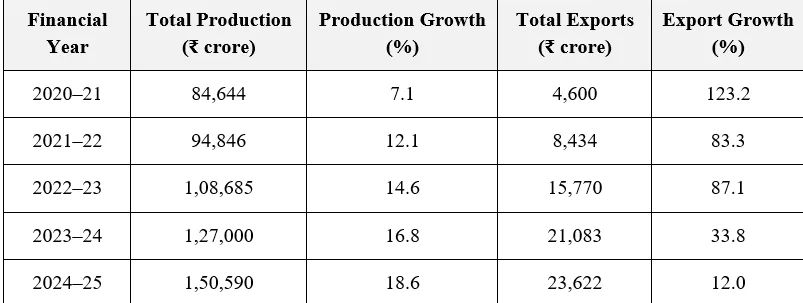
Under the Umbrella of Swadeshi goods, defence industry is touching sky. Not many years ago, the country relied heavily on imports for its military hardware. The story is different now, in the financial year 2023-24, India recorded defence production worth Rs 1,27,000 crore and by 2024-25 that figure reached Rs 1,50,590 crore, representing an 18 per cent rise over the previous year. At the same time defence exports climbed to Rs 23,622 crore in 2024-25. These numbers are not mere statistics, they represent a deliberate shift in strategy, capability and national self-belief.
From Dependence to Swadeshikaran of Products
For decades India’s armed forces depended on foreign supply chains for their major equipment needs. With the launch and steady rollout of the Make in India mission, that dependence is being now replaced by swadeshi production. Today the armed forces receive more of their systems equipped with swadeshi design and from Indian manufacture. Platforms such as the Light Combat Aircraft Tejas, various artillery and missile systems and even naval vessels now carry Indian labels. When a nation manufactures its own defence equipment the readiness, maintenance and logistical support improve significantly.
The role of government is crucial. The “Positive Indigenisation Lists” issued by the Ministry of Defence now cover over 5,500 items of equipment and components that must be sourced from Indian industry. By early 2025 the official count for indigenized items under initiatives such as SRIJAN exceeded 14,000. This policy gives Indian firms clarity, scale and the confidence to invest and innovate.
The sustained transformation in defence industry needs the mix of right policies, reforms and industry linkages. The Innovations for Defence Excellence (iDEX) program has connected startups and MSMEs with the needs of defence research and manufacturing. More than 500 plus issues were resolved and contracts had been signed and placed in 2025.
In FY 2024-25, 193 major contracts with a value of Rs 2,09,050 crore were signed by the Ministry of Defence and out of these, 177 contracts (approximately 92 per cent) were placed with Indian industry. These numbers show that the procurement engine is now very much in favor of domestic companies. Licensing has been simplified, foreign investment norms relaxed and private-public partnership models encouraged, all aligned with the goal of self-reliance.
Private Industry and Public Collaboration
Historically the defence business was dominated by public sector undertakings such as HAL, BEL and BDL. Today, the private sector is supporting this venture. In FY 2024-25 the private industry’s share of total production rose to about 23 per cent.
In exports private firms have been particularly active. Of the total exports of Rs 23,622 crore in FY 2024-25, approximately Rs 15,233 crore came from the private sector, while public sector units accounted for Rs 8,389 crore. This demonstrates a healthy ecosystem where private innovation and manufacturing scale are being used to meet defence needs and global demand.
Companies such as Tata Advanced Systems, L&T, Bharat Forge, Adani Defence and others have begun major defence production and export lines. Defence corridors in Uttar Pradesh and Tamil Nadu are drawing in investment, building industrial clusters, training centres and supplier chains.
Economic, Innovation and Strategic Value
Making defence equipment at home is strategically smart and economically wise. For every ₹1,000 crore that are invested in the industry, around 10,000-12,000 jobs across engineering, manufacturing and logistics are supported. With the yearly production now in the north of Rs 1.5 lakh crore, its impact on employment is quite substantial.
On the strategic side, reducing foreign dependency improves resilience. In times of crisis, supply chains must hold, any delays or embargoes are unacceptable. When the systems are made at home, that risk drops. Further the export industry sustains the industrial base, brings in foreign exchange and positions India as a partner in global defence supply chains rather than purely a buyer. The government has set a target of defence exports reaching Rs 50,000 crore by 2029.
Defence systems are not just about tanks or missiles. They also have sensors, networks, drones, radars and space assets. The Indian defence industry has embraced these domains. In FY 2024-25 the government reported over 1,762 export authorizations and a significant year-on-year jump in the number of Indian exporters.
DRDO an academic institutions and private firms are working together on advanced propulsion systems, sensors, unmanned aerial systems and satellite communications. Several major defence programmes have direct civilian benefits, for example remote sensing satellites originally aimed at defence can help disaster management and agriculture. This cross-pollination of innovation strengthens both security and development.
Future for Defence and Aatmanirbhar Bharat
Although the trajectory is already strong, the path that lies ahead now demands strong ongoing efforts. The challenges like scaling up of manufacturing capacity to meet the growing demands, maintaining high quality standards across thousands of suppliers, building a substantial skilled workforce and keeping procurement logistics tight are all non-trivial. The Ministry of Defence and relevant ministries recognises this and hence are working on skill development programmes while establishing testing centres and strengthening supplier linkages at the same time.
Budgetary commitment remains firm. With capital acquisition approvals and domestic production targets rising, the government has signaled long-term support for the sector. Industry analysts expect a revenue growth of 15 per cent to17 per cent in FY 2025-26, which will be supported by a strong domestic order book and an increase in export orders.
The export target of Rs 50,000 crore that is due to be achieved by 2029 will demand strong discipline and partnership between the government and the industry. But the foundation is stronger than ever and the momentum is visible.
This drive is not simply about making more guns or more exports. It is about forging a nation that is capable of defending itself. It is about building a technological base that future generations can expand. It is about giving India the confidence that its security will not depend on others and that its economy will benefit from its own strength.
The Make in India defence mission reflects the ideas of swadeshi in a modern setting, rooted in our soil, built by our people and trusted by our nation. This is patriotic action with a practical horizon. India’s defence manufacturing story is now entering a new phase. It is not just the symbolism of import substitution. It is raising the bar of capability, production, export and self-reliance. The numbers tell the story, the policies support the motion and the industry is now stepping up.
From coastal shipyards to aerospace production lines and sensor factories in our hinterlands, India is building its shield with its own hands. An aatmanirbhar defence ecosystem is no longer a vision, it is a reality in progress. That is the true meaning of Make in India for defence and the nation will carry this mission forward with pride.
















Comments