





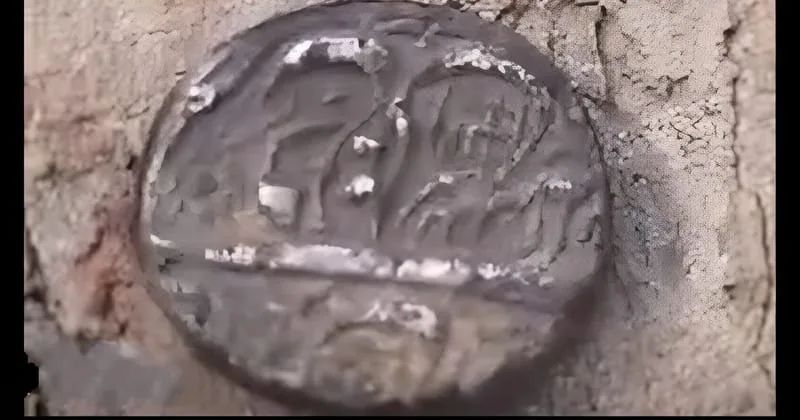
During an excavation in Khandwari village, Baghpat district, Uttar Pradesh, locals uncovered a wall resembling an ancient Mandir. The discovery drew a crowd of villagers, and authorities were promptly informed, leading to an immediate halt in excavation activities.
Historian Amit Rai Jain later visited nearby Sisana village to examine the site. After inspecting the structure and surrounding area, he remarked, “The design suggests it could belong to the Mahabharata period, possibly four to five thousand years old.”
Archaeologists and villagers also discovered ancient pottery, Mughal-era coins with Arabic inscriptions, and several other items, including bones, a clay pot containing millet grains and ashes, children’s marbles, and remnants of a metal smelting furnace.
Following the discovery, villagers hoisted a saffron flag at the site. Local resident Rajiv Chauhan recalled, “I went to collect fodder on Tuesday when I saw people digging in Khandwari. They came across what looked like an old temple wall. We informed the village elders and the police, and the digging was stopped. Later, I uploaded a video of the site on social media, which caught the attention of historian Amit Rai Jain.”
According to Jain, “The visible wall, made of conical bricks, appears to be a human-made architectural example from an ancient civilisation. The findings from the surface suggest people once lived here, but only a full archaeological excavation will confirm the age and cultural context of the site.”
Villagers also shared oral histories suggesting that about 150 years ago, Khandwari was inhabited. Following an epidemic, many residents died, and two surviving families relocated to Sisana, where their descendants live today.
Astrologer Pandit Rajkumar Shastri called the discovery “an important historical event,” adding, “Baghpat is known for its connection to the Mahabharata. It is said that Bhagwan Krishna and the Pandavas once visited this region. Khandwari is believed to date back to that era, and the Lakshagriha cave associated with the Pandavas’ exile is also said to pass through here.”













Comments