





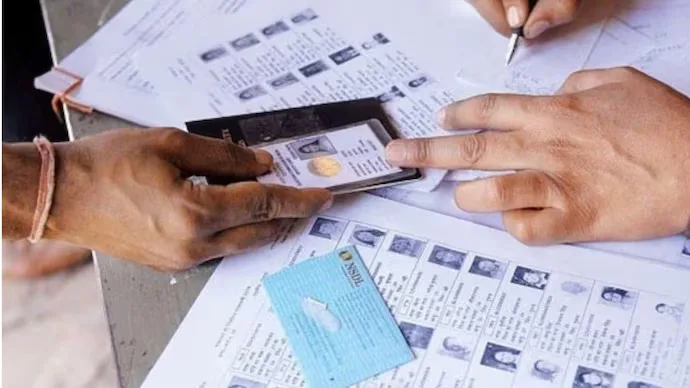
The Election Commission of India (ECI) has embarked on one of its largest-ever voter verification exercises, announcing a Special Intensive Revision (SIR) of electoral rolls in 12 states and Union Territories. Among them are politically crucial states such as Uttar Pradesh, West Bengal, Tamil Nadu, Chhattisgarh, Rajasthan, and Gujarat. The process officially began after midnight on October 27, 2025, when existing electoral rolls were frozen to pave the way for a door-to-door verification campaign.
The revision is aimed at updating, verifying, and cleansing the voter lists to ensure accuracy ahead of a packed electoral calendar in 2026, which will include several key Assembly elections. The process involves three physical house visits by Booth Level Officers (BLOs) and will conclude with the publication of the final updated rolls by February 2026.
Why 2003-04 as baseline?
What has drawn the most attention and some controversy is the ECI’s decision to use 2003-04 electoral rolls as the baseline for the ongoing revision.
According to the Commission, the last major all-India verification drive was conducted during 2002-03 and 2003-04, when voter registration systems were digitised in several states for the first time. That dataset, the ECI claims, remains the most reliable, verifiable benchmark before large-scale urbanisation, migration, and demographic shifts began altering the composition of constituencies.
“Between 2004 and 2024, India’s population has grown by nearly 300 million, and the scale of migration and urban expansion has been unprecedented,” an Election Commission official explained. “Using the 2003–04 lists as a reference point allows us to track long-term patterns of duplication, deletion, or demographic change with historical continuity.”
In other words, the 2003-04 rolls will serve as a comparative baseline, not a determinant of eligibility. Officials emphasise that the intention is to ensure no genuine voter is left out while identifying inconsistencies, duplication, or ghost entries that have accumulated over the past two decades.
How the process works?
Under the SIR framework, the ECI has laid down a detailed procedure for both officials and voters.
Freezing of Existing Rolls: As of midnight on October 27, the existing voter rolls stand frozen. Any change, henceforth addition, deletion, or correction, will take place only through the special revision mechanism.
Door-to-Door Verification: BLOs will conduct three rounds of household verification to cross-check details such as age, address, citizenship, and existing documentation.
Use of 2003-04 Data: Names appearing in the 2003-04 rolls will be auto-confirmed, requiring no new documents from those voters.
For New or Later Additions: Voters who were added after 2004 or whose records were never included in the older rolls will need to provide supporting documentation, proof of date of birth, parentage, and citizenship, to verify their eligibility.
Final Publication: The revised and verified electoral rolls will be published by February 2026, after due hearings and corrections.
The ECI has also launched public awareness campaigns urging voters to check their names through official portals, respond to BLO visits, and ensure their records are up to date.
Citizenship shadows return
While the Election Commission has clarified that the 2003-04 lists are merely a reference tool, the decision has revived old propaganda, particularly in border and minority-dominated districts like Murshidabad, Malda, North 24 Parganas, and Kishanganj.
Many groups and opposition parties have expressed concern that the linkage to old records may indirectly echo the debates around the NRC and CAA, which caused widespread protests in 2019-20.
However, the Commission has categorically dismissed such apprehensions. “No one will be removed from the rolls merely because their name did not exist in 2003–04,” an official clarified. “This is about data verification, not citizenship determination.”
States on alert: Bengal, UP, and Tamil Nadu
Among the 12 states, the ECI has identified a few as “high scrutiny zones” those that have witnessed rapid population changes, high migration, or border linkages.
West Bengal, sharing a 2,216-km border with Bangladesh, has long been sensitive to citizenship-linked exercises.
Uttar Pradesh and Bihar, with their dense populations and inter-state migration, face challenges in keeping voter lists updated.
Tamil Nadu and Chhattisgarh have reported large-scale internal migration in industrial and mining belts.
State election offices have been instructed to maintain transparency in every stage of verification and to hold public hearings before final deletions or inclusions are made.
For the ECI, the SIR exercise is a balancing act, between maintaining the integrity of India’s 95 crore-strong voter base and avoiding unnecessary panic among communities already wary of documentation drives.
Notably, the choice of 2003-04 reflects a technical, not political, rationale.
Still, the timing, coming months before major elections in West Bengal, Tamil Nadu, and Uttar Pradesh has lent a political edge to what might otherwise be a bureaucratic exercise.
ECI’s appeal to voters
To quell doubts, the ECI has urged voters to actively participate. Officials have advised individuals, particularly those who registered between 2015 and 2024, to:
1. Verify details through the NVSP portal or mobile app,
2. Respond promptly to BLO visits or document verification calls, and
3, File claims or objections if errors are detected.
The Commission has also warned that failure to verify details when requested could result in temporary exclusion, though every such case will have an appeal mechanism.
By February 2026, the ECI hopes to publish error-free and transparent voter rolls across all 12 states. The initiative, if successful, could become a template for nationwide roll maintenance, reducing instances of fake or duplicate entries.
However, the political temperature around the process indicates that the task won’t be easy. In states like Bengal and Tamil Nadu, opposition parties have already accused the Centre of attempting demographic “data mining” through voter verification.
For now, the Commission maintains its stance: the 2003-04 rolls are just a reference, not a verdict. The objective, it insists, is not to revisit old debates of identity but to restore public trust in one of the world’s largest and most complex electoral systems.














Comments