





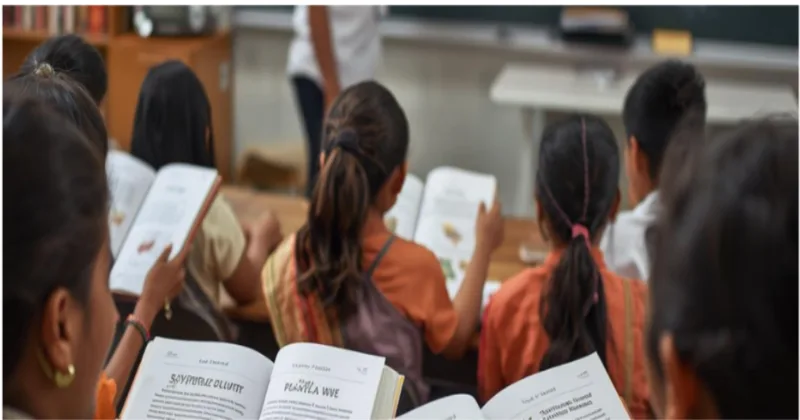
NEW DELHI: In a landmark step towards integrating India’s traditional knowledge systems with modern education, the National Council of Educational Research and Training (NCERT) has announced that Ayurveda-related content is incorporated into school science textbooks from the academic session 2025. The initiative is part of the government’s broader vision under the National Education Policy (NEP) 2020, which emphasizes holistic learning, health, and well-being.
The upcoming NCERT science textbook series, titled Curiosity, for classes VI to VIII, include exclusive chapters on Ayurveda. These chapters are designed to help students gain a scientific understanding of the ancient Indian system of medicine that focuses on balance between the body, mind, and environment.
According to Dinesh Prasad Saklani, Director of NCERT, the inclusion aims to foster awareness among students about traditional health practices and their scientific relevance in the modern world. “Ayurveda is being introduced not merely as ancient wisdom, but as a science that promotes equilibrium and sustainability in life,” Saklani stated.
The Curiosity textbooks explain core Ayurvedic concepts such as Dinacharya (daily routine), Ritucharya (seasonal regimen), and Prakriti (individual body constitution). Students also learn about mindful eating, physical exercise, seasonal adaptation, and mental wellness, all integral aspects of Ayurvedic philosophy.
The NCERT also plans to extend the integration of Ayurveda to higher classes and collegiate education. The University Grants Commission (UGC) is responsible for formulating a separate Ayurveda-based curriculum for colleges and universities.
Saklani highlighted that the school-level curriculum will be structured as a readiness programme for higher education. It will ensure a smooth academic progression from school to university, enabling students to develop a deeper understanding of scientific and traditional systems simultaneously. The approach also aligns with vocational education courses in classes X and XII, providing vertical mobility for learners across disciplines.
Ayurveda Principles in Physical Education and Well-being
In addition to science subjects, NCERT has developed a new initiative titled Physical Education and Well-being, covering classes III to X. This programme integrates Ayurvedic concepts with lessons on yoga, nutrition, exercise, and balanced lifestyles, aiming to promote both physical fitness and emotional well-being among students.
By combining traditional and modern approaches, the council seeks to nurture a holistic education framework that values health, sustainability, and mindfulness as much as academic achievement.
To ensure effective implementation, NCERT has prioritized teacher training and capacity-building programmes. Orientation sessions and workshops are being organized for educators across the country. Special teacher handbooks are also under preparation to guide instructors on incorporating Ayurvedic principles in classroom teaching.
Furthermore, Ayurveda-related modules are being introduced into teacher education and professional development courses offered by NCERT’s Regional Institutes of Education and other constituent units. This step is expected to ensure consistency and quality in the teaching process across schools nationwide.
Government’s Vision and Ayush Ministry’s Role
The announcement regarding the inclusion of Ayurveda in school textbooks was made by Ayush Minister Prataprao Jadhav. He emphasized that the objective is to help young learners reconnect with India’s traditional systems of health and well-being. The initiative is also intended to encourage the adoption of holistic lifestyle practices from an early age, in accordance with the NEP 2020 vision.
“The introduction of Ayurveda into mainstream education is not just about preserving heritage but about making ancient knowledge relevant and applicable to modern life,” Jadhav noted.
Director Saklani highlighted that NCERT’s approach will focus on blending scientific reasoning with cultural wisdom. He said the curriculum will help students appreciate the harmony between health, environment, and human values aspects that have always been central to the Indian knowledge system.
“Through this initiative, we want students to see Ayurveda as a living science that connects health with habits, environment, and mindfulness,” he remarked. “It is an important step toward achieving the NEP’s goal of education that nurtures both intellect and well-being.”














Comments