





Mumbai: Critical minerals are a key catalyst in scripting the geopolitical landscape of the 21st century. Nations across the globe are indulged in an ambitious yet contentious project to secure and seal their future with a strategic tool called as ‘critical minerals’. These strategic minerals that are crucial for the prosperous future and economic security of the globe are indeed also emerging as an instrument to harness respective geopolitical and hegemonic ambitions. At such a highly contested geopolitical juncture, it is imperative to carve a credible ‘mineral diplomacy’ for a shared and sustainable future.
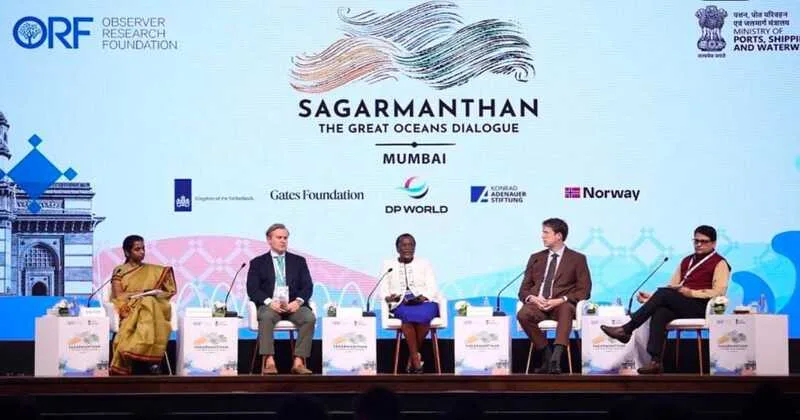
In this direction, Sagarmanthan 2025: The Great Oceans Dialogue co-hosted by the Ministry of Ports, Shipping and Waterways and Observer Research Foundation(ORF) in Mumbai held a session titled, ‘Redrawing the maps: New Routes for Critical Minerals’. The session aimed to accelerate a convincing, sustainable and mutually beneficial path to furnish the potential of critical minerals that are set to redefine the future geopolitical architecture. The Sagarmanthan dialogue is held in line with the flagship initiative of the Ministry of Ports, Shipping and Waterways ‘India Maritime Week’.
Africa: An epicentre for processing & prosperity, not for extraction and exploitation
Speaking at the session on critical minerals Nancy Karigithu, Special Envoy and Advisor, Maritime and Blue Economy, Executive Officer of the President, Kenya asserted on the incredible critical mineral potential prevailing in Africa. She also highlighted how the vital and abundant strategic minerals of the continent are being exploited in the vicious circle of great power competition.
She highlighted that the African continent houses more than 40 per cent of the global critical minerals. This includes cobalt, lithium, graphite, manganese etc. that are pivotal in crafting the 21st century technological and industrial revolution. However, this vast repository of minerals is exploited by foreign powers to fulfill their hegemonic ambitions. The minerals meant for prosperity unfortunately have been a tool to control the fate of the world order.
Nancy Karigithu, thus, affirmed that such extraction and exploitation principle should be erased from Africa and the minerals of the continent should be a pawn for prosperity. Critical minerals that are vital for the current era aspirations such as nourishing green transition, fuelling digital revolution should not just be extracted from Africa, but should be processed in Africa, Nancy Karigithu further added.
Investing in establishing such critical mineral processing centres across Africa will also boost the employment and developmental prospects for the youth of the continent. Providing such opportunities for a young continent is also a solution to reduce civil wars, coups and social unrest in the continent, Nancy Karigithu remarked. To realize this vision and mould Africa as an integrated single largest critical mineral market, it is vital to integrate the continent through state-of-the-art connectivity mechanisms and infrastructure credentials.
In this backdrop, Nancy Karigithu stressed that the resource rich continent of Africa is hitherto disintegrated, thus derailing its economic and developmental prospects. There is no efficient and swift connectivity between mineral-rich hinterlands and the coasts of Africa. Thus no scope to connect with foreign markets and connectivity is the greatest challenge for Africa. Advancing road, rail, highways and port connectivity in Africa will yield the integration of the country, attract investment, thus a stimulus to fully flourish the critical mineral potential of the continent in view of the growth of Africa and beyond.
Nancy Karigithu, called on foreign companies and credible partners to invest in the connectivity projects of Africa, thus turning challenges into opportunities and ensuring last mile connectivity. This will in turn aid in exploring the critical mineral capacity in the continent.
Arctic: An aisle for trustworthy partnership and not for monopoly
Speaking at the critical mineral session of Sagarmanthan 2025, Mads Qvist Frederiksen, Executive Director of the Arctic Economic Council spoke about how the Arctic region is emerging as a potential critical mineral hub, with its depleting ice scapes. However, he asserted that this new and emerging corridor should not be a breeding ground for great power contestation.
The Arctic region that has immense scope to harness a green future with its vast critical minerals aspires to foster a trust-based partnership, but doesn’t encourage monopolistic ambitions. In this backdrop, Frederiksen also envisioned a trustworthy partnership between the Arctic region and Global South. The Arctic has abundant resources but is ailing with an ageing population. Thus, he opined that the critical resources of the region can be harnessed with the help of a young population in the Global South, including India.
The resources of the Arctic and the skilled youth power of the Global South can make a defining partnership to champion a green and secure future for global prosperity. Frederiksen thus exclaimed that Arctic believes in a trustworthy and long-term partnership and not on the short-term deals for seeking hegemony. When nations sit on the table to negotiate there are no big or small nations and every stakeholder is equally important, every nation deserves equal voice and respect, reiterated Mads Qvist Frederiksen.
This statement makes a huge assertion, especially in the wake of contentious and hegemonic acts expressed by the US President Donald Trump. Frederiksen thus reiterated that monopoly of critical minerals is expensive and partnership is pivotal for global prosperity.
Mediterranean region: A key maritime corridor to mobilize critical minerals
Speaking in the Sagarmanthan 2025 session, Konstantinos Foutzopoulos, Executive Director of the Athens Rivera Forum, Greece highlighted the potential of the Mediterranean region in ensuring a credible connectivity landscape to nurture critical minerals. The Mediterranean domain is the least integrated region, thus connectivity is important to realize a shared economic prosperity, said Foutzopoulos.
In this direction, he also highlighted the role of the ambitious India-Middle East-Europe Economic corridor(IMEC) revolutionized in the G-20 New Delhi Summit, 2023. Uniting ports, digitization of the ports, carving new maritime corridors are crucial to harness the potential of critical minerals, exclaimed Foutzopoulos.
He further ascertained that the Mediterranean region is gaining prominence as a reaction to the current era of geopolitical protectionism. Nations are vouching for alternative maritime trade routes and the Mediterranean region has huge potential in this direction. Irrespective of the reason, its high-time the world nations partner in developing the Mediterranean landscape as a key route to transit critical minerals. The Mediterranean helps to connect continents as the region acts as a converging point between Asia, Europe and Africa.
India: A key partner in nurturing critical mineral capabilities
Voicing out the initiatives of Government of India in terms of securing credible critical mineral partnership, Irene Cynthia, Managing Director of Kamarajar Port Limited, highlighted the self-reliance ambition of the Prime Minister Narendra Modi government in the domain of critical minerals. She asserted the role of Khandesh Limited in the exploration of critical minerals and espousing global partnerships.
She also spoke about the advancements and state-of-the-art technology unleashed in the ports of India that are currently capable of handling and transporting huge quantities of goods. India with its strategic location in the Indian Ocean Region(IOR) and in the Indo-Pacific is a key maritime corridor that helps to connect countries in navigating the challenges with respect to critical minerals. The robust initiatives taken by Government of India(GOI) in terms of port modernization, self-reliance or forging global partnerships is indeed an added advantage to the hitherto benefit of strategic location, Irene Cynthia affirmed.
To foster a secure and equitable future in terms of critical minerals thus needs a continental convergence. Like-minded partners should build stable, reliable and long-lasting partnerships to thwart short-term hegemonic ambitions. Only such cooperative confluence can lead to domestic as well as global economic security and comprehensive & sustainable growth.















Comments