





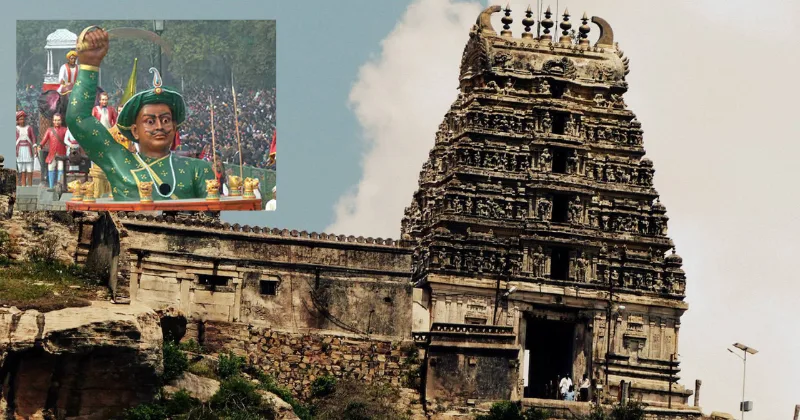
The gleam of a thousand lamps, flickering in the dusk, usually fills hearts with warmth and hope during the “festival of lights. Diwali, embodies the triumph of good over evil and the promise that light will always chase away darkness. Yet, for one community in Karnataka, Deepavali casts long shadows that reach deep into memory and grief. For the Mandyam Iyengar community-a Brahmin sub-sect—”Naraka Chaturdasi” is not a celebration but a day painted in sorrow. Over two centuries ago, the so called ‘Tiger’ of Mysore, tyrant Tipu Sultan, unleashed a wave of violence, drenching the town of Melkote in blood and anguish as nearly 800 Mandyam Iyengar men, women, and children were mercilessly massacred.
Today, Melkote, a small hill town nestled in the Mandya district of Karnataka, stands as silent testimony to this tragedy. Its ancient streets wind around two sacred temples-the Cheluvanarayana Temple and the Yoga Narasimha Temple-where prayers have mingled with tears for generations.
The Mandyam Iyengars, among the earliest followers of Sri Ramanujacharya, made Melkote their home in the 12th century after being embraced by the Hoysala King Vishnuvardhana. Though the Hoysalas faded into history by 1343 CE, with the death of their last ruler, Veera Ballala III,, the Iyengar community flourished under the benevolent gaze of the Vijayanagar Empire, whose kings lavished the Cheluvanarayana Temple and the Iyengars with generous grants, weaving faith, resilience, into the fabric of Melkote’s identity. By 1565, the glorious Vijayanagar Empire, once a beacon of southern might, teetered on the edge of oblivion.
Under the visionary Raja Wodeyar I, Mysore’s spirit, began to recover and radiate outward. Over the next 150 years, the Mandyam Iyengar community flourished under Wodeyar patronage, their destinies entwined with the pulse of the kingdom. They rose to prominence, holding keys to administrative and sacred chambers alike, while the revered Cheluvanarayana temple found its guardianship entrusted to their care. Prosperity blossomed, watered by the generosity and vision of the Wodeyars, and hope seemed eternal. By 1760, the Wodeyar family’s grasp had weakened, their authority siphoned away by the Dalwai—the commanders-in-chief—while the Wodeyar king became a mere shadow on the throne. When Krishnaraja Wodeyar II passed away in 1763, Hyder Ali, the most ruthless of the commanders, seized the kingdom’s reins. His rise was as swift as it was relentless, casting a pall of anxiety and uncertainty over Mysore. Rani Lakshammanni, the rightful heiress of the Mysore kingdom, with her unyielding courage, plotted to resurrect the Wodeyar legacy. She was not alone; the Mandyam Iyengars, with Thirumalai Iyengar and his brother Narayan at the helm, rallied to her cause. She tried three times secretly to get rid of the Mahommaden usurpers. In 1765, the queen sent an emissary to the Governor of Madras for help against Hyder Ali, but the Nawab of Karnatic’s pressure and British political maneuvering prevented assistance. In 1770, Rani Lakshammanni secretly sought aid from Peshwa Madhavarao against Hyder Ali, who suspected her emissary Pradhan Tirumal Iyengar.
Hyder arrested Tirumal but, fearing his intelligence, later released him and sent him to Kadapa, thwarting the Rani’s plan. But the Maharani did not lose her grit and tenacity. In 1776, Maharani Lakshmammanni sent emissaries to Lord Pigot for British help against Hyder, but found him imprisoned. Pigot advised them to wait in Tanjore, but his subsequent death thwarted the plan.
Despite this failure, the determined emissaries remained in Tanjore to await another opportunity to negotiate with the British. When Hyder Ali died in 1783, his son, Tipu Sultan, captured the throne. Unlike Hyder, Tipu was acutely aware of the dangers posed by the alliance between the Iyengars and the Queen, Rani Lakshmammani. Upon discovering Pradhans Tirumal Iyengar and Narayana Iyengar alliance with the British to dethrone, Tippu Sultan ordered the imprisonment of their relatives and others involved. 700 Iyengar families were chained with heavy irons and thrust into the dungeons of Srirangapatnam. After returning to his capital, Tippu massacred the families on the day of Naraka Chaturdashi and confiscated their estates, decimating Melkote and rendering it a ghost town overnight. This mass butchering by Tipu’s army forced Mandyam Iyengars to move to Nagamangala and later settle down in Melukute from Baburayana Koppalu, Mandya Koppal and Mandya.
This dark chapter in history is a stark illustration of the political and military realities of the time, where ambition and intolerance led to unspeakable tragedy. Even today Anandampillais of Bharadwaja gotra staying in Melkote and other places, do not celebrate Deepavali, as a mark of homage to their ancestors who were killed in this Massacre. This article is a tribute to all those families who were brutally killed.
The biography of Tipu Sultan is a case study which highlights the fact that teaching a complete and unfiltered version of history, including its darker moments, is crucial for fostering critical thinking, promoting empathy, and learning from past mistakes. Presenting a sanitized, one dimensional view of a historical figure creates an unrealistic unrealistic role models & creating ill-informed citizens susceptible to repeating past errors. Failure to acknowledge the “darker side” of a historical figure while glorifying their achievements has significant consequences, including the distortion of historical truth, the cultivation of uncritical hero worship, and the perpetuation of harmful ideologies. This can have negative effects on a society’s collective memory, moral judgment, and educational integrity.














Comments