





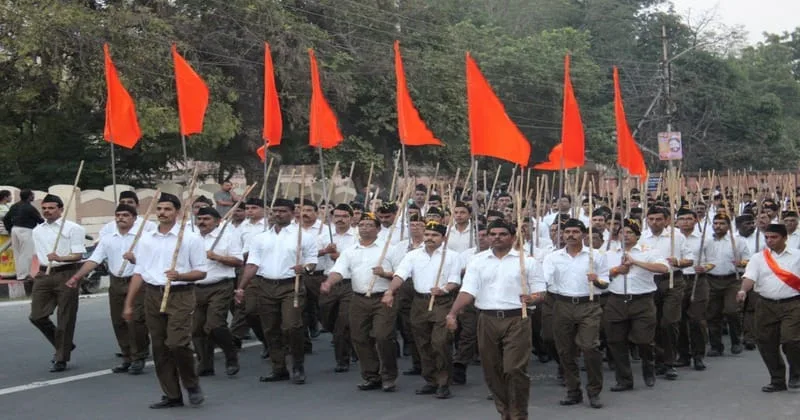
The vast political changes in 1947, followed by the launch of the Praja Parishad movement in J&K in 1951, led the Sheikh Abdullah government in J&K to impose severe restrictions on the Rashtriya Swayamsevak Sangh (RSS) throughout the state, especially in the Kashmir valley. Simultaneous founding of Bhartiya Jana Sangh at the national level by Dr Shyama Prasad Mukherjee and its open support to the Praja Parishad movement further irked the Sheikh Abdullah regime. Consequent upon the change of the government in the state and the taking over of the reigns by Bakshi Ghulam Mohammed after the arrest of Sheikh Abdullah in the Kashmir conspiracy case in 1953, these restrictions on RSS didn’t ease; in fact, they got more severe and direct.
The core of the swayamsevaks in J&K were the government employees, and these restrictions curtailed their direct participation in the RSS activities. This scenario of witch-hunting created a lot of difficulties for the first-generation swayamsevaks in the valley. It was also followed by some serious administrative and police actions against the persons having direct or indirect links with the RSS in J&K. However, the RSS activities continued under some pseudo names and ways. RSS was officially recognised as an object of social and political taboo and ridicule, and it generated an environment of fear psychosis in the minuscule minority community of Hindus in the valley. Accordingly, the top RSS functionaries at the Prant and national level decided to restrict their visits to the valley for some time, keeping in view the difficulties in the valley for the swayamsevaks; however, they continued to visit the Jammu province on a regular basis.
The scenario detailed above continued for a long period of two decades, from the 1950s to the 1960s. The RSS’s important functionaries and some active swayamsevaks in the Kashmir valley would often make visits to Jammu and Punjab to attend important baithaks, shivirs, and vargas, and would take the necessary guidelines therein. With the passage of time, things eased, and the swayamsevaks learnt the art of running the activities under different banners and names in the Kashmir valley. By the end of the decade of 1960s, the second generation swayamsevaks got active and participated in the activities of the organisation quite regularly. Accordingly, this brought a qualitative and quantitative change in the overall scenario for the organisation in the valley. However, the CID & Police reporting about the functionaries of RSS continued as usual, but it didn’t deter the swayamsevaks from doing their routine organisational activities.
With the onset of the decade of 1970s, the RSS top functionaries at the Prant and national level revisited their policy of pravas (visits) to the Kashmir valley. It was during these two decades of the 1970s and 1980s that most of the visits by the top RSS functionaries were conducted in the Kashmir valley and Ladakh, which created a great impact for the organisation and its activities in the entire valley of Kashmir. It is important here to give some details in this connection in a chronological order so that a proper study of the events is done for the sake of research, knowledge and record.
Madhavrao Mulle, the Sarkaryavah of RSS (in the 1970s), who had accompanied Guru Golwalkar to Kashmir in 1947 when Guruji met Maharaja Hari Singh in Srinagar, decided to pay a visit to the valley of Kashmir in the early 1970s. He was the Prant Pracharak of the Punjab prant in 1947. However, his visit couldn’t take place, though all preparations for his visit were made in Srinagar due to certain unavoidable reasons. The all-India functionaries like Anantrao Gokhale and Bapurao Moghe visited Srinagar in 1974, and two programmes were conducted in the hall of the Arya Samaj at Wazir Bagh, Srinagar. Netrapal Shastri, an important functionary of Arya Samaj in Kashmir valley who was also a swayamsevak from his childhood, facilitated the organisation to organise the two influential and successful programmes in the valley. The programmes were followed by meetings with the active swayamsevaks in the valley.
In July 1974, Eknath Ranade, the founder of the Swami Vivekanand Shila Samarak at Kanyakumari, paid a visit to the valley of Kashmir with a certain mission and purpose. Eknath Ranade was earlier the Sarkaryawah of RSS before his deputation to the Shila Samarak. His four-day tour programme in the valley included a public programme at Shivalaya-Srinagar, a meeting with the active swayamsevaks of Kashmir, visit to Nagdandi Ashram in the Anantnag district and formally launching the Vivekananda Kendra at Nagdandi Ashram. He also met the top government functionaries at Srinagar and thanked them for their contributions on behalf of the J&K state to the Shila Samarak at Kanyakumari. It was the good fortune of this author that Eknath Ranade, during his entire tour in the valley, took me along with him and thus bore witness to the important activities that took place during his visit.
In the same year, Sunder Singh Bhandari, an important all-India functionary of the BJS, also paid a visit to the Kashmir valley and met swayamsevaks at Srinagar. He, in particular, encouraged and inspired the BJS functionaries in the Kashmir valley to take the party activities ahead in the entire valley to the grassroots level. ABVP and BMS functionaries also started their visits to the valley, and in this connection, Alok Kumar, the then Organising Secretary of ABVP for the North Zone (currently the President of the VHP) and Raj Krishen Bhagat, Secretary-BMS, also paid a number of visits to Kashmir in connection with the furtherance of organisational activities in the valley. These frequent visits activated the core group of swayamsevaks in the valley and inspired the youth to work with more dedication and commitment to the cause of the RSS.
In May 1975, both the top leaders of BJS, Atal Bihari Vajpayee and L.K.Advani, visited Srinagar in connection with a meeting of the parliamentary standing committee. Swayamsevaks based in Srinagar met them at the MLA hostel, Srinagar. I very well remember the enthusiasm with which those meetings took place with them. It was the time when the JP movement was making huge headlines at the national level. Around this very time, Thakur Ram Singh and Narain Dass Seh-Kshetriya Pracharak, Uttar Kshetra and Punjab Prant Pracharak respectively, visited Kashmir and held a series of meetings with the active swayamsevaks and other functionaries of the organisation in Srinagar, Baramulla and Anantnag and apprised them about the future planning of RSS in regard to the expansion of the organisation in Jammu and Kashmir.
It was just after one month of the above-stated developments that the Indira regime clamped the state of internal emergency on 25 June 1975, and immediately after it, the RSS was also banned at the national level. In Kashmir, a number of senior functionaries of RSS were taken into custody by the government of J&K, and the RSS functionaries were directed by the organisation to go underground and wait for the next guidelines. But all this didn’t take away the initiative and the dedication of the swayamsevaks in general, and the RSS senior adhikaris started once again visiting Kashmir by the end of the year 1975. They took due precautions and mostly visited in a disguised manner. Thakur Ram Singh, Dr Om Prakash Mengi-Sambhag Sanghachalak, Dr Subhash Gupta-Sambhag Pracharaak and Vivek Kumar-Vibhag Pracharak paid a number of visits to the valley during the period of emergency and made a positive impact on the ground.
During the period of emergency, a number of swayamsevaks in Kashmir came out as Vistaraks for short duration periods of one month to three months and were deputed to various districts, tehsils and villages to conduct a census about the Hindu population and other related details. These operations would be conducted under the banner of VHP and ABVP. The visiting adhikaris would guide the activists in conducting the census. Under the banner of Lok Sangharsh Samiti, large-scale work was done to compile documentation of people’s protests against the 42nd Amendment Bill passed by the parliament. People were contacted by the swayamsevaks at various levels and requested to put their signatures on the forms prepared in this regard for their dispatch to the President of India.
When the government decided to conduct the general elections in March 1977, the important adhikaris of RSS again came to the Kashmir valley and inspired active swayamsevaks to take part in electioneering in large numbers wherever the organisation deputed them. A bunch of swayamsevaks from Kashmir again came out as Vistaraks and were deputed to various constituencies outside J&K to work against the Congress government in the elections, so as to finally lead to the upliftment of emergency and restoration of democratic rule in the country. This was virtually the last and desperate attempt by the democratic forces against the forces of dictatorship and the state of emergency.
Ultimately, the truth prevailed, and the Congress lost the elections, and the emergency was lifted, followed by the nullification of the ban on RSS. The period after the emergency witnessed a great volume of RSS activism in the valley, coupled with frequent and useful visits of the top RSS functionaries to the valley of Kashmir. That story the next time….!









Comments