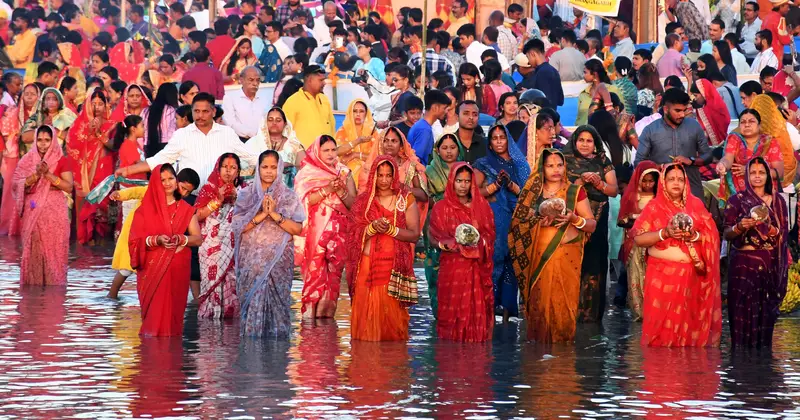
The four-day Chhath Puja festival, one of the most revered Hindu rituals dedicated to Surya Dev and Chhathi Maiya, concluded with deep devotion and grandeur across India and abroad. After completing the 36-hour nirjala fast, devotees offered Usha Arghya, prayers to the rising sun, on Tuesday (October 28) morning, marking the end of the festival.
On Monday (October 27) evening, millions had gathered at rivers, ponds, and ghats across the country to offer Sandhya Arghya to the setting sun, an act symbolising gratitude, purity, and discipline.
In the national capital Delhi, celebrations took place at 1,300 ghats, including 17 major ghats along the Yamuna river, where thousands of women, dressed in traditional attire, offered prayers amid devotional songs and rituals. Similarly, in Mumbai and Thane, 83 ghats witnessed collective celebrations organised under the supervision of civic authorities, ensuring smooth and safe observance of the age-old tradition.
Global Celebrations: From Australia to America
Chhath’s divine glow extended far beyond India’s borders. Devotees in Australia, the US, Canada, and the UK celebrated the festival with traditional rituals and community gatherings. Lakes and parks in Melbourne, Houston, New Jersey, and Toronto were adorned with diyas, sugarcane, and baskets of offerings. The celebration also resonated in countries with historic Indian diasporas such as Fiji, Suriname, Mauritius, and Trinidad and Tobago, where the festival is woven deeply into cultural identity.
Bhopal Marks a Historic Milestone
Adding a special touch to this year’s celebrations, Madhya Pradesh witnessed the inauguration of its first-ever temple dedicated to Chhathi Maiya in Bhopal. The idol, sculpted by Jaipur-based artists Mahavir Bharti and Nirmala, signifies growing recognition of the festival’s deep cultural and spiritual significance beyond eastern India.
Chhath: A Festival Beyond Caste, Class, and Creed
Chhath Puja stands out among Indian festivals for its egalitarian spirit. There are no priests or mantras, and the rituals are performed collectively, irrespective of caste or class. People clean the ghats, paint the surroundings, and distribute prasad together, symbolising unity and selflessness.
The prasad, a vital part of the celebration, includes thekua, bananas, water chestnuts, sweet potatoes, ginger, radish, and other seasonal fruits, simple, natural, and accessible to all.
Ancient Roots and Modern Recognition
According to the Skanda Purana, the origins of Chhath Puja trace back to King Priyavrat and Queen Malini, who were blessed with a child by the goddess Shashthi Devi, the elder sister of Usha, after performing the ritual. The Rigveda also mentions worship of the sun’s rays for purification of body and mind.
Recognising its deep cultural significance, the Government of India has initiated efforts to include Chhath Puja in UNESCO’s Intangible Cultural Heritage list, further cementing its global identity.
Four Sacred Days of Chhath Puja
Nahai Khai: The festival begins with a ritual bath and consumption of a simple vegetarian meal to purify the body.
Kharna: Devotees observe a full-day fast and break it after sunset with kheer made of jaggery and rice.
Sandhya Arghya: The third day is dedicated to offering prayers to the setting sun with baskets of fruits, thekua, and rice laddoos.
Usha Arghya: On Kartik Shukla Saptami, devotees gather again at dawn to offer prayers to the rising sun, marking the conclusion of the festival.
For millions across India and the diaspora, Chhath Puja represents purity, discipline, and gratitude toward nature. As rivers and ponds glow with lamps and songs of devotion echo worldwide, the festival continues to unite generations in reverence to the life-giving power of the Sun.