





MUMBAI: India is emerging as a key stakeholder and detrimental architect in articulating global prosperity and growth. The vision of Viksit Bharat not just reflects the agenda for a progressive India, but reciprocates the message of global prosperity, mutual and sustainable development. Indeed, ‘Vasudaiva Kutumbakam’ is a civilizational principle of India. In this path of navigating geopolitical challenges and accelerating the ladder of developmental discourses, oceans are a key and consequential pillar. Ensuring maritime security, scripting free, open, inclusive and rule-based maritime domain, furnishing the potential of the blue economy and echoing the motto of sustainable development across oceans is an integral part of Viksit Bharat and a prosperous geopolitical latitude.
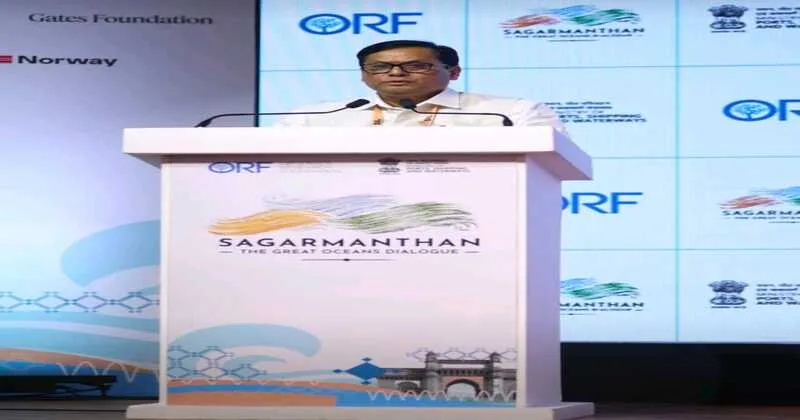
This message was reciprocated in Sagarmanthan 2025: The Great Oceans Dialogue held at Mumbai as a part of the Indian Maritime Week, a flagship initiative of the Ministry of Ports, Shipping and Waterways. The ocean dialogue is organized in association with the Observer Research Foundation, the country’s premium think-tank. The premium maritime platform has attracted delegates from more than 85 countries.
Prime Minister’s Maritime Amrit Kaal Vision: Securing collective blue future
Speaking at Sagarmanthan 2025, Sarbananda Sonowal, Union Minister for Ports Shipping and Waterways highlighted the Maritime Amrit Kaal Vision-2047, an ambitious goal espoused by Prime Minister Narendra Modi. This maritime aspiration of the Prime Minister aims to realize the goal of collective and sustainable blue future through modernization of ports, championing robust maritime connectivity and fuelling green transition in the maritime sector. Ultimately, Amrit Kaal Vision with respect to oceans seeks to revolutionize sea borne globalization with India as its epicentre.
Maritime Amrit Kaal Vision 2047 is a long-term maritime memorandum of India with an initial investment of Rs. 80 lakh crore. The goal is to revolutionize maritime trade, connectivity, port modernization and digitization along with nurturing inland waterways. In this path there are more than 300 ambitious projects to carve India as globally responsible maritime power. Most importantly India’s maritime vision is set to unleash more than 1.5 lakh jobs.
Series of maritime initiatives as India is the strategic nucleus in IOR and Indo-pacific
India’s strategic location that falls in the middle of Indian Ocean Region(IOR) and Indo-pacific renders New Delhi paramount opportunity and responsibility to ensure a secure, credible, reliable, inclusive and rule-based maritime domain. In this direction, a series of initiatives have been rationalized by the government.
In the ongoing India Maritime Week alone, more than 600 Memorandum of Understanding(MoUs) have been inked with global maritime partners that translates to USD 120 billion dollars. Government’s flagship maritime initiatives such as Sagarmala, Gati Shakti have fueled billions of investment to assure state-of-the-art maritime connectivity. In the path of digitization, home-grown Sagar-Setu mobile application helps in ease-of-doing-business as it provides real-time information about vessel movement, port status etc.
Green transition and climate resilience are stimulus for seaborne globalization
Minister Sarbananda Sonowal also asserted that in the path of materializing the maritime economy, the goals of ocean health, climate resilience and sustainable development cannot be downgraded. In this backdrop, India is consistently working towards transition to green energy. The agenda includes grooming green hydrogen ports and ports that run with the aid of methanol and ammonia. The Minister also assured to achieve a completely carbon neutral port by 2035.
Confluence of technology and traditional knowledge to catalyse coastal ecosystem
Speaking at Sagarmanthan 2025, Vijay Kumar, Secretary of Ministry of Ports, Shipping and Waterways exclaimed the message of coexistence, sustainable development and modernization with respect to the development of the maritime sector. He affirmed that India being a responsible maritime economy is sensitive to ecological balance and restoration. A comprehensive and holistic maritime approach is pivotal and modernization cannot be at the cost of coastal communities or other species.
Protecting the precious marine resources is of utmost pivotalness. To realize this goal of sustainable and equitable benefit, rigorous research and development is underway. India’s maritime ambitions have an angle of positive social impact as it considers the dimensions of accelerating the blue economy, ensuring environment protection and creating better livelihood for the coastal communities.
To ensure 360 degree maritime prosperity and sustainable development India aims to perfectly blend traditional, ancient knowledge ecosystems along with cutting-edge technology traits. The strategic location of India at the heart of IOR and Indo-pacific is an added advantage and New Delhi seeks to unleash the potential opportunities, navigate the maritime challenges in a sustainable, responsible way as a credible and resilient maritime partner for the sake of shared and collective maritime future.















Comments