





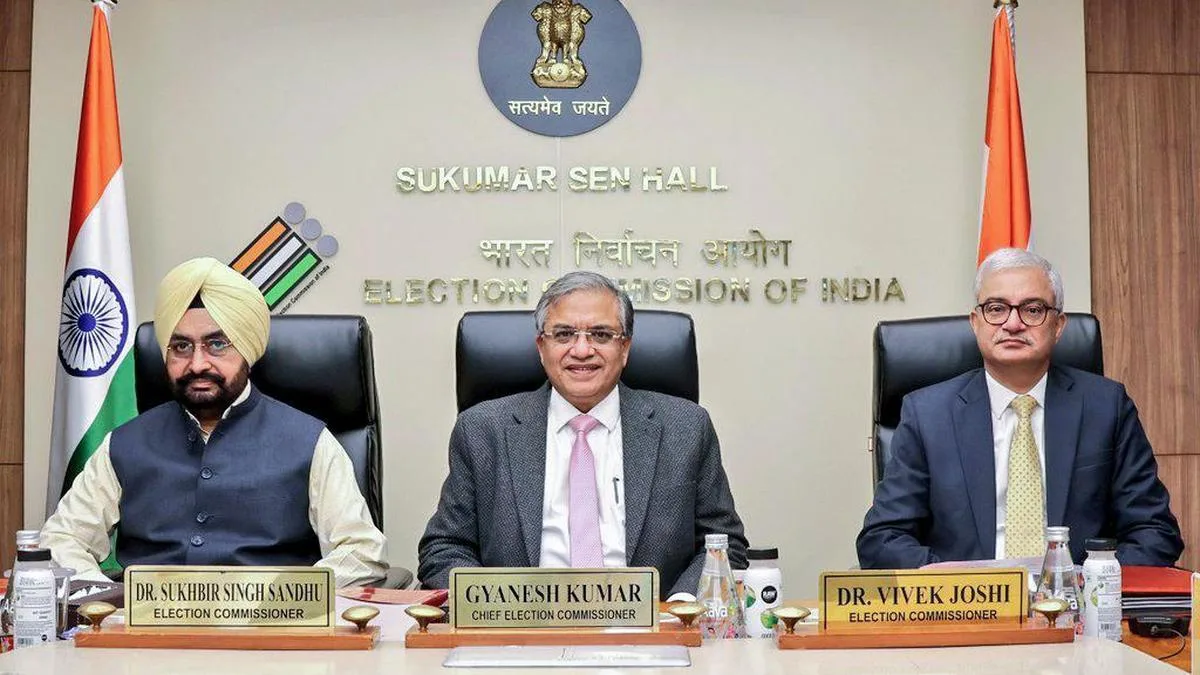
Chief Election Commissioner Gyanesh Kumar on Monday (October 27) announced the Special Intensive Revision (SIR) of voter rolls across 12 states and union territories, marking the Election Commission’s largest such exercise in recent years. The process, he said, will ensure a cleaner, more accurate, and inclusive electoral database ahead of upcoming elections.
“The voter list of all those states where SIR will be conducted will be frozen at 12 am tonight. Booth Level Officers (BLOs) will begin distributing Unique Enumeration Forms to every elector, containing all the necessary details from the current voter list,” Kumar said while addressing a press briefing.
This special revision aims to update voter details, identify duplicates or shifted electors, and add new eligible voters before finalising the updated electoral roll.
Aadhaar is optional, not mandatory
A significant clarification from the Election Commission is that Aadhaar will remain optional for the ongoing SIR process. As per the Commission’s latest directive (Letter No. 23/2025-ERS/Vol.II dated 09.09.2025), voters are not required to furnish Aadhaar for verification.
Instead, the ECI has listed a wide range of alternate documents that can be submitted, ensuring that no eligible voter is excluded due to lack of Aadhaar.
Chief Election Commissioner Gyanesh Kumar emphasised that if a voter’s or their parent’s name appears in the 2003 voter list, they do not need to submit any new documents. This provision covers a large section of the population already registered before the 2004 General Elections.
Who needs to submit documents?
For individuals whose names (or their parents’ names) do not appear on the 2003 electoral roll, document submission will be required. BLOs will assist such voters in verifying their identity and eligibility during house-to-house enumeration.
The SIR voter lists from 2002-2004 have been made publicly available at voters.eci.gov.in. Citizens can search for their names or those of their parents to confirm whether documentation is necessary.
“If their names are not there, but their parents’ names are on the list, then too they need not submit additional documents,” Kumar clarified, adding that transparency and ease for citizens remain top priorities for the Commission.
Accepted documents for verification
For those who need to submit proof, the Election Commission has provided a comprehensive list of acceptable documents. These include:
- Any identity card or pension payment order issued by the Central or State Government, PSU, or local authority.
- Any government-issued certificate (by a bank, post office, LIC, PSU, etc.) prior to July 1, 1987.
- Birth Certificate issued by a competent authority.
- Passport or educational certificate (matriculation or above) from recognised boards or universities.
- Permanent Residence Certificate issued by a competent State authority.
- Forest Right Certificate or caste certificates (OBC/SC/ST) issued by competent authorities.
- National Register of Citizens (NRC) record (wherever applicable).
- Family Register maintained by State or local bodies.
- Government-issued land or house allotment certificate.
These alternatives are designed to accommodate all eligible citizens, especially those in rural or migrant populations who may lack certain identity proofs.
Who are the key officers in the SIR process?
Each Assembly Constituency has an Electoral Registration Officer (ERO), usually a Sub-Divisional Magistrate (SDM)-rank official, responsible for overseeing the SIR.
The ERO’s duties include: Preparing draft electoral rolls; Receiving and deciding claims and objections; and Publishing the final electoral rolls after verification.
Supporting them are Assistant Electoral Registration Officers (AEROs), typically at the Tehsil level, who assist in managing field operations.
At the grassroots, Booth Level Officers (BLOs) play the most crucial role. Each BLO is responsible for roughly 1,000 voters per polling station. They are tasked with distributing forms, assisting electors, and verifying household information.
How the enumeration process works
The enumeration exercise, which began after midnight, follows a structured system:
1. Printing Enumeration Forms: EROs will generate Unique Enumeration Forms (EFs) for every voter as of October 27, 2025. These forms contain prefilled details from the existing voter list.
2. House to House Verification: BLOs will distribute these EFs, verify information, and assist voters in linking or matching their names to the 2003 rolls. Each BLO is expected to make at least three visits to ensure maximum coverage.
3. Collection of New Entries: For those newly eligible (aged 18 and above), BLOs will help fill Form 6 and a declaration form for inclusion in the updated roll.
4. Digital Access: Urban voters and temporary migrants can also complete this process online via voters.eci.gov.in.
Verification and Cleanup: BLOs will identify voters who are deceased, permanently shifted, or registered in multiple locations.
Notably, no additional documents are required during the initial enumeration phase—except the Enumeration Form itself.
From enumeration to final electoral roll
Once all Enumeration Forms are collected, the EROs and AEROs will verify and compile the Draft Electoral Rolls.
They will issue notices to electors whose names could not be matched with the old SIR data, and hearings will be conducted to determine inclusion or exclusion.
The process includes a two-tier appeal system:
The District Magistrate (DM) will hear first appeals against ERO decisions.
The Chief Electoral Officer (CEO) of the respective state will hear second appeals.
The Election Commission has directed that no eligible citizen be left out and no ineligible name remain on the list, ensuring both inclusion and integrity.
Which states are included in the first phase?
While the EC has not yet published the final list of all participating states, officials confirmed that the 12 states and UTs in the first phase include a mix of large and smaller jurisdictions where voter roll duplication or outdated data has been a concern.
The process in these regions will help the Commission assess the efficiency of enumeration ahead of extending SIR nationwide in later phases.
A similar drive in Bihar earlier this year resulted in near-zero appeals, an outcome the Commission considers a benchmark for transparency and accuracy.
Why SIR 2025 matters
The Special Intensive Revision is not merely an administrative exercise; it is a cornerstone of electoral democracy. Ensuring every eligible Indian citizen is registered and that every ineligible or duplicate entry is removed, is vital to free and fair elections.
With Aadhaar kept optional, the ECI has attempted to balance transparency, inclusion, and privacy, acknowledging public concerns over data linkage while maintaining robust verification mechanisms.
In doing so, the Commission aims to make the voter list more accurate, inclusive, and digitally accessible than ever before.
How to check your name
Citizens can verify whether their name or that of their parents appears on the 2003 list through the official ECI portal.
Once verified, they can either confirm their eligibility with the BLO or submit necessary documents for inclusion.
The SIR 2025 initiative signals the Election Commission’s determination to modernise the voter registration process while ensuring historical inclusivity. By linking records with the early 2000s rolls and enabling online participation, the ECI is moving towards a digitally integrated, transparent, and citizen-friendly electoral framework.











Comments