
C.S. Seshadri: Quiet luminary who redefined Indian mathematics
December 5, 2025
  • Read Ecopy
  • Circulation
  • Advertise
  • Careers
  • About Us
  • Contact Us
Android AppiPhone AppArattai
Organiser
  • ‌
  • Bharat
    • Assam
    • Bihar
    • Chhattisgarh
    • Jharkhand
    • Maharashtra
    • View All States
  • World
    • Asia
    • Europe
    • North America
    • South America
    • Africa
    • Australia
  • Editorial
  • International
  • Opinion
  • RSS @ 100
  • More
    • Op Sindoor
    • Analysis
    • Sports
    • Defence
    • Politics
    • Business
    • Economy
    • Culture
    • Special Report
    • Sci & Tech
    • Entertainment
    • G20
    • Azadi Ka Amrit Mahotsav
    • Vocal4Local
    • Web Stories
    • Education
    • Employment
    • Books
    • Interviews
    • Travel
    • Law
    • Health
    • Obituary
  • Subscribe
    • Subscribe Print Edition
    • Subscribe Ecopy
    • Read Ecopy
  • ‌
  • Bharat
    • Assam
    • Bihar
    • Chhattisgarh
    • Jharkhand
    • Maharashtra
    • View All States
  • World
    • Asia
    • Europe
    • North America
    • South America
    • Africa
    • Australia
  • Editorial
  • International
  • Opinion
  • RSS @ 100
  • More
    • Op Sindoor
    • Analysis
    • Sports
    • Defence
    • Politics
    • Business
    • Economy
    • Culture
    • Special Report
    • Sci & Tech
    • Entertainment
    • G20
    • Azadi Ka Amrit Mahotsav
    • Vocal4Local
    • Web Stories
    • Education
    • Employment
    • Books
    • Interviews
    • Travel
    • Law
    • Health
    • Obituary
  • Subscribe
    • Subscribe Print Edition
    • Subscribe Ecopy
    • Read Ecopy
Organiser
  • Home
  • Bharat
  • World
  • Operation Sindoor
  • Editorial
  • Analysis
  • Opinion
  • Culture
  • Defence
  • International Edition
  • RSS @ 100
  • Magazine
  • Read Ecopy
Home Bharat

CS Seshadri: The mathematician who blended logic and music

Professor Conjeevaram Srirangachari Seshadri— one of India’s greatest mathematicians whose life was a testament to balance — between intellect and intuition, structure and spontaneity, mathematics and Carnatic music

Dr Praveen Kumar KaudlayDr Praveen Kumar Kaudlay
Oct 27, 2025, 07:00 am IST
in Bharat, Culture, Karnataka
Follow on Google News
Professor Conjeevaram Srirangachari Seshadri

Professor Conjeevaram Srirangachari Seshadri

FacebookTwitterWhatsAppTelegramEmail

Srinivasa Ramanujan remains a household name in India — a legend whose brilliance defined an era. Yet Ramanujan’s genius might have remained unknown were it not for G.H. Hardy, the British mathematician who recognised his extraordinary talent and nurtured it at Cambridge. A similar story unfolded decades later with Professor Conjeevaram Srirangachari Seshadri, whose mathematical promise was first identified by Fr. C. Racine, a Jesuit mathematician at Loyola College, Chennai. Fr. Racine’s encouragement inspired Seshadri to pursue research, nurturing a spark that would later illuminate Indian mathematics.

Born on February 29, 1932, in Kanchipuram, Seshadri was the eldest of twelve children of C. Srirangachari, a respected advocate, and Chudamani. His formative years in Chengalpattu were marked by curiosity and quiet discipline — qualities that would later shape both his mathematical and musical pursuits. After completing his schooling locally, he joined Loyola College in 1948, where the encouragement of Fr. Racine and Prof. S. Narayanan firmly set him on the path of mathematics. For Seshadri, mathematics was not merely a collection of rules and formulas but a living art capable of evoking beauty and insight, much like music.

After completing his bachelor’s degree at Loyola College, Seshadri joined the Tata Institute of Fundamental Research (TIFR) in Mumbai in 1953, then a burgeoning hub for India’s brightest scientific minds. There he forged a lifelong partnership with M.S. Narasimhan, his schoolmate and later colleague, who had also studied at Loyola. Together, they produced the celebrated Narasimhan–Seshadri Theorem, a landmark result bridging algebraic geometry and differential equations. This work transformed the field and reflected Seshadri’s intuitive sense of elegance and harmony — qualities mirrored in his deep love for music.
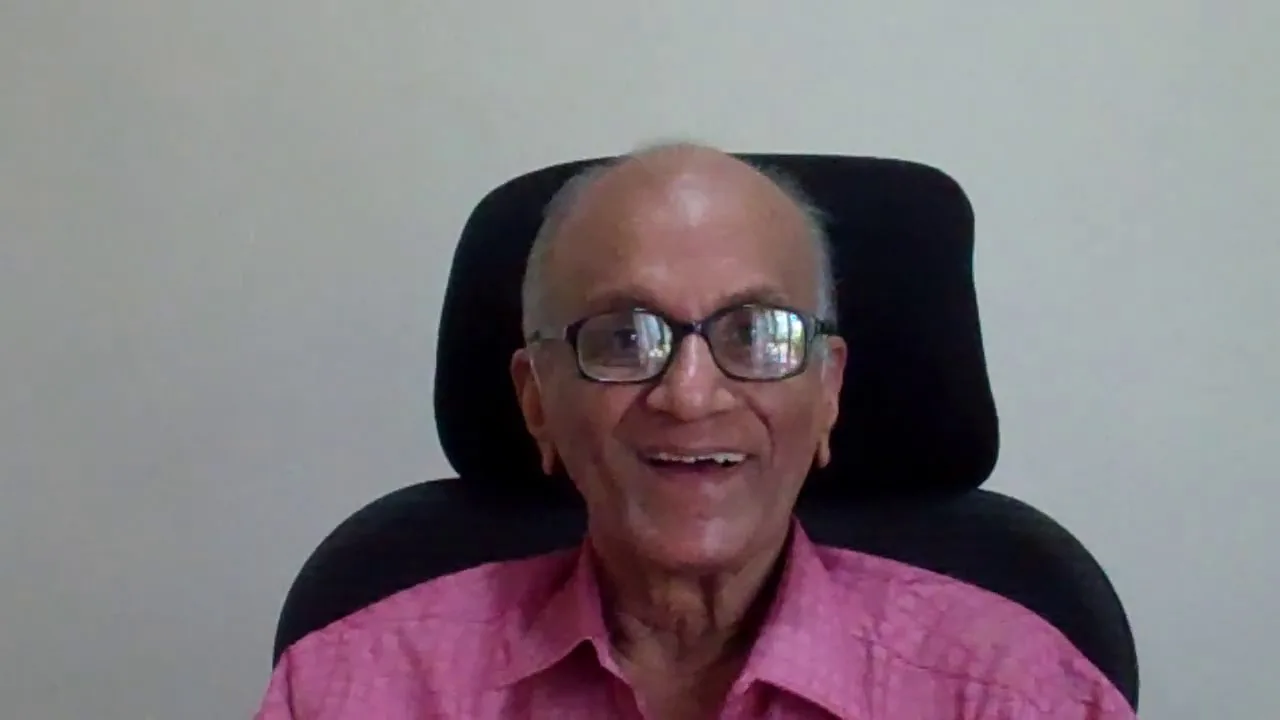
CS Seshadri

After completing his doctoral thesis in Bombay, Seshadri spent three years (1957–1960) in Paris, immersed in the rigour and sophistication of the French mathematical school. He interacted with towering figures such as Claude Chevalley, Henri Cartan, Alexander Grothendieck, and Jean-Pierre Serre. This exposure profoundly shaped his approach to mathematics — as both a logical discipline and a creative art — and fostered the conceptual clarity, geometric intuition, and structural elegance that became hallmarks of his work. It also strengthened his belief in the value of collaborative inquiry, a philosophy that later informed his mentoring style.

Also Read: Sagarmanthan 2025: A forum to furnish ocean potential, fabricate maritime security & fortify the future of blue economy

Returning to TIFR in 1960, Seshadri helped transform the School of Mathematics into a centre of international repute. As Prof. M.S. Raghunathan — himself a distinguished mathematician who played a pivotal role in TIFR’s success — recalled, Seshadri was among the architects who elevated the school from a modest research group to a globally respected institution. His mentorship was as impactful as his research: he guided young mathematicians with patience and humility, celebrating their achievements while remaining characteristically unassuming about his own. “He had a self-effacing charm that won him friends instantly,” Raghunathan observed.

In 1984, Seshadri returned to Chennai and joined the Institute of Mathematical Sciences. His vision of a research-led undergraduate teaching institute culminated in the founding of the Chennai Mathematical Institute (CMI), supported by AC Muthiah and the SPIC Science Foundation. CMI embodied his philosophy — rigorous inquiry, intellectual independence, and the seamless integration of teaching and research.

His former student and collaborator, Prof. V. Balaji of CMI, remembered Seshadri’s lectures as “meticulously prepared and often spartan, yet every session offered something profound — a takeaway for an aspiring researcher.” Praise from Seshadri was rare and deeply meaningful. After Balaji once presented a piece of work, Seshadri remarked, “There is meat in your work. Now I can say you are a mathematician.” Balaji also recalled Seshadri’s intellectual generosity: he shared ideas freely, expecting only diligence in their pursuit. His humility, humour, and broad interests — spanning philosophy, politics, and music — endeared him to all who knew him.

Seshadri’s devotion to Carnatic music was as deep as his passion for mathematics. Trained initially by his grandmother, a disciple of Nainapillai, and later by Pallavur Mani Iyer, he mastered the compositions of Muthuswamy Dikshitar and Shyama Sastri. Balaji described his music as having “a royal gait profoundly suited to expressing Dikshitar’s kritis,” reflecting a spiritual depth born of lifelong sadhana: his wife, late Smt. Sundari Seshadri, an accomplished Carnatic vocalist, shared his musical interests. Even in his later years, he continued mentoring young musicians at CMI, embodying the same discipline and elegance he brought to mathematics — where every theorem, like every raga, demanded both intellect and heart.

Prof. David Mumford, the Harvard mathematician, remembered Seshadri for his brilliance and humanity—their friendship, which began in the early 1960s, spanned continents and decades. Mumford admired how Seshadri bridged cultures effortlessly — Indian and Western, scholarly and artistic — living simply yet advocating persuasively for the cause of mathematics. “He lived simply,” Mumford wrote, “yet could speak with conviction to ministers and officials when mathematics needed support.”

Seshadri received numerous honours, including the Shanti Swarup Bhatnagar Prize, Fellowship of the Royal Society, TWAS Science Prize, and the Padma Bhushan. Yet his enduring legacy lies in his vision, mentorship, and integrity. Prof. K. Chandrasekharan, a pioneering mathematician at TIFR, captured this best: “I cherish the values that inspired the creation of CMI and your unswerving commitment to those values.” These values — integrity, clarity, and generosity — defined Seshadri’s life as much as his work.

He often encouraged exceptionally talented students to consider mathematics as a fulfilling vocation, emphasising that a life devoted to the subject could harmoniously blend intellectual satisfaction with professional success. For Seshadri, mathematics resonated like a well-composed raga — one had to feel it deeply to master it truly.

Even as illness slowed him in later years, Seshadri remained intellectually vibrant and musically active. He passed away on 17 July 2020, leaving behind a legacy that continues to inspire generations. His life was a rare harmony of thought and art, reason and feeling. He transformed Indian mathematics not through force or fame, but through quiet brilliance, generosity, and enduring grace. His theorems will continue to shape the field, but it is his humanity — his humility, warmth, and faith in others — that will be remembered longest.


Topics: Srinivasa RamanujanCarnatic musicCS SeshadriChennai Mathematical InstituteTata Institute of Fundamental ResearchProfessor Conjeevaram Srirangachari Seshadri
Dr Praveen Kumar Kaudlay
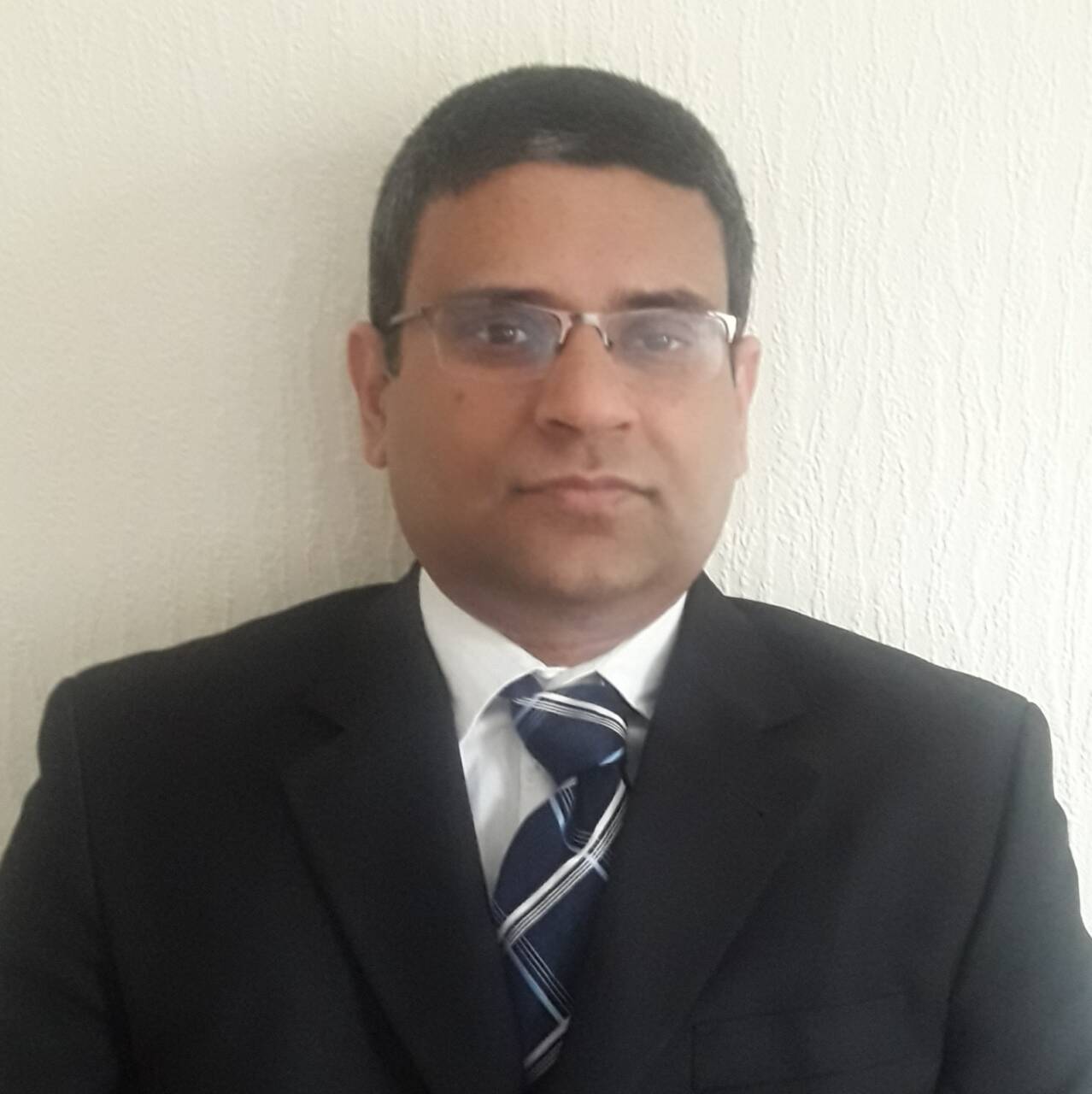
Haemato Oncology Consultant and an honorary Associate Professor at University of Birmingham Institute of Clinical Sciences, employed at Royal Wolverhampton NHS trust UK. Special interest in Bharateeya culture, tradition,arts.Been a writer for the national media for the past three decades. [Read more]
ShareTweetSendShareSend
✮ Subscribe Organiser YouTube Channel. ✮
✮ Join Organiser's WhatsApp channel for Nationalist views beyond the news. ✮
Previous News

Gives message of unity, cooperation & collective participation in society: President Murmu extends greetings on Chhath

Next News

Yashoda Medicity Hospital is a symbol of ‘Swadeshi Sanskar’, along with healthcare facility: President Droupadi Murmu

Related News

Ranjani and Gayatri captivated audiences with a soul-stirring performance

A tryst with destiny of Carnatic Music – Ranjani Gayatri score a massive point with concert at Narada Gana Sabha

TM Krishna’s social justice wokeism, victimhood performance and impact on MS Subbulakshmi’s award controversy

Tamil Nadu: Outrage over Hinduphobic musician TM Krishna conferred with Sangita Kalanidhi award by Madras Music Academy

Sri Kuldeep Pai

Sri Kuldeep Pai: Know the man whose music is uniting Bharat musically and spiritually

Srinivasa Ramanujan and India’s growth in Mathematics

Load More

Comments

The comments posted here/below/in the given space are not on behalf of Organiser. The person posting the comment will be in sole ownership of its responsibility. According to the central government's IT rules, obscene or offensive statement made against a person, religion, community or nation is a punishable offense, and legal action would be taken against people who indulge in such activities.

Latest News

BJYM leader Shyamraj with Janaki

Kerala: Widow of BJP worker murdered in 1995 steps into electoral battle after three decades at Valancherry

Russian Sber bank has unveiled access to its retail investors to the Indian stock market by etching its mutual fund to Nifty50

Scripting economic bonhomie: Russian investors gain access to Indian stocks, Sber unveils Nifty50 pegged mutual funds

Petitioner S Vignesh Shishir speaking to the reporters about the Rahul Gandhi UK citizenship case outside the Raebareli court

Rahul Gandhi UK Citizenship Case: Congress supporters create ruckus in court; Foreign visit details shared with judge

(L) Kerala High Court (R) Bouncers in Trippoonithura temple

Kerala: HC slams CPM-controlled Kochi Devaswom Board for deploying bouncers for crowd management during festival

Fact Check: Rahul Gandhi false claim about govt blocking his meet with Russian President Putin exposed; MEA clears air

Union Minister for Road Transport and Highways Nitin Gadkari (Right)

India set for highway overhaul as Union Minister Nitin Gadkari unveils nationwide shift to MLFF electronic tolling

RSS Akhil Bharatiya Prachar Pramukh Shri Sunil Ambekar

When Narrative Wars result in bloodshed, countering them becomes imperative: Sunil Ambekar

Ministry of Civil Aviation mandates emergency action: IndiGo ordered to stabilise flight operations by midnight

Chhattisgarh CM Vishnu Deo Sai at Panchjanya Conclave, Nava Raipur, Image Courtesy - Chhattisgarh govt

Panchjanya Conclave: Chhattisgarh CM Sai shares views on development projects in Maoist hotbed, women empowerment

Union Finance Minister Nirmala Sitharaman

‘TMC is holding Bengal back’: Sitharaman slams Mamata govt over industrial & healthcare setbacks

Load More
  • Privacy
  • Terms
  • Cookie Policy
  • Refund and Cancellation
  • Delivery and Shipping

© Bharat Prakashan (Delhi) Limited.
Tech-enabled by Ananthapuri Technologies

  • Home
  • Search Organiser
  • Bharat
    • Assam
    • Bihar
    • Chhattisgarh
    • Jharkhand
    • Maharashtra
    • View All States
  • World
    • Asia
    • Africa
    • North America
    • South America
    • Europe
    • Australia
  • Editorial
  • Operation Sindoor
  • Opinion
  • Analysis
  • Defence
  • Culture
  • Sports
  • Business
  • RSS @ 100
  • Entertainment
  • More ..
    • Sci & Tech
    • Vocal4Local
    • Special Report
    • Education
    • Employment
    • Books
    • Interviews
    • Travel
    • Health
    • Politics
    • Law
    • Economy
    • Obituary
  • Subscribe Magazine
  • Read Ecopy
  • Advertise
  • Circulation
  • Careers
  • About Us
  • Contact Us
  • Policies & Terms
    • Privacy Policy
    • Cookie Policy
    • Refund and Cancellation
    • Terms of Use

© Bharat Prakashan (Delhi) Limited.
Tech-enabled by Ananthapuri Technologies