





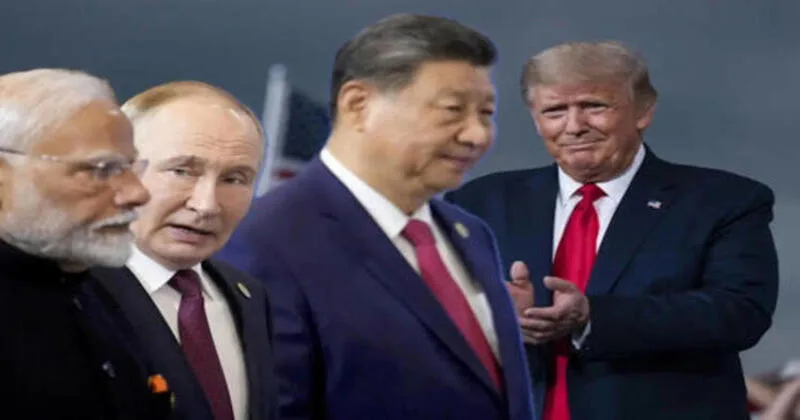
US President Donald Trump, embarking on his first visit to Asia since taking office, is pursuing what his aides describe as aan attempt to position himself as both a peacemaker and an economic dealmaker. During the tour, Trump will seek China’s support in bringing an end to the war between Russia and Ukraine, while also witnessing the signing of a peace agreement between Cambodia and Thailand. The White House views these developments as opportunities to reinforce Trump’s image as a global mediator.
A key focus of the trip will be Trump’s meeting with Chinese President Xi Jinping to explore the possibility of a new trade deal between the United States and China. Although officials acknowledge that the likelihood of a breakthrough remains slim, both leaders are expected to discuss ways to de-escalate ongoing trade tensions. According to administration sources, Trump’s main demand will be the removal of Chinese restrictions on the export of rare earth minerals, which are vital to US high-tech industries. He is also expected to press Beijing to resume large-scale purchases of American soybeans and to take concrete steps to curb the smuggling of the synthetic opioid fentanyl into the US through third countries.
In return, China is expected to push for a reduction in US tariffs on its goods. Trump has recently threatened to impose an additional 155% tariff on Chinese imports, effective November 1, alongside a possible suspension of American software exports to China. The US President is said to believe that even limited progress toward an understanding with China would be enough to portray the talks as a significant win.
During his journey from Washington to Asia, Trump is scheduled to make a stopover in Doha, where he met with Qatari leaders. He will then attend the ASEAN Summit in Malaysia, where separate talks are planned with Malaysian Prime Minister Anwar Ibrahim. Trump will later travel to South Korea and Japan, meeting Xi Jinping in Seoul before heading to Tokyo for discussions with Japanese Prime Minister Sanae Takaichi, the country’s first female leader. Officials in Washington have indicated that Trump hopes to emerge from the trip with a reputation not just as a “peacemaker,” but also as a “moneymaker” who can secure beneficial deals for the United States.
Russia–Ukraine conflict intensifies
Back in Europe, the conflict between Russia and Ukraine has escalated further, frustrating Trump’s earlier diplomatic efforts to broker a ceasefire. In response, the US administration has imposed new sanctions on two of Russia’s largest oil companies, Rosneft and Lukoil. These measures have prompted major countries to reconsider their purchases of Russian crude. Meanwhile, reports from Ukraine indicate that its forces have carried out a drone strike on Russia’s Ryazan Oil Refinery, the country’s fourth-largest, which is operated by Rosneft. The refinery, capable of processing around four million metric tons of crude oil annually, suffered severe damage in the attack, reportedly disrupting the output of nearly 80,000 barrels per day.
Ukrainian forces have increasingly focused on targeting oil refineries, tankers, and pipelines, key sources of revenue for Moscow, as Kyiv remains unwilling to agree to a ceasefire. The attacks have contributed to acute shortages of petrol and diesel within Russia, with several refineries operating at limited capacity and fuel being rationed at numerous petrol stations.
Canada faces additional tariffs amid advertisement row
In a separate development, Trump has reignited tensions with Canada after criticizing an advertisement aired on American television networks. The ad, funded by a Canadian campaign, featured artificial intelligence-generated footage of former US President Ronald Reagan, condemning import tariffs. Trump dismissed the ad as fraudulent and announced the suspension of all ongoing trade talks with Ottawa. In addition, the US President declared a new round of tariffs on Canadian goods. The existing 35% tariff on Canadian imports will rise to 45%, while levies on steel and aluminum will increase from 50% to 60%. Trump’s decision follows his claim that Reagan never made any statement opposing tariffs, accusing Canada of misleading the American public through manipulated media.Canadian Prime Minister Mark Carney later said the advertisement would be withdrawn, adding that Ottawa remained open to negotiations. He expressed optimism that the two countries could soon reach a fresh trade agreement to resolve the dispute.
Sanctions may not fully halt Russian oil flow to India, Say industry sources
The latest US sanctions on Russian oil companies may not completely halt the flow of crude oil from Russia to India, according to industry reports. Analysts suggest that Indian refiners could continue to receive supplies by taking advantages of certain legal loopholes within the sanctions framework. The United States on Wednesday imposed sanctions on two major Russian oil producers, Rosneft and Lukoil, in an effort to tighten economic pressure on Moscow. However, the restrictions are limited in scope, and there remain regions and subsidiaries where the sanctions do not apply. Experts in the oil refining sector note that transactions through such intermediaries may remain unaffected, potentially allowing Indian firms to import Russian crude without technically breaching US law.
Despite this, concerns persist about short-term supply disruptions. Industry officials warn that the sanctions could reduce the availability of Russian oil in December, as most orders for that month have already been placed. Many companies are not yet equipped to adapt to the new compliance requirements, which could delay shipments. Currently, about 70 percent of Russian oil imported into India originates from Rosneft and Lukoil. The US had previously sanctioned other Russian energy giants, including Surgutneftegaz and Gazprom Neft, yet both continue to sell oil in the global market. Data from energy tracking firm Kpler show that India receives an average of 159,000 barrels of crude per day from Surgutneftegaz alone.
Industry experts point out that India does not officially recognize unilateral sanctions imposed by Western nations, adhering only to those endorsed by the United Nations. Unlike Iran or Venezuela, Russian oil itself is not banned but only specific companies are targeted. This distinction leaves room for interpretation and maneuvering among Indian refiners. Reports also indicate that Russian representatives have arrived in the United States for discussions aimed at resolving the issue.













Comments