





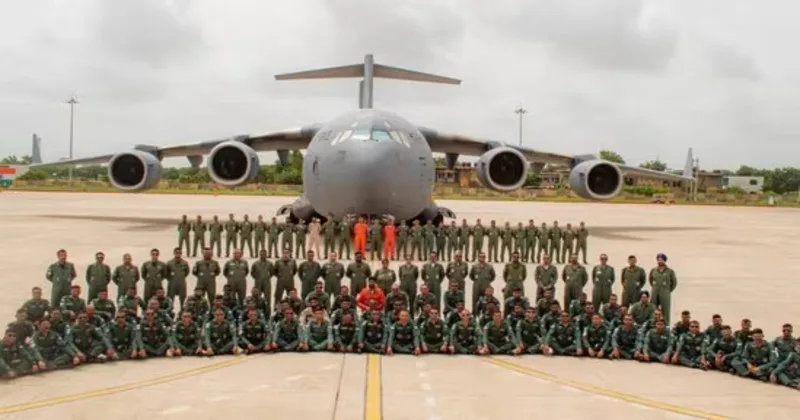
India’s decision to launch the tri-services exercise codenamed Exercise Trishul along its western border shows a stronger operational integration among the Indian Army, Indian Air Force and Indian Navy. It also sends a clear strategic message to Pakistan during a time of heightened tension. According to official notices to airmen (NOTAMs) from India, the exercise will take place from October 30 to November 10, 2025. It involves reserved airspace up to 28,000 feet, which is unusually high for regular drills in that area.
The timing and scale of Ex Trishul are important in the larger picture of Indo-Pakistan relations. Earlier this year, after the deadly Pahalgam terror attack in Jammu & Kashmir, which took the lives of 26 civilians, India launched Operation Sindoor. This operation targeted alleged militant infrastructure across the border, leading to one of the most serious escalations between the two nuclear powers. In this context, the drills along the western border are being closely monitored as both a sign of India’s military preparedness and a way to strengthen deterrence.
Operationally, the exercise highlights New Delhi’s shift towards joint force structure and deployment, which has become a priority in recent defence planning. The involvement of all three services shows an effort to improve interoperability and command and control in a challenging terrain that includes land, air and maritime dimensions. This is particularly relevant since the border area covers coastal Gujarat, desert Rajasthan and airspace extending to 28,000 feet.
Another aspect is the symbolic messaging included in such a large-scale exercise. By issuing the NOTAMs months ahead of time, India demonstrates transparency in its military planning to both domestic and international observers. It also highlights its ability to reserve extensive airspace and mobilize tri-service assets. Analysts pointed out that the chosen area and scale are unusual, drawing attention to India’s preparedness and determination.
From a strategic perspective, the drill serves several purposes. It enhances India’s deterrence along the western border by showcasing readiness for multi-domain operations and the capacity for rapid escalation if needed. It also reassures domestic stakeholders—both political and public—about the armed forces’ ability to respond to threats from across the border or from non-state actors with external support. Additionally, it gives the services an opportunity to train realistically in a high-intensity environment, improving logistics, coordination, air defense, surveillance and maneuvers under real conditions.
Given the recent hostilities and repeated NOTAMs issued by both Pakistan and India along the border, the exercise occurs when shadow boxing in the air and on land has become common in this tense environment. In that regard, Ex Trishul also sends a measured message: military readiness does not have to lead to immediate escalation but should be convincing enough to influence adversary thinking.
In conclusion, Ex Trishul is more than just a routine training event; it signals India’s shifting military doctrine and posture along a volatile border. It underscores the country’s emphasis on joint capabilities, deterrence and readiness in an era of multi-domain conflict. Ultimately, the true impact will depend not only on executing the drills but also on how the message of strength is coupled with efforts to stabilize the border.















Comments