





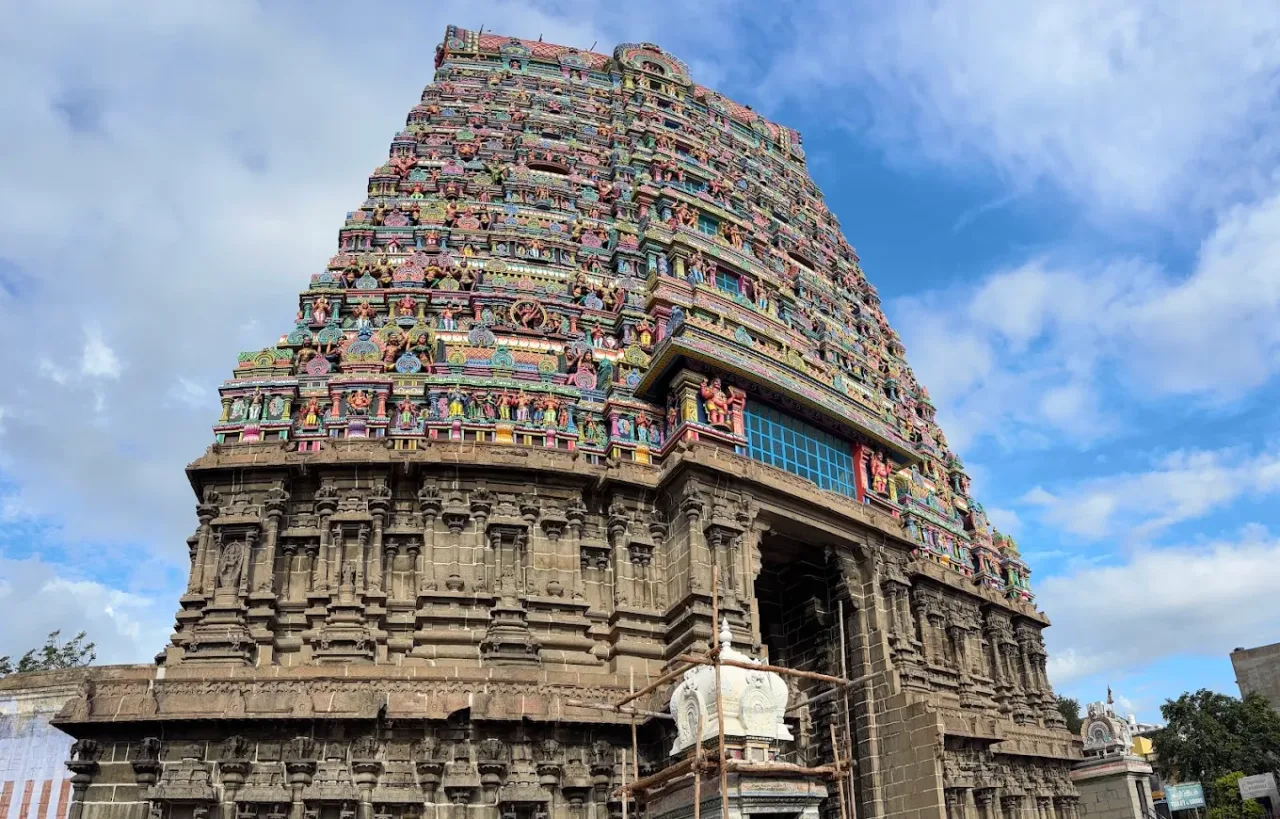
Preventing a group of devotees from reciting Thevaram (a hymn on Bhagwan Shiva) inside the Kasi Viswanathar Temple premises in Tenkasi, a tradition observed for a long time, created tense moments and sparked protests by Hindu outfits. The recitation finally took place on 21 October following public outrage and social media backlash.
As usual, a group of devotees, both men and women, gathered at the Bhagwan Shiva Temple in Tenkasi on 17 October, unaware of what awaited them. As they entered the main tower (Gopuram), temple staff stopped them, saying they could not recite the Thiruvasagam (holy Tamil Saivite hymns sung by the four Saivite saints) within the temple premises. This led to heated arguments between the Hindu Religious and Charitable Endowments (HR&CE) Department staff, particularly the Executive Officer (EO).
"கோவிலில் திருவாசகம் படிக்க கூடாது…வெளியே போ…" அறநிலையத்துறை அதிகாரிகள் அட்டூழியம்…#tenkasi #tiruvaasagam #sprituality #tngovt #hrce #tamiljanam pic.twitter.com/ENZifekPov
— Tamil Janam (@TamilJanamNews) October 19, 2025
Hindu Munnani functionary and advocate Kutralanathan said, “They assemble every month on the last Friday to recite the hymns in a group. It has been going on for several years. But on 17 October, the temple staff denied them permission. Allegedly, they demanded Rs 200 or more for the recitation event. The devotees argued — why should we pay to sing songs for Bhagwan, a revered one? Where else can we recite, if not in front of God and inside the temple? Kings once appointed Oothuvars to recite the same rhythmically and made endowments for them. The practice still continues in some temples.”
The incident, captured in a video that has since gone viral on social media, drew widespread condemnation. Netizens called out the hypocrisy of the DMK government, which claims to champion the Tamil language. Ironically, the devotees were reciting verses from Thiruvasagam — a classic Tamil devotional text — inside a temple dedicated to Bhagwan Shiva. The devotees maintained that, despite having prior permission for their activities, they were abruptly asked to leave and continue their recitation outside.
In the video, one devotee can be heard asking, “You have taken permission for all this and are reading? You have already submitted a letter saying you are going to read it, right?” The group affirmed this, confirming that they had formal permission which they believed was being unjustly revoked.
It is learnt that the EO spoke derogatorily to the devotees, particularly to the guru (head) of the group. Another devotee alleged that the EO nearly attempted to assault him with an umbrella and used disrespectful language. The devotees said, “We consider him as our God — he is our guru.”
Another devotee alleged that the temple authorities questioned who had allowed them in and threatened to file a police complaint if they did not leave.
Upon hearing about the incident, Hindu Munnani functionaries rushed to the site and announced large-scale protests condemning the EO’s behaviour. They demanded the revocation of the EO’s verbal order, as well as an apology for the derogatory remarks made against the group’s head and for preventing them from singing bhajans inside the temple.
Buckling under pressure and the widespread outrage on social media, the recitation was finally allowed on October 21 after BJP Tamil Nadu’s Spiritual and Temple Development Wing functionaries held talks with HR&CE and police officials. Following the discussions, the recitation of bhajans inside the temple was permitted as usual.
During the talks, district BJP Spiritual and Temple Development Wing functionaries V. Venkatachalam, Muthuraj, Sankarasubramanian, Hindu Munnani district secretary Essakkimuthu, Temple Protection Movement president Siva Balasubramanian, VHP district secretary Thalavai, BJP functionaries Senthil and Kumaraswamy, and others took part. The devotees now see this as a victory for Hindus in asserting their rights.
One of the devotees remarked, “This incident is reminiscent of earlier times. During the Jain period, if anyone chanted Shiva’s name, they had to pay fines. If someone was seen sporting sacred ash, they were penalised. These were called ‘seeing and hearing fines’. Now, the HR&CE levies a fine of ₹200 or so for chanting sacred hymns inside temples — just like Aurangzeb imposed jizya tax on Hindus.”
In November 2023, Hindu Munnani spokesperson A. T. Elangovan and other members were stopped by the police from chanting ‘Om Namah Shivaya’ inside the Mylapore Kapaleeswarar Temple. The incident occurred while they were conducting prayers and presenting a petition to the deity.
Similarly, during the Ram Murti Pran Pratishtha in Ayodhya, devotees had to move the Supreme Court and High Court to hold special events and Annadhanam. Critics say, “The DMK government has been acting against the interests of Hindus and their rituals — and we can cite numerous such incidents.”















Comments