





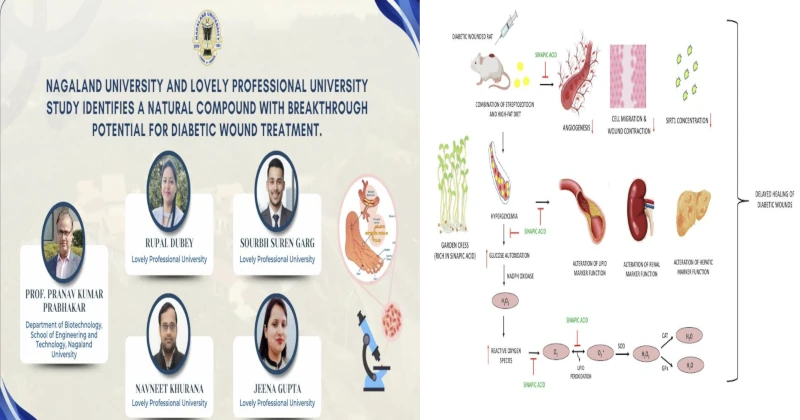
Researchers at Nagaland University have identified a naturally occurring plant compound, Sinapic acid, as a powerful therapeutic agent capable of significantly accelerating wound healing in diabetic conditions. The discovery, published in the globally reputed Nature Scientific Reports (Nature Portfolio), marks the first-ever study worldwide to demonstrate that oral administration of Sinapic acid can enhance diabetic wound healing in preclinical models opening up new possibilities for affordable, sustainable, and natural oral therapies to prevent amputations and chronic wound complications.
Led by Prof. Pranav Kumar Prabhakar, Head of the Department of Biotechnology, School of Engineering and Technology, Nagaland University, the research team included Rupal Dubey, Sourbh Suren Garg, Navneet Khurana, and Dr. Jeena Gupta from Lovely Professional University (LPU), Punjab. The interdisciplinary collaboration brought together expertise in biotechnology, pharmacology, biochemistry, and medical laboratory sciences, uniting efforts toward a common goal addressing one of the most challenging complications of diabetes: delayed wound healing.
According to the study, Sinapic acid, a natural antioxidant commonly found in various edible plants, accelerates diabetic wound healing by activating the SIRT1 molecular pathway, which regulates tissue repair, angiogenesis (formation of new blood vessels), and inflammation control.
This is the first research globally to establish that oral Sinapic acid unlike topical or invasive treatments can promote systemic bioavailability and target healing at the wound site, providing a safer and more practical therapeutic alternative.
“We set out seeking a safe, plant-based alternative exploring how Sinapic acid could accelerate tissue repair, reduce inflammation, and promote new blood vessel formation in diabetic wounds,” explained Prof. Pranav Kumar Prabhakar.
“Interestingly, a lower dose (20 mg/kg) proved more effective than a higher one (40 mg/kg), a phenomenon known as ‘Inverted Dose-Response,’ which has major implications for clinical dosing strategies and future drug development,” he added.
Expressing pride in the university’s scientific achievement, Prof. Jagadish K. Patnaik, Vice Chancellor of Nagaland University, stated:
“I am delighted to share that our researchers have identified a natural compound with remarkable potential for treating diabetic wounds. This discovery not only showcases the strength of our scientific community but also our commitment to addressing pressing health challenges through innovation rooted in nature.”
Dr. Jeena Gupta, from Lovely Professional University, highlighted the translational importance of the discovery:
“Our findings suggest that Sinapic acid enhances tissue repair by promoting angiogenesis and reducing oxidative stress. Unlike conventional therapies, oral delivery ensures systemic action, making it cost-effective and patient-friendly. The next step involves developing patentable formulations for scalable human use.”
Diabetes mellitus affects hundreds of millions worldwide, with diabetic foot ulcers and delayed wound healing among its most serious complications, often leading to infection and limb amputation. Current synthetic drugs frequently show limited efficacy and adverse side effects, underscoring the urgent need for safe, natural alternatives.
The discovery of Sinapic acid’s therapeutic potential carries significant implications for reducing amputation risk, accelerating recovery in diabetic foot ulcers, and offering a low-cost oral therapy accessible to patients in rural and resource-limited settings. The research also aligns with India’s vision for integrating traditional medicine, nutraceuticals, and modern biotechnological innovation, reflecting a sustainable, culturally compatible approach to healthcare.
Building on the strong preclinical evidence, the research team will now advance to the translational phase, focusing on:
- Detailed molecular pathway studies involving PI3K/Akt and NF-κB mechanisms
- Toxicity and pharmacokinetic profiling to ensure long-term safety
- Development of capsule or nutraceutical tablet formulations for easy oral use
- Pilot clinical trials in diabetic patients to validate efficacy and safety
The Nature Scientific Reports publication (DOI: https://doi.org/10.1038/s41598-025-03890-z) lends strong international credibility to the discovery, positioning Nagaland University at the forefront of cutting-edge biomedical research from India’s Northeast.











Comments