





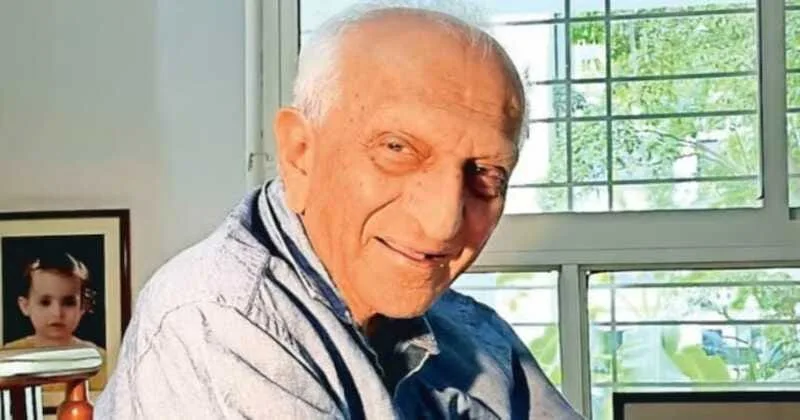
Veteran space scientist and Padma Bhushan awardee Professor Eknath Vasant Chitnis, a pioneering figure in India’s space programme, passed away at the age of 100.
A close associate of Dr Vikram Sarabhai, Chitnis played a pivotal role in establishing the Indian National Committee for Space Research (INCOSPAR), which later evolved into today’s Indian Space Research Organisation (ISRO).
Born on July 25, 1925, in Kolhapur, Chitnis faced early hardships after losing both parents and was brought up by his grandmother. After earning a degree in physics from Pune, he began his career at All India Radio, but his passion for science soon led him to join the newly founded Physical Research Laboratory (PRL) in Ahmedabad, an institution established by Sarabhai and destined to become the cradle of India’s space ambitions.
At PRL, Chitnis made significant contributions to early space physics research, developing Cerenkov Counters to study cosmic rays. His expertise and dedication eventually led him to collaborate with Professor Bruno Rossi’s group at MIT, a partnership that brought him international acclaim.
Upon his return to India in the early 1960s, Professor Chitnis’s vision and meticulous fieldwork led to the identification of Thumba, Kerala, as the ideal site for India’s first rocket launches, an equatorial location perfectly suited for atmospheric studies. He later played a significant role in developing Sriharikota as the nation’s second launch site.
As Member Secretary of INCOSPAR and later Director of ISRO’s Space Applications Centre, Chitnis was a driving force behind the use of space technology for national progress.
One of his most groundbreaking contributions was spearheading the Satellite Instructional Television Experiment (SITE) in 1975–76, which employed NASA’s ATS-6 satellite to beam educational programmes to 2,400 remote villages across India. Hailed as a forerunner to the INSAT programme, SITE introduced satellite television to rural India, setting the stage for the country’s telecommunications and broadcasting revolution.
Chitnis is also remembered for recognising and nurturing young talent, most notably recruiting a young A P J Abdul Kalam into ISRO after reviewing his résumé and spotting his immense potential, a decision that would profoundly influence India’s future in space and missile technology. His leadership blended scientific excellence with a deep commitment to public service, shaping ISRO’s philosophy of inclusive national development.
Honoured with the Padma Bhushan in 1985 for his outstanding contributions to science, Chitnis later served as Chairman of the Press Trust of India and taught for many years at Savitribai Phule Pune University. He is survived by his son, Dr Chetan Chitnis, a leading malaria researcher at the Pasteur Institute in Paris.














Comments