





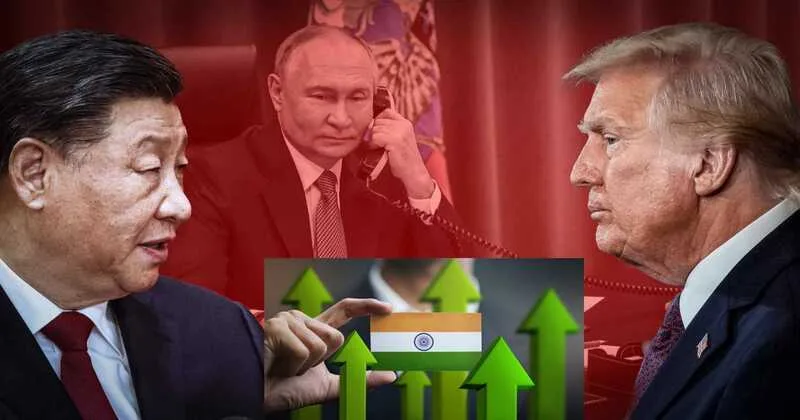
The United States has imposed sanctions on two of Russia’s largest oil companies, intensifying pressure on Moscow as part of President Donald Trump’s latest strategy to end the war in Ukraine. The move follows the earlier, largely ineffective step of levying an additional 25 per cent tariff on India, a major buyer of Russian oil. Announcing the sanctions, US Treasury Secretary Scott Bessant said it was time to “stop the killings in Ukraine” and stressed that a ceasefire was essential. He accused Russian President Vladimir Putin of having no genuine intention to end this senseless conflict.
The sanctions target Rosneft and Lukoil, two energy giants collectively valued at over $50 billion (around Rs 4.4 lakh crore). The measures extend to all entities and countries that purchase oil, gas, or petroleum products from these companies, as well as to ships transporting their oil. Individuals or entities owning more than 50 per cent stakes in the sanctioned firms, along with their subsidiaries, are also subject to the restrictions.
U.S. Treasury Sanctions Major Russian Oil Companies, Calls on Moscow to Immediately Agree to Ceasefire pic.twitter.com/yYsPag65d7
— The White House (@WhiteHouse) October 22, 2025
Collapse of Trump-Putin talks
President Donald Trump reiterated yesterday that India would gradually stop buying Russian oil. The sanctions came in the aftermath of the collapsed Trump-Putin meeting that was scheduled to take place in Budapest, Hungary. The meeting fell through after Russia declared it had “no interest in a ceasefire,” drawing a sharp response from Washington. Following the diplomatic breakdown, Russia escalated its military offensive against Ukraine.
Prior to the cancelled meeting, US Secretary of State Marco Rubio and Russian Foreign Minister Sergei Lavrov had held a phone conversation. However, the US side later claimed that Lavrov “kept repeating” Russia’s refusal to discuss a ceasefire. “He was reading from a prepared script,” a senior US official said. Shortly after, Trump remarked that there was “no point in wasting time meeting Putin.”
Trade tensions with China escalate; Market jitters across the globe
Even as the Ukraine crisis worsened, the US-China trade war entered a new phase. President Trump is now preparing to restrict American software exports to China starting November 1, further straining bilateral economic relations. Washington has warned Beijing to lift its curbs on rare earth exports and to comply with existing trade agreements, failing which an additional 155 per cent tariff could be imposed on Chinese goods. The restrictions on US software exports are expected to hit China’s laptop manufacturing and aircraft engine industries hard. China has yet to issue an official response, but analysts predict heightened tensions ahead of a possible meeting between President Xi Jinping and President Trump in South Korea.
The announcement of sanctions and the prospect of a deepening trade war rattled global stock markets. In the United States, all major indices closed lower on Wednesday. The S&P 500 fell 0.53%, the Nasdaq Composite slipped 0.93%, and the Dow Jones Industrial Average dropped 0.71%. The trend was mirrored across Asia and Europe. Japan’s Nikkei declined 1.27per cent, Topix dropped 0.71%, Shanghai Composite fell 0.72 per cent, Hong Kong’s Hang Seng lost 0.53 per cent, and South Korea’s KOSPI plunged 1.5 per cent. Australia’s ASX200 edged down 0.03 per cent, while Germany’s DAX slipped 0.74%. The only exception was the UK’s FTSE, which rose 0.93 per cent. In futures trading, the Dow Jones fell by 87 points, while the S&P and Nasdaq futures remained largely flat.
Adding to the bearish sentiment were disappointing quarterly results from major US corporations. IBM and Tesla both reported weaker-than-expected earnings for the September quarter. While Tesla’s revenue grew, its profits fell due to higher operating costs, causing its stock to plunge 5% in post-market trading.
Optimism for Indian markets
Despite global uncertainties, Indian investors are watching developments closely with renewed optimism. Hopes are high that the long-delayed India-US trade deal could soon be finalized. Reports suggest that Washington may reduce tariffs on Indian goods from 50% to around 15–16%, which could lift investor sentiment and trigger a rally in domestic equities. The timing coincides with Diwali-Dhanteras, a festive season that traditionally boosts consumer spending. Stocks in sectors such as FMCG, electronics, and automobiles are expected to benefit from strong retail demand. Early signs are positive: the Gift Nifty rose 340 points (+1.33 per cent) in morning trade, suggesting a strong opening for Indian markets. The Nifty50 index is now just 409 points short of its all-time high of 26,277, set on September 27, 2024. After a two-day holiday break for Diwali, markets reopened with optimism but will need sustained momentum to capitalize on the festive season’s potential. Among Indian companies, Federal Bank recently released disappointing quarterly results. Today, several prominent firms, Hindustan Unilever (HUL), Colgate Palmolive, Laurus Labs, Tata Tele (Maharashtra), Andhra Cements, Sagar Cements, and Vardhman Textiles, are scheduled to publish their financial results. Analysts believe that the India-US trade deal prospects could boost shares of export-oriented sectors such as garments and seafood.
Oil and Gold prices surge
International oil prices soared after the announcement of US sanctions on Russian oil companies. At one point, crude prices rose by as much as 5 per cent before stabilizing slightly. As of early Thursday, WTI crude was trading 2.39 per cent higher at $59.90 per barrel, while Brent crude rose 2.33 per cent to $64.05 per barrel. Simultaneously, the US dollar index, which tracks the dollar against six major global currencies including the euro, yen, and pound, rose from 98 to 99, adding further downward pressure on currencies.
Gold prices have shown volatility following recent profit-booking. In early international trading, gold fell by $15 per ounce to around $4,082. In India, gold prices witnessed one of their steepest declines in recent history on Wednesday, dropping from Rs 97,000 to Rs 92,000 for 8 grams. Analysts, however, expect prices to stabilize today, with no major fluctuations anticipated. The global economic landscape remains tense, shaped by Trump’s aggressive sanctions strategy against on Russia. Rising oil prices, a strengthening US dollar, and volatile markets suggest that the coming weeks could see continued financial turbulence.














Comments