





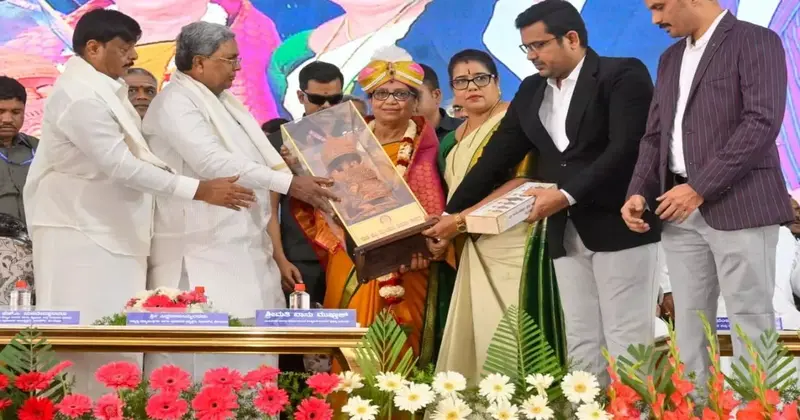
A storm erupted across the country when the Congress-led Karnataka state government invited writer and activist Banu Mushtaq, a vocal critic of Hindu rituals and idol worship, to inaugurate this year’s Mysuru Dasara festival at Chamundi Temple—a sacred celebration dedicated to Goddess Chamundeshwari (Maa Durga). The move triggered widespread outrage, with opposition parties, especially the BJP, condemning it as a deliberate attempt to undermine Hindu sentiments and distort the festival’s spiritual essence. Chief Minister Siddaramaiah’s defense—that “Dasara is not a religious festival and everyone celebrates Dasara as Naada Habba(state festival), it is a festival for everyone…”, only deepened the divide.
What might appear as an act of inclusivity is, in reality, part of a deeper ideological effort to appropriate Hindu festivals, weaken temple autonomy and detach Hindus from their civilizational roots. The Mysuru controversy thus symbolizes a larger pattern—where state control and selective secularism work hand in hand to disrupt the very soul of Hindu Dharma.
Hindu festivals are not merely cultural gatherings; they are the living pulse of Sanatana Dharma. Each celebration—whether Diwali, Holi or Dasara—reverberates with centuries of devotion, symbolizing the eternal and external battle between Dharma and Adharma. They are both spiritual and social expressions of Hindu identity, anchoring communities in rituals, art and divine remembrance. These festivals, rooted in ancient mythology and scriptures, offer opportunities for spiritual growth and devotion to gods and goddesses. The religious significance of these festivals lies in their ability to bring individuals closer to the divine, encouraging reflection, ritualistic practices and the pursuit of moral virtues.
Yet, what we witness today is an insidious campaign to secularize these festivals—to strip them of their Hindu essence and recast them merely as “cultural” events owned by everyone and not specifically by Hindus. The recent controversy over Banu Mushtaq inaugurating the Mysuru Dasara festival epitomizes this political and ideological project to detach Hindus from their own faith and traditions.
From divine devotion to political display
Dasara, also known as Navratri in broader India, commemorates the triumph of good over evil through the worship of the divine feminine, Devi Shakti, in the form of Goddess Chamundeshwari or Maa Durga and her nine avatars. In Mysuru, Dasara also marks the victory of Chamundeshwari Devi over Mahishasura, symbolising the eternal triumph of Dharma over Adharma. This is not merely a culture or ritual but civilizational expressions of metaphysical truths: the triumph of Devi Shakti over Asur, Lord Ram over Ravan, light over darkness.
This year, however, that sanctity was shaken when Banu Mushtaq, a writer and activist with a history of anti-Hindu remarks and opposing Hindu practices, was invited to inaugurate the festival. The decision drew widespread outrage — and rightly so. Mushtaq has previously publicly opposed Devi Chamundeshwari, haldi-kumkum, and Hindu ritualistic practices. Her ideological alignment and prior statements make her appointment highly inappropriate for a Hindu sacred event. A person who openly rejects murti puja and has consistently mocked Hindu traditions was given the honor of opening a festival devoted to Devi Chamundeshwari herself. This is not inclusion; it is an affront to faith.
While the Congress state government also defended this move by citing precedents — including Muslim chief guest Nisar Ahmed in 2017 — such claims are unsustainable. One past instance does not justify repeating acts that undermine the religious essence of the festival. It is a poor defense. A wrong precedent cannot justify a continued error. Repeating an injustice does not sanctify it. Secularism, as understood in the Indian context, demands neutrality—not selective interference in Hindu religious practices only.
State festival vs. Religious festival
It is commendable that Mysuru Dasara has been recognized as a state festival, promoting cultural participation and celebration. Yet, this recognition must not come at the cost of erasing its Hindu religious character. To reduce Dasara merely to a cultural or state event is to sever the Hindu community from its Dharmic roots. Hindus do not celebrate Dasara as an abstract cultural festival; they honor Devi Chamundeshwari, performing rituals and invoke the goddess for blessings.
The same logic applies to all Hindu festivals. Celebrating Diwali, Holi or Navratri is inherently tied to devotion, mythology and Dharmic practices. Claiming these events are “for everyone” or “secular” does not make it so — it merely erodes the sacred character of these festivals over time. The justification offered by many so-called secular voices follows a familiar pattern: “Festivals belong to everyone”. This sentiment sounds inclusive but conceals a deep prejudice against the Hindu character of these events.
Selective secularism and the erosion of hindu religious autonomy
The ongoing attempt to secularise Hindu festivals is not an isolated administrative act — it is part of a broader ideological project aimed at detaching Hindus from the sacred essence of their faith. This ideological re-engineering has been made possible largely through state control over Hindu temples and religious institutions, including the Chamundi Hills temple at Mysuru.
By seizing temple administration and treasury, the state has financially and institutionally weakened Hindu temples, reducing them to government departments rather than autonomous Dharmic spaces. Temple funds, offered by devotees for spiritual and charitable purposes, are absorbed into state machinery. Once the government controls the purse and the premises, it begins to dictate every aspect — from who can inaugurate the festival to how it should be branded.
This is precisely what we are witnessing today. Since the government now “organizes” Dasara using temple funds, it exploits the opportunity to recast a deeply religious celebration into a mere cultural or state event. Instead of allowing temple priests, trustees, or even the royal family — who have preserved this tradition for centuries — to conduct the festival, the state takes over entirely, appoints its committees, and then claims Dasara is “for all” and “non-religious.” The irony is profound – the very funds collected from Hindu devotees are used to dilute the Hindu identity of their own festival.
The government further justifies these actions by invoking principles of equality and secularism, arguing that it cannot discriminate among citizens — whether Hindu, Muslim, Christian or otherwise — in determining who may inaugurate a festival. But at the same time, it ignores Hindus right to religion under Article 25 and 26 of the Constitution. By claiming that the festival must be “inclusive” to all faiths, it sanctions the appointment of individuals who openly reject Hindu rituals and beliefs — such as those who oppose murti puja or worship of Devi Chamundeshwari.
This interference also violates the spirit of Article 29 of the Constitution, which guarantees every citizen (including Hindus) the right to conserve their distinct language, script, or culture. Hindu festivals like Dasara are central to the preservation of Hindu cultural and spiritual identity. By taking control of festivals and temples, the state infringes upon this fundamental right, weakening the capacity of Hindus to safeguard and perpetuate their own religious traditions.
Even more telling is the selective application of secularism. Government control extends only to Hindu temples, not to mosques, churches, or other religious institutions. The state would never claim the right to appoint the chief guest of an Eid gathering or a Christmas service, nor would it declare a mosque or church belongs “to everyone.” Yet it routinely asserts such ownership over Hindu temples, arguing that Chamundi Hill (which houses the famous Chamundeshwari Temple) is not only a Hindu property but belongs to all. From this episode, selective secularism is evident – while Hindu temples are controlled, mosques and churches are completely autonomous, with no comparable government interference. This unequal application of principles of equality and secularism not only undermines Hindu rights but also sets a precedent for further erosion of Hindu Dharmic authority.
Attempts to secularise Dasara under the pretext of inclusivity also ignore the distinction between participation and appropriation. Hindus welcome others to witness or partake in their celebrations, but the festival’s spiritual core is non-negotiable. Hindus have always stood for religious harmony, but they cannot and must not, tolerate politically or ideologically motivated attacks on their festivals, temples or religious sentiments. The legacy of Chamundeshwari Devi is not up for negotiation. A person who openly rejects murti puja and has consistently opposed Hindu dharmic practices can never be the rightful face for chief guest in Dasara festival.
This is not respect for diversity; it is deliberate desecration. A government that truly valued pluralism would protect the sanctity of every religion equally — not target one for deracination. The Mysuru Dasara controversy should thus serve as a wake-up call – if Hindus do not reclaim their festivals, others will continue to usurp and redefine them.
Secularism is meant to ensure equality among religions, not erase the identity of one. The attempt to secularise Dasara is a direct attack on Hindu spiritual autonomy — a continuation of a centuries-old project to detach Hindus from their gods, temples, and traditions. The Mysuru Dasara controversy is not about one individual or one festival; it is about the right of Hindus to preserve the sanctity of their own faith without external interference. When the State that controls Hindu temples also claim the authority to redefine their rituals and select anti-Hindu figures as their public face, secularism ceases to be neutrality—it becomes coercion.
It is time to restore the authentic spirit of Dasara and other Hindu festivals: a celebration of devotion, tradition and dharmic identity that belongs to Hindus first and foremost, even while welcoming all who respect that sacred foundation. Our deities, our temples, our festivals and our faith are not tools of political theatre or ideological manipulation — they are the living heart of Hindu and Bharat’s civilization. No government or secularist has rightful authority to redefine them.











Comments