





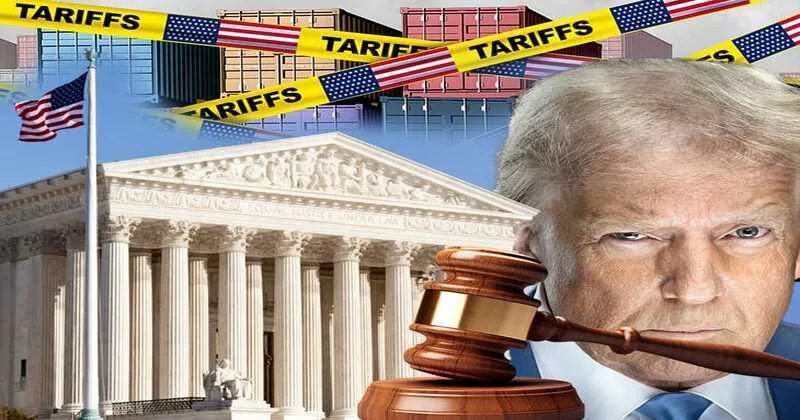
The United States Supreme Court is set to hear President Donald Trump’s appeal next month over the legality of the sweeping tariffs he imposed unilaterally on several countries during his term. The tariffs, introduced under the banner of Liberation Day on April 2, were announced following the declaration of a national emergency under the International Emergency Economic Powers Act (IEEPA). Trump argued that the tariffs were essential to reduce the United States’ massive trade deficit, force global manufacturers to relocate production to the US, and pressure countries to lower import duties on American goods.Trump imposed a 10% basic tariff on all imports entering the United States, alongside individual tariffs for specific countries. Some nations, including China, Mexico, and Canada, were targeted with additional “special” or “trafficking” tariffs, reaching as high as 50% for certain goods. These measures were justified by Trump as a means to counter illegal immigration, drug trafficking, and unfair trade practices.
However, the US Court of International Trade and, subsequently, the US Court of Appeals for the Federal Circuit ruled that most of Trump’s tariff measures were illegal and constituted an abuse of executive power. The appeals court held that the president does not possess the authority to impose tariffs as a tool to address issues such as immigration or narcotics trafficking. It further declared that the 10% base tariff, the special tariffs on China, Mexico, and Canada, and the additional duties of up to 50% on other nations were unlawful. Although the courts ruled against Trump, they refrained from overturning the tariffs, pending the outcome of his appeal to the Supreme Court. Trump has maintained that both courts’ rulings were “arbitrary” and warned that upholding them would devastate the American economy. He has vowed to personally appear before the Supreme Court when the case is heard, a move that would make him the first sitting US president to appear in person before the nation’s highest judicial body.
Describing the case as “the most important in American history,” Trump has said that if the Supreme Court upholds the lower courts’ rulings, the US will face an economic disaster requiring years to recover. US Secretary of State Scott Besant echoed similar concerns, warning that the loss would weaken America’s leverage in trade negotiations and damage its international reputation.
The outcome of the Supreme Court hearing is expected to have major economic and diplomatic repercussions. If the court rules against Trump, the administration will be obligated to refund all the duties already collected under the disputed tariffs. The US will also lose much of its bargaining power in ongoing trade negotiations with key partners, including China, India, the European Union, Canada, and the United Kingdom. The ruling would effectively dismantle the pressure-based strategy that has been central to Trump’s trade policy. Legal experts note that while the president does have certain tariff powers, they are limited under the Trade Act of 1974. The law allows the president to impose tariffs of up to 15%, but only for a duration of 150 days, and strictly under specific conditions. If the Supreme Court affirms the lower court rulings, Trump will be forced to roll back most of the current tariffs and reduce rates to the 15% limit. Such a decision would mark a major victory for countries like India, which have faced tariffs as high as 50% under Trump’s trade measures.
The tariffs, though controversial, have generated an estimated $215.2 billion in revenue for the US Treasury, approximately ₹19 lakh crore. Yet, the appeals court’s ruling does not apply to the 25–50% tariffs on steel, aluminium, copper, and vehicles, which remain in force. As the Supreme Court prepares to hear the case, global markets and trade partners are watching closely. A ruling against Trump could reshape the landscape of US trade policy and limit the scope of presidential authority under the IEEPA. Conversely, if Trump prevails, it could reaffirm broad executive powers over trade and trigger new rounds of tariff-based economic confrontation worldwide. Either way, the Supreme Court’s decision is poised to become a landmark verdict defining the limits of presidential authority in shaping US trade and economic policy.











Comments