





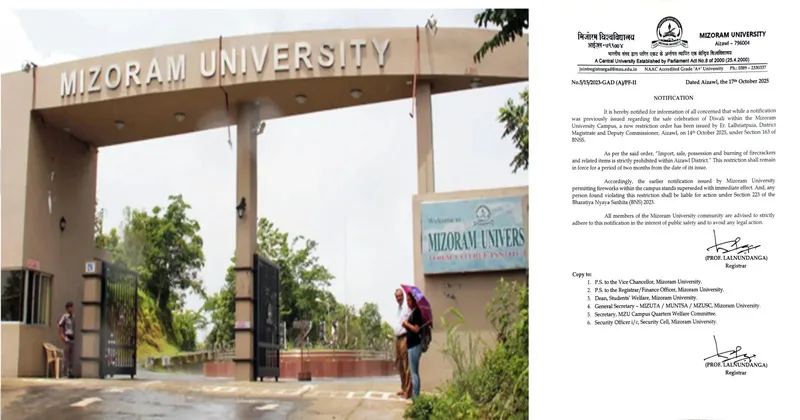
Guwahati: While American state California takes a historic step to recognize Deepawali as an official state holiday, authorities in Mizoram, India, move to restrict the celebrations and firing crackers just ahead of the festival Simultaneously, Mizoram University also impose the ban sparks dissatisfaction amongst the Hindu students.
California Governor Gavin Newsom signed Assembly Bill 268 on October 6, 2025, officially recognising Deepawali as a state holiday — a landmark move making California the first West Coast state in the United States to honor the “Festival of Lights”.
But a central university, Mizoram University, has banned firecrackers without any valid reason. The order issued by the District Magistrate of Aizawl city cited safe celebration of Diwali as a reason to ban firecrackers. But the 2 month ban issued on October 17 will end on December 17, just ahead of Christmas. Critics of the order question whether the state government will issue such restrictions during Christmas and New Year too?
In stark juxtaposition, Mizoram University in Aizawl issued a notification on October 17, 2025, informing students and staff that, in compliance with an order by the District Magistrate and Deputy Commissioner of Aizawl, all activities related to the import, sale, possession, and burning of firecrackers are strictly prohibited within the university district boundaries during Deepawali. The action was justified as a public safety measure, citing Section 163 of BNSS and rules laid down to prevent noise and air pollution. The university further warned that violations would attract legal action under the Bharatiya Nyaya Sanhita and existing campus rules.
This sequence of events has sparked widespread discussion among observers and social media commentators who see irony in the contrast: While California — thousands of miles away — officially celebrates Deepawali, a major Indian university is compelled to ban its popular festivities under local administrative directives.
On Deepwali, the celebration of light becomes — perhaps more than ever — a global phenomenon marked by vastly different official attitudes, reflecting both the challenges and opportunities of cultural coexistence in a changing world.














Comments