





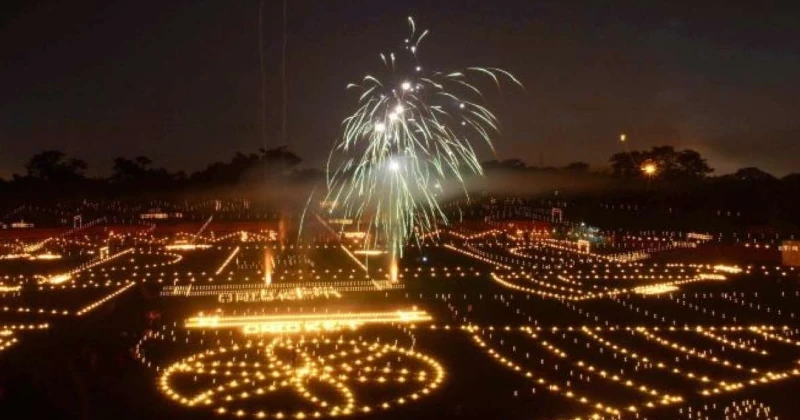
Hindu organisations such as the BJP, VHP, and Hindu Munnani have strongly condemned the Tamil Nadu state government’s new guidelines restricting the bursting of firecrackers to two designated time slots, between 6 a.m. and 7 a.m., and 7 p.m. and 8 p.m. on the day of Deepawali. The order, issued in line with the Supreme Court’s 2018 directive aimed at curbing air and noise pollution, has been described by Hindu groups as a selective and targeted measure against Hindu festivals.
The organisations questioned what they perceive as the selective restrictions imposed on Hindu festivals by authorities across different states. Their objections include limitations on firecracker usage during Deepawali and perceived bias in school holiday calendars, pointing out that the DMK government appears eager to impose curbs only on Hindu festivities while turning a blind eye to minority religious events.
Critics alleged that Chief Minister M. K. Stalin does not extend greetings to Hindus on their festivals but regularly wishes citizens on Ramzan, Bakrid, and Christmas. “That is acceptable,” they said, “but creating trouble for Hindus by way of restrictions is not secular. It reflects a rank Hinduphobic and minority appeasement mindset.”
Applying the same logic as the Supreme Court’s repeated orders, they questioned whether the DMK government would act against mosques that use blaring high-decibel cone speakers at odd hours. “Are these not a nuisance to senior citizens, patients, lactating mothers, and students?” they asked. The critics also challenged the government to apply similar environmental or cruelty-based restrictions on animal slaughter during Bakrid, or on the preparation and distribution of Ramzan porridge and biryani, and even to bakeries manufacturing Christmas cakes, which flood markets every December.
They further accused the DMK of barring the distribution of food and prasad prepared by devotees for the poor as part of annadhanam, while turning a blind eye when people burst crackers during New Year’s Eve celebrations or when political parties do so during victory rallies or birthdays.
“Why such selectivity and so many restrictions only for Hindu festivals?” they asked. “During Vinayagar Chaturthi, the government bans chemically-made idols citing environmental concerns, but ignores industrial and river pollution. This hypocrisy is glaring.”
Hindu Munnani Tamil Nadu State President Kadeswara Subramaniam, in a statement, condemned the DMK for “restricting the bursting of firecrackers on the pretext of pollution” and “sabotaging the festive mood of Hindus.”
He said, “Lakhs of vehicles ply daily causing pollution, will the government restrict vehicle movement? Rivers are polluted with tannery effluents and dyeing units, and groundwater has become unfit for drinking. Instead of addressing these pressing issues, the DMK targets Hindu festivals. It has not yet banned cone-shaped speakers from mosques, which also violate Supreme Court orders.”
He further noted that while the BJP government in Delhi is making arrangements for citizens to celebrate Deepawali over six days, and the Supreme Court has relaxed norms, Tamil Nadu’s time restrictions are “unacceptable and must be revoked.”
“Nowadays, only Supreme Court-mandated green crackers are being manufactured. So why these restrictions?” he questioned.
Government’s guidelines
In its official release on October 16, the Tamil Nadu state government appealed to the public to celebrate a noiseless, smoke-free, and safe Deepavali, emphasising the use of green crackers that emit fewer pollutants. It encouraged community celebrations through welfare associations, which must obtain permission from local bodies or district administrations for bursting crackers in designated common areas.
The government also cautioned citizens against using series (joined) crackers and advised them not to burst crackers near hospitals, schools, courts, religious places, or fire-prone areas such as thatched houses. It reiterated that Deepawali celebrations must not cause inconvenience to senior citizens, patients, or infants.
In a separate order, the DMK government issued guidelines for Deepawali sweet and savoury preparation, mandating that sweet makers must hold a valid FSSAI licence, maintain hygienic conditions, and use quality ingredients.









Comments