





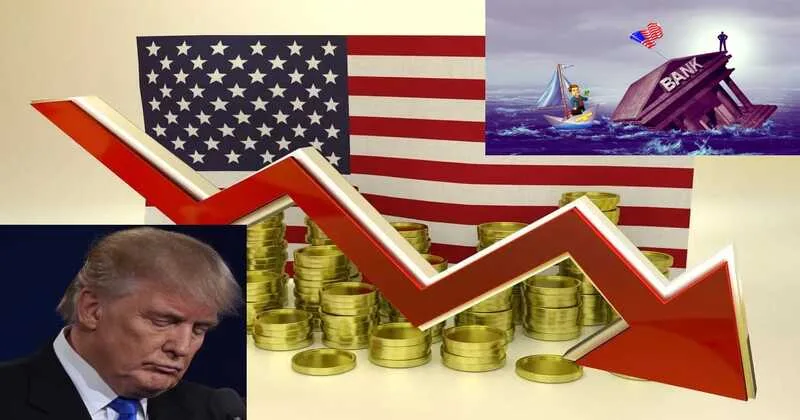
The United States is facing yet another banking crisis, sparking widespread global concern. Shares of leading American banks have plummeted after two major auto component manufacturers filed for bankruptcy. The shockwaves have rippled through stock markets across the world, with Asian indices showing early signs of pressure.
Auto component makers First Brands and Tricolor Holdings have filed for bankruptcy protection, triggering fears that loans extended to them by major investment banks could turn into bad debts. The exposure of financial giants such as Jefferies, JP Morgan, and UBS has sent alarm bells ringing among investors, leading to massive selling in the banking sector. Shares of Jefferies plunged more than 10 per cent, while JP Morgan, UBS, Zions Bancorporation, and Western Alliance Bancorp witnessed declines of up to 13 per cent. The SPDR S&P Regional Banking ETF, a key index tracking mid-sized US banks, dropped 6%, reflecting broad-based panic. The deepening banking woes in the world’s largest economy have rekindled fears of another global financial contagion. Although analysts point out that the current crisis is not yet as severe as the 2008–09 global meltdown, the steep selling pressure underscores the fragility of the US financial system.
US regional banks are crashing today.
This is not a good outlook in the short term.
In the mid- to long term, if this continues, the Fed will step up to provide liquidity similar to 2023. pic.twitter.com/KR249oRHME
— Ted (@TedPillows) October 16, 2025
US -China trade war intensifies as oil down, gold surges and rupee strengthens
Major US stock indices tumbled amid renewed uncertainty. The S&P 500 and Dow Jones Industrial Average fell 0.65 per cent, while the Nasdaq Composite dropped 0.47 per cent. Futures markets mirrored the slump, with Dow, Nasdaq 100, and S&P contracts each shedding about 0.3 per cent in early trading.
Adding to the gloom, tensions between Washington and Beijing have flared up once again. China has accused the US of fabricating allegations regarding rare earth exports, after Washington warned Beijing of “serious consequences” if it imposed export restrictions. The escalation of the US–China trade war has further dampened investor confidence, pushing global markets deeper into the red. Amid the turmoil, geopolitical developments have offered a glimmer of hope. US President Donald Trump met Ukrainian President Volodymyr Zelensky at the White House, and announced plans to hold talks with Russian President Vladimir Putin in Hungary soon. The diplomatic outreach has raised hopes of a potential breakthrough in the prolonged Russia–Ukraine conflict. Following the announcement, international oil prices declined sharply as traders anticipated that successful peace talks could lead to the lifting of Western sanctions on Russian oil exports. The resulting supply surge is expected to ease global prices.
WTI crude dropped to $57 per barrel, while Brent crude slipped to $60 per barrel. In contrast, gold prices soared, breaching a historic high of $4,300 per ounce for the first time. At one stage, gold rallied more than $180 in a single session to touch $4,378.98, before stabilising around $4,341. In India, gold prices remained unchanged yesterday but are expected to surge sharply today in line with the global trend.
Defying global headwinds, the Indian rupee strengthened by 12 paise, closing at Rs 87.96 per US dollar on Thursday. The rupee’s gain was supported by the weakness of the dollar against major global currencies and the positive performance of domestic equities. The steady appreciation highlights India’s relative macroeconomic stability and growing investor confidence amid global turbulence.
Asian markets under pressure
The ripple effects of the US banking slump and renewed trade tensions have hit Asian equities hard. Japan’s Nikkei slipped 0.77 per cent, Shanghai Composite fell 0.88%, and Hong Kong’s Hang Seng plunged 1.45 per cent. In India, the GIFT Nifty, an early indicator of domestic market sentiment, declined 50 points in morning trade, suggesting a weak start. However, India’s fundamentals remain strong, and the market is likely to withstand the global volatility better than many peers. Yesterday, Indian indices had posted robust gains, the Nifty 50 rose 262 points (+1.03 per cent) and the Sensex climbed 862 points (+1.04 per cent). Analysts expect short-term corrections today but believe that India’s resilient economy, backed by strong earnings and domestic demand, will limit downside risks.
A slew of major Indian corporates are scheduled to release their September quarter results today, including Reliance Industries, Tata Technologies, JSW Energy, JSW Steel, Polycab India, CEAT, Central Bank, REC, Hindustan Zinc, and UCO Bank. Yesterday, Infosys reported a 13.2 per cent increase in profit and an 8.6% rise in revenue (in rupee terms), projecting 2–3 per cent growth for FY2025–26. Wipro announced a modest 1.2 per cent profit growth and 1.8 per cent increase in revenue, while Jio Financial Services posted a 0.9 per cent profit rise and a remarkable 41.5 per cent surge in revenue, reflecting India’s growing financial sector momentum even amid global uncertainty. Meanwhile, IndusInd Bank has come under fresh scrutiny after forensic auditing firm Grant Thornton India uncovered an additional Rs 255 crore discrepancy in its balance sheet. The bank had earlier admitted losses of Rs 1,979 crore due to irregularities in its derivatives portfolio. Investigations have also revealed the inflation of balance sheet figures through fictitious entries, prompting an ongoing police probe.
India’s market resilience and strong corporate earnings offer a silver lining at a time when Western economies are once again rattled by financial instability. While the US banking sector grapples with another crisis, India continues to stand out as an island of stability in an uncertain global financial landscape.
















Comments