





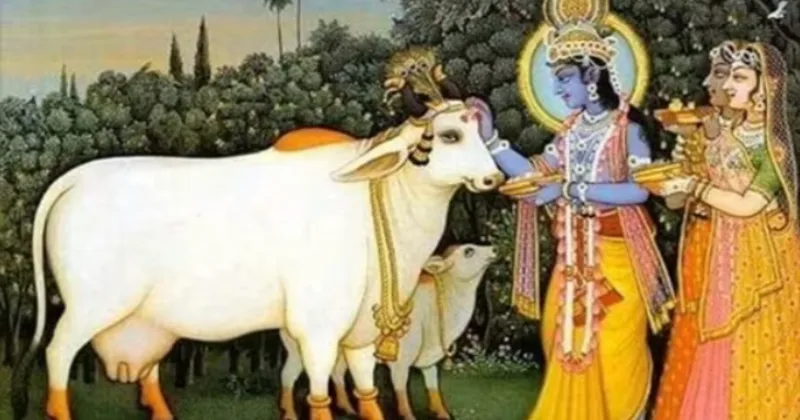
Cows are worshipped on Vasu Baras, the first day of Deepawali. Every Hindu worships cows as divinity, and we believe that cows rank highest among all living things in terms of the existence of the divine. Other names for this day include Nandini Vrat, Vasubaras, and Govatsa Ekadashi. It occurs on the twelfth day of Krishna Paksha in the month of Ashwin, according to the Hindu calendar. A sign of riches, strength, abundance, selfless giving, and a prosperous life, the cow is highly respected in Bharatiya culture.
In a world of failing mental, physical, and social health, the indigenous cow offers several health benefits, which we will explore in detail.
Panchgavya Benefits of Indigenous (Desi) Cow
We get five things from Indigenous (Desi) cows: ghee, butter, dung, urine, and milk. Every component yields outstanding advantages for the environment and the health of all living things. Panchagavya is derived from the Sanskrit words “gavya,” which means cow, and “panch,” which means five. Cow dung, urine, milk, curd, and ghee are the primary components of Panchagavya. In addition to farmers themselves, many scientists produce diverse recipes. Some people combine all five of these ingredients with sugarcane, bananas, toddy juice, and water from a tender coconut to make Panchagavya. It is claimed that this mixture lessens the odor.
Research indicates that Panchagavya helps animals produce more antibodies, which strengthens their immune systems. It has been shown to boost appetite, treat wounds, and cure a variety of deceases in humans, including psoriasis and white spots. These findings are consistent with our ancient texts, which have praised and recorded the importance of Panchagavya in human life, including the Kashyapa Samhita, Charaka Samhita, Sushruta Samhita, Gad Nigraha, and Ras Tantra Saara. Frequent use of Panchagavya helps the body rid itself of toxins, prevent food addiction, treat the negative effects of alcohol and tobacco use, and boost immunity.
Benefits of Indigenous (Desi) Cow Urine
The cow is regarded as the medicine’s treasure. Numerous ailments, both curable and incurable, can be cured by cow urine. The health advantages of cow urine are described in texts like the Atharvana Veda, Charaka Samhita, Rajni Ghuntu, Vridhabhagabhatt, Amritasagar, Bhavaprakash, and Sushruta Samhita. After conducting extensive research in recent years, the Cow Urine Treatment and Research Center in Indore has concluded that it can cure a number of diseases, including diabetes, blood pressure, asthma, psoriasis, eczema, heart attacks, artery blockages, fits, cancer, aids, piles, prostrate, arthritis, migraine, thyroid, ulcer, acidity, constipation, gynecological issues, ear and nose issues, and abortion.
Research from science demonstrated that the consumption of Cow urine has been linked to the treatment of several illnesses, particularly cancer. US and Chinese patents provide four different validations for this claim. The US patent (7718360) was granted on May 18, 2010, while the patent (100475221) was granted on April 8, 2009. The composition’s ability to shield and/or repair DNA from oxidative damage has been proven by the two patents. Cancer is known to be caused by DNA oxidation. The United States had already granted two other patents for cow urine distillate (Patent numbers 6410059 and 6896907).
Indigenous (Desi) Cow dung
Cow dung possesses anti-radioactive, anti-thermal, and antibacterial qualities. The occupants of the house are protected when cow dung is used to clean the floors and cover the walls. Over 20,000 people were murdered in the Bhopal gas leak in 1984. People who lived in homes with walls covered in cow dung were unaffected. Even now, cow dung is used to shield radiation in atomic power plants in Russia and India. Burning cow dung removes airborne pathogens and balances the temperature of the atmosphere. Using cow dung to treat water can help lower its acidity level.
Nuclear radiation and prevention strategies were discussed by Dr KN Uttam, an associate professor in the physics department. The most dangerous rays released by nuclear radiation are gamma rays, which he claimed may be lessened by following some ancient Indian customs. “Traditional methods like putting a layer of cow dung on the outside walls of houses and keeping onions in pockets absorb the harmful gamma rays,” Uttam said. In actuality, cow dung has the ability to absorb all three types of radiation: gamma, beta, and alpha. The most dangerous of these, he continued, are the gamma rays, which pierce bodily tissues. According to Uttam, a former employee of the Ministry of Science and Technology and MHRD, people would be secure if the outer walls of homes were covered with thick layers of cow dung since it would absorb the gamma rays. “It’s very healthy to walk on fresh cowdung,” researcher Kesari Gumat emphasized. “It cures wounds and eradicates all bacteria and germs. Additionally, dry cowdung works well as a scrub to remove dead skin cells and enhance blood flow. Cow dung has a strong anti-radiation effect, according to research findings.
Indigenous (Desi) Cow’s milk
Twelve characteristics of cow milk that support good health are listed in the Charaka Samhita: sweetness; coldness, softness; unctuousness, oiliness; thickness, density; smoothness; stickiness, slimness; slowness; and clarity, calmness. Ojas (vigor) has these qualities as well. It is anticipated that milk consumption will increase Ojas because it possesses the same qualities. One of the elixirs is milk. Cow’s milk enhances intelligence, builds brain tissue, and supports good health. Naturally, cow’s milk and its derivatives are used primarily to make sweets and other meals in various religious rituals and acts of deity worship. Yogurt, butter, ghee, and fresh cheese (paneer) are among the many products generated from cow’s milk.
A2 milk, produced by the Desi cow breed in India, has a lower level of Betacosmophorine-7 (BCM-7) than A1 milk from other cow breeds. Desi milk contains calcium, which lowers blood pressure, protects breast cancer, and prevents colon cancer. Additionally, it lessens the symptoms of PMS, avoids migraine headaches, stops childhood obesity, and aids in adult weight loss. Numerous vitamins and nutrients can be found in cow’s milk. People have been drinking milk to keep their skin supple for millennia. It maintains the skin hydrated since it includes amino acids. Since milk is the primary source of calcium, it is advised to consume it to maintain strong bones, avoid osteoporosis, and prevent cavities and tooth decay.
Ghee from indigenous ( Desi) cows
The Charaka Samhita states that cow ghee enhances fat, Ojas, Kapha, memory, cognition, and digestive ability. Additionally, it relieves emaciation, lunacy, toxic disorders, Pitta, and Vata. Among all the unctuous (oily) substances, it is regarded as the best and most auspicious. It produces several utility and enhances potency by a thousand times. In a similar vein, Bhavaprakash claims that “Ghee is cooling in energy, sweet in taste, rejuvenating, good for the eyes and vision, kindles digestion, bestows lustre and beauty, enhances memory and stamina, increases intellect, promotes longevity, is an aphrodisiac, and protects the body from various diseases.” ” (6.18.1)
Governments, social organisations, and the general public should work together to increase the number of Indigenous cows so that we can rebuild our society.
















Comments