





The political landscape of Kerala, traditionally defined by fierce ideological competition between the Left Democratic Front (LDF) and the United Democratic Front (UDF), is undergoing a profound and potentially irreversible transformation. The ruling Communist Party of India (Marxist)-led LDF, currently facing unprecedented administrative failures and acute fiscal distress, has engineered a desperate pivot toward a strategy defined by cynical, transactional communal appeasement. This strategy is not rooted in progressive secular values but is rather a calculated mechanism for political self-preservation ahead of the crucial Local Body Elections in late 2025 and the Legislative Assembly Elections in May 2026.
This electoral calculus manifests as a dual-axis appeasement policy: simultaneously attempting to court the numerically dominant Hindu majority through calculated ideological capitulation (Sabarimala reversal) while aggressively consolidating the Muslim minority by embracing highly polarized identity politics and tolerating, or even aligning with, radical fringe elements (Palestine solidarity, PFI links). This approach fundamentally sacrifices long-term communal harmony for short-term electoral gain, risking the fragmentation of Kerala’s traditionally delicate social fabric and providing an unprecedented opening for majoritarian nationalism to expand its foothold. The LDF’s shift confirms that when a government cannot govern effectively, it inevitably turns to highly emotional identity markers to mobilize support.
The Foundational Crisis – Governance Deficit as the Catalyst for Appeasement
The LDF’s radical adoption of identity politics is not an organic ideological evolution but a direct consequence of its inability to manage the state’s finances and maintain administrative transparency. The subsequent turn to communal mobilization functions primarily as a powerful diversionary tactic aimed at insulating the ruling structure from escalating anti-incumbency sentiment.
The Extravagance and Mismanagement Critique
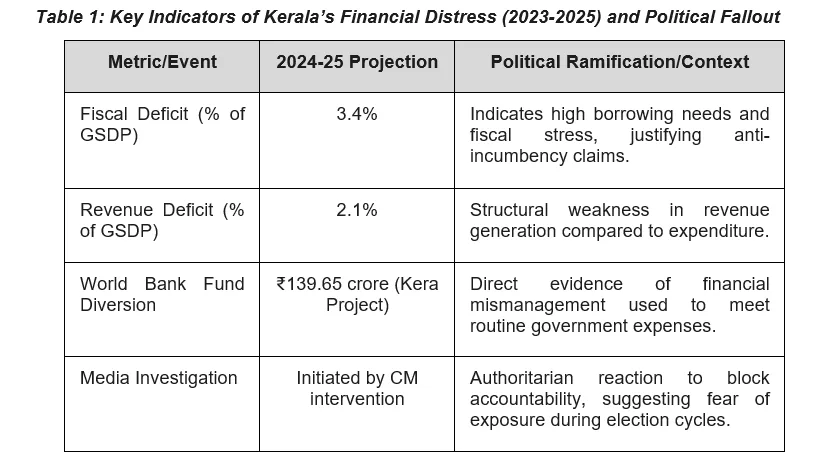
Kerala is grappling with severe structural financial difficulties, pressures that intensified the need for short-term political victories in the 2025-2026 election cycle. Financial projections for the 2024-25 fiscal year confirm this acute fiscal distress. The Fiscal Deficit is targeted at 3.4 per cent of the Gross State Domestic Product (GSDP), amounting to Rs 44,529 crore. Furthermore, the Revenue Deficit is projected at 2.1 per cent of GSDP (Rs 27,846 crore). These figures indicate a high structural reliance on borrowing and a consistent failure to match expenditure with revenue generation, justifying the growing skepticism regarding the state’s economic health.
This financial crisis has drawn sharp criticism from the Union government. The Centre has alleged that the state’s massive debt burden is not the result of reduced central borrowing limits, but is solely attributable to the “financial mismanagement and extravagance” of the LDF government. When an administration faces such acute fiscal pressure and cannot showcase tangible development or sustained financial health, the pressure mounts to secure the vote through emotionally charged, non-economic means, typically involving identity and polarization. The political cost of buying these crucial vote blocs effectively becomes leveraged against the state budget itself, leading to the normalisation of high-risk electoral maneuvers.
Erosion of Integrity and the Suppression of Critical Discourse
The administration’s integrity was further compromised by specific instances of financial irregularity that necessitated a defensive, authoritarian response. Reports regarding the World Bank-funded Kera project, intended to directly benefit 4 lakh farmers and indirectly support 10 lakh others, revealed serious governmental lapse. The LDF government allegedly diverted a crucial first phase disbursement of Rs 139.65 crore, originally intended for the project’s dedicated account, to meet routine end-of-year government expenses.
The governmental reaction to the exposure of this financial lapse was highly concerning, illustrating a deep fear of public accountability ahead of the electoral cycle. Instead of addressing the fund diversion, the government initiated an investigation aimed directly at curbing the media, targeting reports perceived as “damaging to its image”. The probe was explicitly launched to trace the source of internal documents and correspondence, with the Principal Secretary in the Agriculture Department granted broad investigative powers, including the right to summon documents, collect statements from officials or private individuals, and seek explanations from journalists and media houses. This aggressive move, allegedly following the direct intervention of the Chief Minister, represents an authoritarian attempt to chill press freedom and block legitimate scrutiny of governmental finance, especially at a time when administrative failure is intensifying anti-incumbency among the informed electorate.
This scenario reveals a critical causality loop: fiscal crisis leads to the diversion of funds, which when exposed by the media, triggers an institutional response of suppression against journalists. This heightens the need for desperate communal mobilization to shift the focus away from governance failures. Moreover, the political survival strategy is intrinsically linked to the central figure, Chief Minister Pinarayi Vijayan. The highly criticized induction of his son-in-law, P.A. Muhammad Riyas, into the cabinet shortly after his marriage to Vijayan’s daughter, suggests a trend toward dynastic centralization. This consolidation reinforces the perception that power is being maintained personally, leading to external political strategies—like appeasement—that are less about party ideology and more about ensuring the survival and continuity of the immediate leadership structure post-2026.
The Retreat from Ideology – Social Engineering for the Majority Vote Bank
Facing the acute economic anti-incumbency detailed above, the LDF has abandoned core progressive tenets, engaging in ideological capitulation aimed at recovering the Hindu vote base lost during previous political confrontations. This shift is the first axis of its dual-axis appeasement strategy.
The Sabarimala U-Turn: Reversing Progressive Values for Electoral Gain
Following a 2018 Supreme Court ruling that allowed entry to women of menstruating age, the Pinarayi Vijayan-led government implemented the order by using force and deceit to hurt the sentiments of Hindu believers. The Pinarayi government interpreted this heinous act as a move to “promote progressive values.” However, this firm stance by the Left led to unpredictable backlash and resulted in a significant alienation of the Hindu majority vote bank, which proved to backfire in subsequent elections.
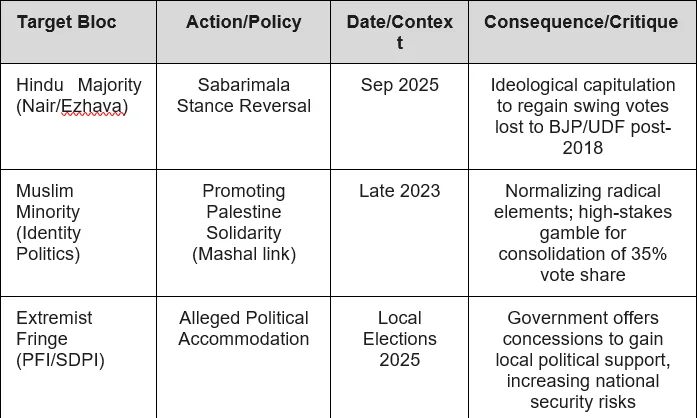
Ahead of the 2026 assembly polls, the LDF executed a stunning “U-turn.” The government has now actively aligned itself with the “sentiments of the devotees,” labeling the contentious issue of women’s entry into the temple as a “closed matter”. This calculated reversal is unequivocally viewed as Chief Minister Vijayan’s “first serious attempt to appease the Hindu-majority vote bank”. Believers consider this change in policy by the Left to be a ploy to capture Hindu votes.
Electoral analysis underscores the necessity of this reversal. Studies following the 2019 Lok Sabha polls showed a sharp decline in the LDF’s traditional Hindu vote base, particularly among the influential Nair community (a slide from 45% in 2016 to just 20% in 2019) and a dip among Ezhava voters. The new thinking within the CPI(M) recognizes that they cannot oppose the sentiments of the vast number of Malayalis who visit Sabarimala. This strategy, therefore, represents a desperate act of social engineering intended to stabilize a critical swing demographic.
The normalisation of cultural nationalism through this imitation strategy grants legitimacy to the majoritarian narrative. By deliberately abandoning the progressive stance on gender equality at Sabarimala, the Marxist party validates the argument that cultural and traditional identity supersedes constitutional mandates when electoral stakes are high. This ideological sacrifice further erodes the distinctiveness that historically separated the LDF from the BJP, lending credence to the observation that secularism in Kerala has devolved into a “passive” and reactive concept.
Symbolic Overtures to Traditional and Spiritual Leadership
Complementing the Sabarimala U-turn, the LDF has undertaken sustained, highly visible outreach efforts to established traditional and spiritual authorities. The CPI(M) State Secretariat has expressed confidence that support from major majority caste organizations, specifically the Nair Service Society (NSS), the Sree Narayana Dharma Paripalana Yogam (SNDP) and the Kerala Pulaya Maha Sabha (KPMS), has “widened LDF’s path to victory” in 2026. This indicates consistent, targeted political engagement beyond standard secular mobilisation.
Furthering this cultural embrace, LDF ministers have engaged in public gestures toward Hindu spiritual figures. Culture Minister Saji Cherian has publicly defended his controversial interaction with Mata Amritanandamayi, dismissing criticism from the Left, which had previously called her a godwoman, a beach Sudhamani, and a fraud, saying that he had surrendered at her feet. He defended his acceptance of the mother’s public physical greeting as “a kiss given by a mother” and that the Kerala Culture Department was honouring the humanitarian work of the spiritual leader Vishwaguru. These actions, particularly the Sabarimala policy shift, align strategically with significant religious events, such as the Travancore Devaswom Board’s (TDB) ‘Global Ayyappa Sangamam’. The planned attendance of the Chief Minister and cabinet colleagues at this event converts a religious celebration into an explicit political endorsement. This dual function seeks both to neutralize the BJP’s most effective cultural campaigning point (Sabarimala) and to rebrand the CPI(M) as protectors of Hindu tradition, thereby confusing and dividing the traditional opposition fronts.
The Perilous Embrace – Minority Appeasement and Extremist Patronage
The LDF’s attempt to regain Hindu support is structurally balanced by the second, equally aggressive axis of appeasement: the consolidation of the Muslim minority bloc, which constitutes nearly 35% of the state’s population. This strategy involves high-risk identity politics deemed “dangerously divisive competitive exhibitionism”.
Competitive Exhibitionism: The Palestine Solidarity Case Study
The intense political competition for the Muslim vote reached a flashpoint in late 2023 with the organization of massive Palestine solidarity rallies. Both the LDF and the opposition UDF participated in this contest, driven by the recognition that neither party can achieve a majority without the active backing of the Muslim community.
The LDF’s participation in the Kozhikode rally was highly controversial due to the rally’s overt endorsement of extremist elements. The event, backed by all Islamic political and religious groups, featured a live virtual address by Hamas leader Khaled Mashal to a crowd exceeding 100,000 people—a privilege reportedly not afforded to a Hamas figure in any other Indian state. This decision elevated a specific religious identity issue above critical national security concern.
During the CPI(M)’s own rally marking the 19th death anniversary of Yasser Arafat (2023 November), Chief Minister Pinarayi Vijayan used the platform to aggressively target the Narendra Modi government, demanding India scrap all military and diplomatic deals with Israel and branding Israel as “one of the biggest terrorist countries,” while accusing the current rulers of India of a “Zionist bias”. The BJP state president K Surendran responded sharply, alleging the CPI(M) had become the “Communist Party of Moulavis” due to the significant presence of Muslim preachers on the dais.
The LDF is leveraging global outrage over Gaza to cement minority loyalty against the perceived majoritarian policies of the central government. However, this strategy normalizes the presence of radical political narratives in mainstream state discourse, resulting in increased communal toxicity and national security risks, given the established alleged links between certain radical groups and international terror outfits. The political payoff—consolidation of the minority bloc—is being pursued at the high cost of increased communal polarization.
Tactical Alliances and Compromises of Radical Groups
The upcoming local body elections (November-December 2025) will serve as the immediate crucible for these tacit communal alliances. Allegations persist that the CPI(M) is engaging in destructive unholy alliances, receiving “political support from the PFI in local elections” and in return providing government support. The CPI(M) has often sought to deflect criticism by accusing the Congress of receiving support from “extremist minority communal forces” such as SDPI, PFI, and Jamaat-e-Islami, illustrating that the use of these blocs is a competitive tactic across both major secular fronts.
Former Union Minister and BJP MP Prakash Javadekar directly accused the LDF government of joining hands with the Popular Front of India (PFI) after its sudden hartal, citing the “complete lawlessness” that ensued. Crucially, Javadekar noted that an LDF MP had publicly defended the PFI against the National Investigation Agency’s (NIA) action, stating that the CPI(M) had not distanced itself from this statement, suggesting the party tacitly supports views opposing counter-terror operations.
The political discourse surrounding the voter list revision exemplifies how the LDF is exploiting national polarization for local communal vote mobilization. The CPI(M) is planning a national seminar to protest the ECI’s voter list revision, explicitly linking the process to the controversial specter of the National Register of Citizens (NRC) and the Citizenship Amendment Act (CAA). The party claims these risks disenfranchising an estimated 50 lakh voters. By bypassing local issues and using national identity-based anxieties (CAA/NCR) as a tool, the LDF creates a powerful ‘us vs. them’ narrative, solidifying its position as the primary political defender of minority rights against perceived central aggression, thereby competing directly with traditional minority political entities like the Indian Union Muslim League (IUML).
The Fragile Christian Axis
In addition to consolidating the Muslim vote, the LDF has pursued targeted outreach to Christian groups, including engaging with Pentecostal pastors and families. This maneuver aims to secure the Christian vote bloc as a strategic counter-balance to the BJP’s majoritarian push and the UDF’s traditional hold over certain Christian denominations.
However, this outreach has been marked by instability and public friction. CPI(M) State Secretary M.V. Govindan publicly attacked Thalassery Archbishop Joseph Pamplany, accusing the prelate of political opportunism and “mood swings” based on his previous statements regarding the BJP. The Archdiocese of Thalassery issued a sharp condemnation of these remarks, labeling them “degrading” and akin to the rhetoric of “fascist forces”. The Church statement explicitly rejected the suggestion that bishops must seek instruction from the AKG Centre (CPI(M) state headquarters) before expressing political views, highlighting the authoritarian nature of the CPI(M)’s expectation of alignment. Such high-profile friction jeopardizes the stability of the LDF’s relationship with the powerful Catholic hierarchy and may force greater compensating outreach toward other groups, such as Pentecostals.
The Ideological Vacuum and The Strategic Risk of Mimicry
The most critical long-term consequence of the LDF’s transactional appeasement strategy is that it inadvertently validates and accelerates the rise of the very force—Hindutva majoritarianism—it claims to oppose.
The Convergence Crisis: LDF and UDF as “Alternating Managers”
The political dynamics in Kerala have shifted fundamentally due to the collapse of ideological distance between the two major fronts. The CPI(M)-led LDF, once anchored in Marxist socialism, and the Congress-led UDF, rooted in liberal centrism, have functionally converged into two large electoral machines. The traditional ideological divide is eroding as both alliances offer highly similar governance models, welfare schemes, and strategies for managing corruption scandals.
The public now sees the LDF and the UDF not as ideological rivals but as “alternate managers of the same governance model.” This view has seriously damaged the public’s trust in the Left and Right fronts. Many voters vote in elections not based on the ideology of these fronts, but on which manager is “less corrupt” or “marginally more efficient”. This ideological vacuum is crucial because it creates a political space that a distinct and ideologically consistent force can take advantage.
BJP’s Exploitation of Ideological Clarity
The Bharatiya Janata Party (BJP) has skillfully positioned itself to fill this vacuum. While the LDF and UDF avoid genuinely polarizing issues or treat secularism as a reactive, rhetorical obligation, the BJP enters the scene with a “starkly different approach,” unapologetically promoting Hindutva—a vision of cultural nationalism grounded in majoritarian identity politics.
The BJP is achieving significant gains through its “practical and scientific ideological clarity.” While traditional fronts offer only empty promises, the BJP provides a clear, emotionally intense narrative that resonates with a segment of the population seeking a sharp identity. For those disillusioned by the sameness of the LDF and UDF, Hindutva provides a sense of meaning. The LDF’s adoption of narrow-minded politics, especially its retreat from its previous stance on Sabarimala, is eroding the idealistic loftiness the Left once held. When the CPI(M) prioritizes electoral survival over its core secular and progressive identity, their actions seem hypocritical. This reinforces the BJP’s argument that secularism in Kerala is just “pseudo-secularism”.
The situation is further complicated by the weaknesses of the Left, which works with the sole aim of political entrenchment or continuity of power. Despite acting as the national leader of the Youth Wing (DYFI), there was widespread criticism surrounding the inclusion of the Chief Minister’s son-in-law, P.A. Muhammad Riyas, in the cabinet immediately after the elections. The allegation that the Left is trying to install his son-in-law in the Chief Minister post of Pinarayi Vijayan is being pointed out as evidence that the Left has abandoned its revolutionary democratic spirit and is degenerating into a dynastic/family-dominated regime. The narrow-minded communal appeasement policies for continued rule are not seen as genuine political moves, but as desperate and pathetic maneuvers of an institution clinging to power amidst serious economic mismanagement.
The Fragmentation Trap (The Thrissur Warning)
The most tangible risk inherent in the LDF’s competitive appeasement strategy is the exacerbation of the secular vote split. The primary goal of both the LDF and UDF is to win the 35% minority vote, leading to a fierce contest that guarantees the remaining majority vote will be fragmented between them.
The recent Lok Sabha elections in Thrissur serve as a “textbook example” of this disintegration trap. The BJP candidate received a disproportionate share of Hindu and Christian votes. In a triangular contest, the BJP secured victory as the CPI(M) and Congress divided the anti-BJP vote, effectively allowing the majority candidate to win with a huge majority. This result reflects a broader structural weakness in the political calculations of secular parties in Kerala. Lack of cooperation, ideological instability, and the lack of a fresh and inclusive narrative make the LDF and UDF vulnerable to the BJP’s unified majoritarian argument. As the LDF’s policy shifts more towards appeasement, it contributes to an environment where the state’s political energy is diverted away from traditional socio-economic issues and towards zero-sum identity politics.
Projected Electoral Consequences (Local Bodies 2025 and Legislature 2026)
The dual-axis appeasement policy employed by the LDF presents a precarious high-stakes gamble with significant and unpredictable electoral outcomes for the 2025 local body polls and the 2026 Legislative Assembly elections.
The 2025 Local Body Elections: A Test of Communal Consolidation
Firstly, the success of the Sabarimala U-turn will be tested in these elections. The election results will reveal whether the significant number of Hindu majority votes (Nairs and Ezhavas) that were lost after 2018 due to the Left’s ideological capitulation have been successfully brought back. If the local vote share continues to be fragmented, the Sabarimala strategy will be considered a failure and a reassessment will be required before 2026.
Secondly, the local body elections are the most crucial level for local political convergence. It remains to be seen whether the strategic CPI(M)-PFI/SDPI ties will bear fruit. If the political convergence of key influencers in wards, panchayats and blocks yields immediate gains, the LDF will intensify this high-risk communal strategy in 2026.
Third, the elections will test the stability of the LDF’s Christian outreach, especially in central Kerala, following its public spat with Archbishop Pamplani. The significant shift of traditional Catholic votes to the UDF indicates the failure of the LDF’s attempt to secure a Christian constituency.
2026 Assembly Election Predictions
The 2026 elections hinge on the LDF’s ability to manage the risks inherent in the Left’s contradictory policy. If the LDF successfully consolidates minority votes through aggressive polarization (for example, using the fear generated by the CAA/NCR narrative and a strong identity focus on Palestine), it could lead to a strong counter-polarization and consolidation of the Hindu majority behind the BJP.
The structural weakness of the secular divide remains a crucial factor. While the LDF and UDF are engaged in a fierce contest for minority votes, the majority votes are more easily exposed to the BJP’s expansionist efforts. The more the LDF relies on communal appeasement that sacrifices basic ideological principles, the more legitimate the BJP’s justified majoritarian claim becomes.
Moreover, the bedrock of economic distress and media suppression provides a strong foundation for anti-incumbency sentiment. The communal appeasement strategy, aimed at providing temporary political oxygen, increases the public perception that the LDF is an unprincipled regime, adding a layer of moral anti-incumbency sentiment to the existing economic crisis.
This strategic shift represents a compromise: the LDF is sacrificing its reliable and traditional cadre-based election campaign model (exemplified by the disciplined and hard-working organizational system rooted in the Chief Minister’s Kannur background) for unpredictable and high-profile communal mobilization. This move introduces volatile and emotional elements that are difficult for the traditional Marxist party system to manage, thus increasing the potential for internal ideological conflict and organizational instability before 2026.
Communalisation of Kerala – a strategy of despair
The LDF’s electoral strategy for 2025-2026 election victory is a contradictory and high-risk strategy driven by administrative despair rather than ideological integrity. The financial mismanagement and growing anti-incumbency sentiment that undermine the state’s progress have forced the CPI(M) to engage in a two-pronged appeasement. The cultural capitulation to the Hindu majority through the Sabarimala policy change and the aggressive and polarizing identity politics that flirt dangerously with extremist elements in the minority community show the decline of the Left.
This formulation of a “politics of communal appeasement” will cause permanent damage to Kerala’s globally praised secular ethos. By strategically adopting religious and cultural appropriation and abandoning progressive positions – by eliminating the ideological distance between the majority forces and themselves, the LDF is inadvertently validating the BJP’s narrative and preparing fertile ground for the development of majoritarian politics.
Whoever wins in 2026, the long-term social degradation is immense. By normalizing communal appeasement, the LDF and the UDF are prioritizing short-term electoral mathematics over long-term communal stability. The CPI(M), once the ideological anchor of the Left, has reduced itself to an incumbent-backed electoral machine willing to sacrifice progressive values and communal unity for a desperate bid for a third term.
Therefore, the opposition’s strategy must go beyond mere allegations of corruption and focus on the deep ideological betrayal inherent in the LDF’s communal machinations. It must articulate a coherent and inclusive secular vision for Kerala that clearly rejects the transactional and destructive identity politics currently practiced by the two dominant fronts.
BJP’s bright future in Kerala Politics
The Bharatiya Janata Party (BJP) is gradually gaining momentum in Kerala’s political landscape, a state historically dominated by the Indian National Congress (INC) and the Left Democratic Front (LDF). The party’s strategic initiatives, including grassroots outreach and targeted campaign strategies, are beginning to resonate with a populace increasingly disillusioned with traditional political alliances. The BJP’s emphasis on development and governance, which contrasts with the regional parties’ often divisive tactics, positions it as a viable alternative that appeals to a broad spectrum of voters.
Moreover, the BJP has successfully enhanced its communication channels and utilized social media to engage with younger demographics. By promoting issues that resonate with the youth, such as employment, education, and technology, the party is redefining its image from a predominantly North Indian entity to a pan-Indian party capable of addressing local concerns. This rebranding effort has the potential to win over first-time voters and those seeking a fresh political narrative, thus expanding the BJP’s base in Kerala.
The BJP’s commitment to cultural nationalism also plays a pivotal role in its appeal. By fostering a sense of pride in Kerala’s rich heritage while integrating it with the broader narrative of Indian civilization, the party positions itself as a defender of both local and national identity. This dual-focus approach can attract voters disenchanted with the perceived neglect of Kerala’s unique cultural needs by the incumbent parties.
The BJP’s “Developed Kerala” campaign will be able to neutralise the evil propaganda of the Left and Right fronts based on religious, caste and communal appeasement and gain massive support from the masses with progressive views. If the BJP front’s voting percentage increases to 25 per cent, it can become the ruling party or the main opposition in the next assembly elections. It is known that major secret moves are being made under the leadership of Amit Shah to bring other prominent parties in the fronts of the prominent parties in Kerala, such as the CPI(M) and the Congress, as well as various Christian-Muslim religious groups and Hindu caste organizations, closer to the BJP. If these crucial moves bear fruit, the Left’s only remaining state rule in India (Kerala) will definitely end forever in the next assembly elections. Along with this, the influence and infallibility that the Congress had in Kerala politics and administration will disappear. With the loss of power at the Centre and in the state, the Hindu-Christian-Muslim sections of the population who blindly supported the Congress will flock to the BJP, which has been ruling the Centre without discrimination for the last 11 years. Raising the income tax limit to 12 lakhs, reducing the GST from 28 per cent to 5 per cent & 12 per cent, building several new national highways, starting Vande Bharat trains, providing free housing – gas connection – medical insurance to the poor, all to those who are eligible, regardless of their caste, religion or politics, will help the BJP get more votes. The massive looting that has been going on in Sabarimala and various temples under the Devaswom Board under the Left government for the last twenty years will make believers of all religions think and protest against the atheist Left.
Since the Left rule of the last ten years has made the daily life of the people a living hell, even the staunch Left cadres are in a position to support the BJP. Due to the one-sided Muslim communal appeasement policy, Hindu and Christian religious believers will reject the Left and welcome the BJP. People will no longer blindly believe the Left’s communal propaganda as they did in the past. Modern Malayalis have acquired the ability to recognize local, national and international developments and respond intelligently. The pathetic failure of the Left and Right parties and the rise of the BJP can now be seen in Kerala politics.











Comments