





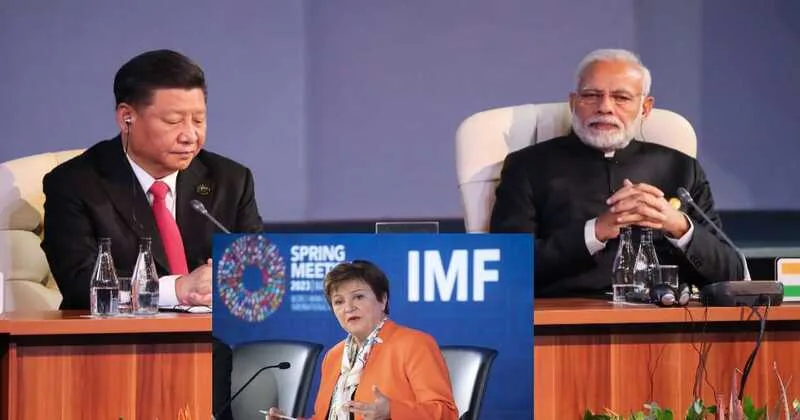
India’s economy is set to surprise critics this year and the next with robust growth, said International Monetary Fund (IMF) Managing Director Kristalina Georgieva. Describing India as the “growth engine of the world,” she emphasised that the country continues to shine even as several major economies weaken. Speaking at the IMF–World Bank Annual Meetings in Washington, Georgieva attributed India’s strong performance to a series of structural and economic reforms implemented in recent years. The IMF reaffirmed its confidence in India’s resilience, projecting that the nation will remain the world’s fastest-growing major economy, expanding by 6.4% in both 2025 and 2026. This marks an upward revision from its earlier estimates of 6.2% and 6.3%, respectively, a significant gain for India amid global uncertainty.
The World Bank has also reinforced its upbeat view of India’s economic trajectory. India’s GDP grew by 7.8% in the first quarter (April–June) of the current financial year (2025–26), and is expected to sustain a near 7% growth in the second quarter (July–September). According to the IMF, this momentum is being driven by robust domestic consumption, expanding service exports, and policy continuity. Structural reforms such as the Goods and Services Tax (GST) are strengthening the consumer market and improving fiscal transparency. Reflecting this optimism, the World Bank raised its growth forecast for India for the current year from 6.3% to 6.5%, citing rising private investment and government-led infrastructure spending. Adding to the positive outlook, the IMF lowered its inflation forecast for India for the current fiscal year from 4.2% to 2.8%, signalling easing price pressures and potential relief in essential commodity prices. This decline in inflation expectations is seen as a stabilising factor for both consumers and businesses.
China and global powers trail behind, trade war clouds world markets
India’s nearest economic rival, China, is forecast to grow by only 4.8% in 2025 and 4.2% in 2026, underscoring the widening gap between the two Asian giants. The United States, meanwhile, is expected to post a modest growth of 1.9% in 2025 and 2% in 2026. Global economic growth, according to the IMF, will slow to 3.2% in 2025, down from 3.3% in 2024 and a pre-pandemic average of 3.7%. The figure is expected to dip further to 3.1% in 2026, reflecting persistent headwinds in trade and debt management. The IMF noted that the tariff war reignited by the US President Donald Trump has severely disrupted global trade, resulting in rising debt burdens and declining investor confidence. These setbacks, it warned, will continue to weigh on the global GDP outlook. Adding to this sentiment, US Treasury Secretary Scott Bessant remarked that “China is weakening and dragging others down with it,” in response to Beijing’s decision to impose export restrictions on rare earth minerals, a move that has heightened tensions in the global supply chain.
However, the broader global economy continues to grapple with the repercussions of the renewed US–China trade war, which has sparked volatility across financial markets. Trump’s recent social media post announcing 100% additional tariffs on Chinese goods triggered a sell-off in the US markets, wiping out nearly $2 trillion (approx. ₹170 lakh crore) in stock value. The uncertainty has rippled through the futures markets, the Dow Jones Industrial Average edged up by only 11 points, while S&P 500 and Nasdaq 100 futures remained flat. Both countries have since raised port fees, with China retaliating by restricting rare earth exports and blacklisting five US companies in South Korea. Beijing’s suspension of US soybean purchases has further strained relations, drawing an angry response from Trump. China has warned that it will respond “in kind” to any further escalation and accused Washington of “double standards.”
Despite these tensions, Asian markets showed signs of resilience, buoyed by Trump’s later statement that there was “no need to worry” and that talks with China would resume soon. Expectations are rising for a potential meeting between Xi Jinping and Trump, which could ease global tensions. Japan’s Nikkei index rose 0.99%, while Shanghai Composite gained 0.46% and Hong Kong’s Hang Seng advanced 1.53%. In Europe, the FTSE 100 rose 0.10%, though Germany’s DAX slipped 0.62%. China’s consumer price index (CPI), meanwhile, fell 0.3% in September, a sharper drop than analysts’ forecast of 0.2%, underlining the deepening crisis in the Chinese economy.
Indian markets poised for a rebound
Back home, India’s stock market is showing early signs of strength. The GIFT Nifty advanced by 90 points in morning trade, indicating that the Sensex and Nifty could open on a positive note. Analysts believe that the growing consensus that the US–China trade dispute may not last long has restored investor confidence.
Further optimism stems from the revival of India–US trade agreement talks, which had stalled amid global trade disruptions. A series of corporate earnings announcements is also expected to shape market sentiment today. Companies including Axis Bank, HDFC Life, L&T Finance, HDB Financial, and Angel One will release their September quarter results. Additionally, the Indian Railway Finance Corporation, Mangalore Refinery, Muthoot Capital, Tata Communications, and Network 18 Media are scheduled to announce their quarterly earnings later today.
On Tuesday, Tech Mahindra reported a 4.4% drop in profit, though its revenue rose 5.1%. ICICI Lombard posted an 18.1% profit increase and a 12.5% rise in total income, alongside an interim dividend of ₹6.5 per share. Investors are also awaiting the minutes of the Reserve Bank of India’s Monetary Policy Committee (MPC) meeting, as well as unemployment and retail sales figures for automobile companies. Newly listed LG Electronics surged up to 50% on its debut, offering bumper gains to investors.
Gold rises, oil declines
Gold prices are soaring amid global economic uncertainty, the US government shutdown, and the Federal Reserve’s hint at further interest rate cuts. The international gold price hit an all-time high of $4,186.57, before settling at $4,171 — a gain of $57. Analysts expect prices to rise in the Indian market. Conversely, crude oil prices have slipped, benefiting oil-importing countries like India, which relies on imports for 90% of its consumption. Fears that the trade war may dampen global demand, combined with OPEC+’s decision to raise output, have intensified worries of oversupply. WTI crude fell 0.26% to $58.55, while Brent crude declined 0.29% to $62.21. The Indian rupee weakened slightly, closing 13 paise lower at ₹88.81 per dollar on Tuesday, though traders expect a modest recovery today as market sentiment improves. As the global economy wavers under trade tensions and inflationary pressures, India’s steady growth, low inflation, and policy reforms position it as a beacon of economic resilience. Both the IMF and World Bank agree that India is not just weathering global turbulence, it is driving global growth forward.













Comments