





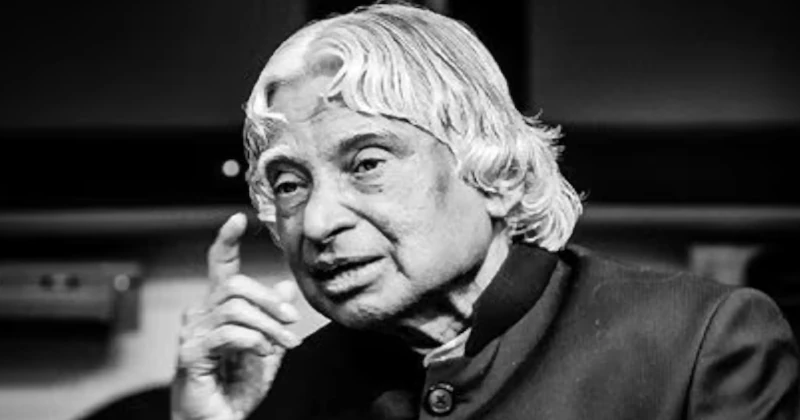
“Ignited minds of the youth are the most powerful resource on the earth, above the earth, and under the earth.” These immortal words of Dr APJ Abdul Kalam echo across time, reminding the nation that its truest wealth lies not in its minerals or monuments, but in the imagination and determination of its youth. On this day October 15, India celebrates World Students’ Day to honour the birth anniversary of Bharat Ratna Dr. Avul Pakir Jainulabdeen Abdul Kalam, the 11th President of India, revered scientist, visionary teacher, and the man who taught India to dream beyond the horizon.
Though the United Nations does not officially recognise October 15 as World Students’ Day (it observes it as the International Day of Rural Women), for India, this day has transcended formal recognition. It has become a day of national introspection a reminder of the man who inspired millions to rise above limitations, to replace fear with faith, and to build an India that is self-reliant, scientific, and spiritually grounded.
Born in 1931 in Rameswaram, Tamil Nadu, to a modest boat-owner’s family, Kalam’s life journey was one of relentless pursuit against all odds. He grew up amidst simplicity and struggle, selling newspapers to support his education. Yet, he carried within him an unshakable belief: that knowledge, when coupled with discipline and vision, could change one’s destiny and the destiny of a nation.
This belief became his lifelong mission. After graduating in aeronautical engineering from the Madras Institute of Technology, Kalam joined the Defence Research and Development Organisation (DRDO) and later the Indian Space Research Organisation (ISRO). His role as Project Director of India’s first indigenous Satellite Launch Vehicle (SLV-III), which successfully placed the Rohini Satellite into orbit in July 1980, was a defining moment in India’s scientific history. It not only made India a member of the elite Space Club but also marked the beginning of India’s journey towards technological self-reliance.
He later spearheaded India’s missile development programme, leading to the operationalisation of the Agni and Prithvi missiles, strategic milestones that earned him the title “Missile Man of India.” His ability to unify scientists across disciplines and institutions created an ecosystem of indigenous innovation, ensuring that India no longer had to depend on others for critical defence technology.
When Dr Kalam assumed the office of President of India in 2002, he transformed the Rashtrapati Bhavan from a ceremonial residence into a beacon of hope and inspiration. He brought warmth, accessibility, and purpose to the highest constitutional post, making it a platform for engaging with the nation’s youth.
He travelled tirelessly addressing students, visiting small towns, and meeting children with the same sincerity he would extend to world leaders. For him, every student was a spark waiting to be ignited. His presidency was defined by a singular mission: to remind India that its greatest potential lay in its young minds.
He envisioned India as a developed nation by 2020 a dream that combined technology with ethics, progress with compassion, and innovation with integrity. To him, development was not merely economic but moral a vision of a nation led by enlightened citizens.
“A developed India will be one where governance is transparent, education is universal, and poverty is eliminated not by charity, but by opportunity,” he had once said — a vision that continues to inspire policymakers, scientists, and teachers alike.
On Dr Kalam’s birth anniversary, Prime Minister Narendra Modi paid heartfelt tribute, writing on X:
“Remembering Dr APJ Abdul Kalam Ji on his birth anniversary. He is remembered as a visionary who ignited young minds and inspired our nation to dream big. His life reminds us that humility and hard work are vital for success. May we continue to build the India he envisioned an India that is strong, self-reliant and compassionate.”
https://twitter.com/narendramodi/status/1978291330418622968
PM Modi’s words resonate with the very ideals Kalam stood for “strength with humility, progress with purpose.” In an era of uncertainty and global turbulence, Kalam’s message feels even more urgent: that India’s true power lies not in weapons or wealth, but in the self-belief of its people.
Despite his towering achievements, Dr. Kalam never saw himself as a politician or bureaucrat. His heart remained in the classroom. “Teaching is my passion. When I see young people, my spirit gets ignited,” he often said. And indeed, till his last moment, he lived by that creed.
On July 27, 2015, Dr. Kalam collapsed while delivering a lecture at the Indian Institute of Management, Shillong addressing students on the theme of creating a “livable planet.” He passed away doing what he loved most: inspiring young minds. His death was a profound national moment not of loss, but of gratitude. A teacher had completed his final lesson.
Dr Kalam’s literary works “Wings of Fire,” “Ignited Minds,” “India 2020,” “Mission India” continue to be guiding lights for students and dreamers. In “Ignited Minds,” he wrote, “Dreams are not what you see when you sleep; dreams are those that don’t let you sleep.”
He challenged India’s youth to break barriers of caste, region, and circumstance, and to dream collectively for a stronger nation. His books, often read in classrooms across India, remain a manifesto for young visionaries who believe that change begins from within.
World Students’ Day is not merely a date on the calendar. It represents a philosophy that the youth are not the leaders of tomorrow; they are the strength of today. The day celebrates education not as a privilege, but as a power; it reaffirms that the future of India depends on how fearlessly its young citizens dream, learn, and act.
Kalam’s belief was clear “A nation’s best brains are found in its villages and classrooms, not in its boardrooms.” His commitment to nurturing these minds led him to interact with millions of students, encouraging them to become scientists, innovators, teachers, and reformers individuals who would build the India of his dreams.
Even a decade after his passing, Dr. Kalam’s legacy remains alive in ISRO’s missions that continue to soar into space, in the young innovators emerging from India’s schools, and in every student who dares to dream beyond their circumstances.
He once said, “If you want to shine like the sun, first burn like the sun.” That sentence sums up not just his life, but his message to India that greatness demands grit, and progress demands purpose.















Comments