





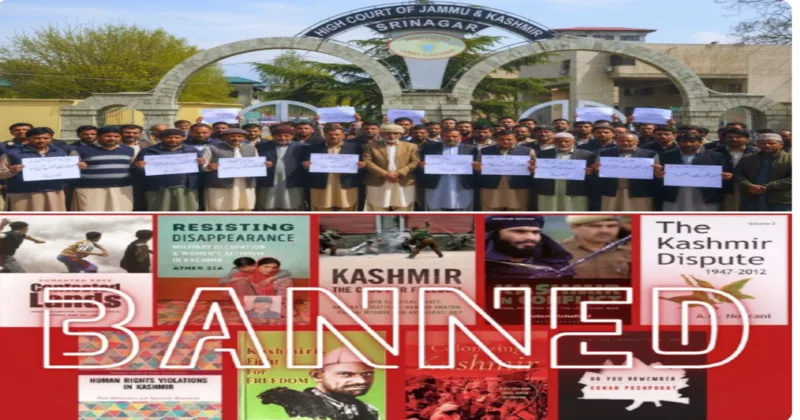
Jammu: The Jammu, Kashmir and Ladakh High Court has refused to give interim relief (stay) in pleas challenging the forfeiture of 25 books under Section 98 Bhartiya Nyaya Sanhita (BNS) for allegedly propagating secessionism. A three-judge special Bench comprising Chief Justice Arun Palli, Justice Rajneesh Oswal and Justice Shahzad Azeem declined interim relief but issued notice on the pleas.
The Bench, however, declined to issue notice on a Public Interest Litigation (PIL) on the issue, stating that the same was not in “public interest’’ and that “90% of people would not understand the issue being raised’’ before the court. The hearing was heard in response to case titled Swastik Singh versus Union Territory (UT) of J&K (Home Department) and related petitions.
Several petitions had been filed on August 5 challenging a notification issued by the UT government declaring 25 books on Jammu & Kashmir’s political and social history as “forfeited” under Section 98 BNS for allegedly propagating secessionism. The list of these books was circulated widely so that these books would be turned in by those who held them.
Section 98 grants the state governments power to declare certain publications forfeited and to issue search warrants for the same. The notification, published in the official Gazette, declared the 25 listed books as forfeited for allegedly “propagating false narratives and secessionism”. The petition, filed under Section 99 read with Section 528 BNSS by Air Vice Marshal (Retd.) Kapil Kak, author Dr. Sumantra Bose, peace scholar Dr. Radha Kumar, and former Chief Information Commissioner Wajahat Habibullah, assails the notification issued by the Home Department of the government of J&K.
Incidentally, the petitioners had first gone to the Supreme Court but it sent them to the J&K, and Ladakh High Court. This had led to the formation of a Special Bench to hear all the petitions on the issue together. The court has now listed the case for final hearing on December 4 when it is likely to be heard in the Jammu wing.
Ban Background
In their petition, the authors and public figures contended that the impugned order was arbitrary, sweeping, and unreasoned, failing to meet the legal requirements under Section 98 of BNSS. They have argued that the notification does not identify any specific portions of the books to demonstrate how they allegedly propagate secessionist narratives, nor does it provide a reasoned basis for forfeiture.
The petition states that the order merely reproduces statutory language “without indicating any facts, passages, or representations from the books that purportedly offend the law”. They cited the Supreme Court’s ruling in Narayan Das Indurakhya v. State of Madhya Pradesh (1972), which held that quoting statutory provisions without disclosing underlying grounds does not satisfy the requirement of a reasoned order. This argument, the reference to an apex court, is the fulcrum of seeking quashing of the government order.
The petition emphasizes the distinction between the ‘opinion’ of the government and the ‘grounds’ for forming that opinion, noting that the latter must be discernible from the order itself. Reliance is placed on precedents such as Harnam Das v. State of Uttar Pradesh, and Arun Ranjan Choudhury v. State of West Bengal, which held that grounds must relate to the “import, effect, or tendency” of the publication as demonstrated by excerpts or content analysis.
The impugned notification states that “systematic dissemination of false narratives and secessionist literature” has contributed to youth radicalisation in J&K by glorifying terrorism, vilifying security forces, distorting historical facts, and promoting alienation. It declares the listed books as “forfeited” under Section 98 BNSS, alleging that they “excite secessionism and endanger the sovereignty and integrity of India”, thereby attracting provisions of Sections 152, 196, and 197 of the Bharatiya Nyaya Sanhita, 2023 (BNS).
The list of 25 books includes works by scholars and writers such as Sumantra Bose, A.G. Noorani, Arundhati Roy, Seema Kazi, Hafsa Kanjwal, and Victoria Schofield, many of which are published by leading academic presses like Oxford University Press, Stanford University Press, and Routledge.
Senior Advocate Rajiv Shakdher, Senior Advocate Shuja ul Haq, Vrinda Grover and others appeared on behalf of the petitioners.













Comments