





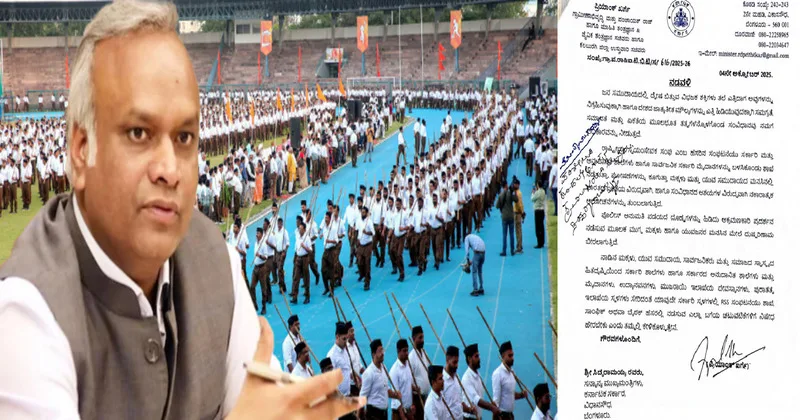
Bengaluru: As the Rashtriya Swayamsevak Sangh (RSS) marks its centenary year with a nationwide celebration of discipline, service, and patriotism, the Congress-led Karnataka government has triggered a storm of controversy. An official letter written by Minister Priyank Kharge, son of Congress president Mallikarjun Kharge, to Chief Minister Siddaramaiah, has demanded a complete ban on RSS activities in government institutions, parks, and temples.
The letter, dated October 4, was made public by the Chief Minister’s Office on October 12. Following this, CM Siddaramaiah directed Chief Secretary Shalini Rajnish to examine the matter and take “appropriate action.” This official move has been widely interpreted as the government’s preparation for an undeclared emergency against the century-old patriotic organization.
Priyank Kharge’s charge — ideological or political?
In his letter, Priyank Kharge alleged that RSS branches were being held without permission in government-aided institutions where, according to him, volunteers “raise sticks and spread hatred among children.” Calling these activities unconstitutional, he demanded their immediate halt.
This is not his first attack on the RSS. Earlier this year, Kharge had said that if Congress came to power at the Centre, it would “ban RSS nationwide under due legal process.” His remarks had then drawn sharp criticism from the BJP, which accused him of harbouring an anti-Hindu mindset.
Now, with this letter gaining official status, the Congress government’s intentions appear to have gone beyond rhetoric, translating into administrative action against the Sangh.
The resilient history of RSS under bans
The history of RSS is testimony to its resilience.
First Ban (1948): After Mahatma Gandhi’s assassination, the Nehru government banned the RSS on February 4, 1948, citing alleged links with Nathuram Godse. Eighteen months later, an inquiry cleared the organization, and the ban was lifted on July 12, 1949.
Second Ban (1975): During Indira Gandhi’s Emergency, the RSS was again outlawed. Thousands of volunteers were jailed, yet it emerged stronger after 1977, contributing decisively to the formation of the Janata Party government.
Third Ban (1992): After the Babri Masjid demolition, the Narasimha Rao government banned the RSS, VHP, and Bajrang Dal, but the order was quashed by the court in 1993 for lack of evidence.
Each time, the RSS faced the bans peacefully, without resorting to violence. Its strength has always come from service and nation-building. From aiding soldiers during the 1962 Indo-China war to organizing relief during floods, earthquakes, and the Covid-19 pandemic, RSS volunteers have stood on the frontlines of national service.
In the wake of Priyank Kharge’s letter, social media platforms have been flooded with the hashtag #BanRSS, largely promoted by left-leaning and Islamist groups. The narrative paints the RSS as “fascist” and “Hindu nationalist,” but observers note that such coordinated campaigns reflect an ideological attempt to weaken India’s largest socio-cultural organisation.
RSS shakhas—morning gatherings in schools, parks, and temples—focus on physical training, yoga, discipline, and social harmony. They have no political activity. The motto “Sarve Bhavantu Sukhinah” (May all be happy) represents the Sangh’s inclusive vision. Opposition to these gatherings, therefore, appears rooted not in concern for law or constitutionality, but in ideological discomfort with the Sangh’s growing social influence.
Political motives and internal strife
Political analysts suggest that this move by the Congress government may be a diversion from internal conflicts between CM Siddaramaiah and Deputy CM D.K. Shivakumar, as well as growing public criticism over corruption, power shortages, and crime rates. Targeting RSS, which enjoys vast grassroots support, could serve as a calculated political distraction.
The RSS has spent a century building national unity across caste, class, and region. Through initiatives like Seva Bharati, Vanvasi Kalyan Ashram, and Samarasata Abhiyan, it has uplifted Dalits, tribals, and marginalized groups—areas long ignored by political parties.












Comments