





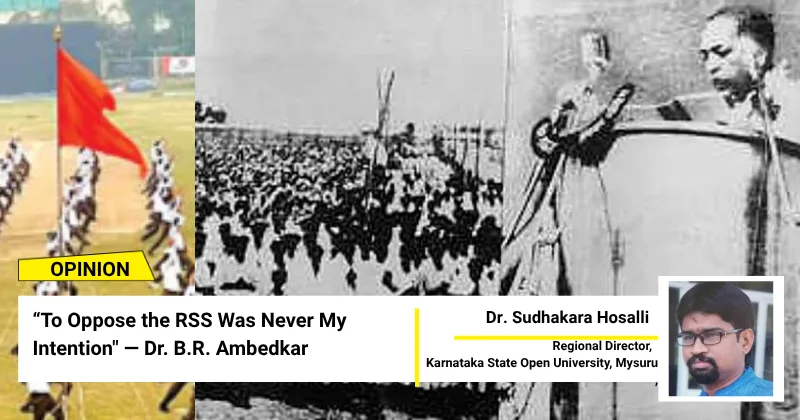
Vijayadashami in 2025 assumed a greater significance than in previous years. Traditionally, Vijayadashami has always been celebrated as a symbol of the valour, heritage, and cultural spirit of this land — a festival rooted in the ethos of resistance against injustice and the assertion of self-respect.
This year, its importance was further elevated by a historic milestone — the Rashtriya Swayamsevak Sangh (RSS) completing its 100th year.
From its inception, without deviation, without desire for power, the RSS has steadfastly moved towards its objective. Rarely in history has there been such an organisation — consistent in purpose, unwavering in discipline, and continuing its work without interruption. Yet, attempts to fracture, discredit, or dismantle this organisation have repeatedly surfaced in various forms.
Deliberate narratives have been crafted over time to create a negative perception of the RSS at a global level. In order to diminish its stature, the names of venerable thinkers and national icons have been selectively misused. Among those most misappropriated was the architect of the Indian Constitution, Dr. B.R. Ambedkar.
Efforts were made to portray Dr. Ambedkar — who dreamt of an equal and harmonious society and devoted his life to that cause — as someone fundamentally opposed to the RSS. This was not merely an ideological ploy to create distance between Ambedkar and the RSS but a strategic attempt to widen the gap between the RSS and society at large.
One of the chronic tendencies of the Left has been this: whenever Dr. Ambedkar’s thought stands in contradiction to their ideological impositions, they do not hesitate to sideline Ambedkar himself. In this context, as the RSS steps into its centenary, it becomes necessary — both from a social and scholarly perspective — to examine the actual relationship between Dr. Ambedkar and the RSS through documented, verifiable sources rather than manufactured political narratives.
Evidence proves that Dr. Ambedkar, who always upheld the national interest and dignity of India, appreciated the RSS for its commitment to national unity and social harmony. He regarded it with respect and acknowledged its disciplined social vision.
“I Never Intended to Challenge the RSS” — Dr. Ambedkar’s Own Words”
When Dr. Ambedkar chose Nagpur — the founding ground of the RSS — as the venue for embracing Buddhism along with his followers, a rumour was circulated that this was a deliberate act intended as a challenge to the RSS.
However, Dr. Ambedkar himself clarified this in his Collected Works, Volume 18, page 724: “Some people are spreading the message that I chose Nagpur for the Buddhist conversion ceremony to challenge the RSS. This is utterly baseless and a complete falsehood. The event at Nagpur has no relation whatsoever to such misguided assumptions. I have never had any plan or intention to challenge the RSS.”
“The Ban on RSS Was Unconstitutional”
Several attempts were made to curtail the growth of the RSS. On November 30, 1966, the then Central Government issued an official order prohibiting government officials and employees from participating in RSS activities. However, on July 9, 2024, the present Central Government officially withdrew this restriction, declaring that participation of government employees in RSS activities is neither unconstitutional nor illegal.
This raises an important question: Did government employees truly stay away from the RSS all those years? In reality, many who held high positions in the government were also deeply involved in the organisation, contributing with dedication even during the period of prohibition. Thus, the ban itself stands exposed as an unfortunate and unjust act.
RSS and the Defence of the Constitution
From the beginning, one of the strongest ideological challenges to the Constitution has been the insistence of certain groups that Sharia law supersedes the Constitution. While such voices emerged, it is noteworthy that on January 26, 1950, the first Republic eve, the second Sarsanghchalak of the RSS, Madhav Sadashivrao Golwalkar, addressed a mammoth public meeting attended by thousands of people from all shades of opinion. He said, “Today, a constitution made by ourselves has been adopted, and even the last link with the British Commonwealth—the Crown, a symbol of British rule—has been replaced by the Ashoka Chakra. We are now no longer bound to the British, morally or politically, and are free to do what our conscience tells us to do.”
Statistically too, the RSS has stood firm on constitutional values. Out of the total 106 constitutional amendments, 76 were made under Congress-led governments, of which only 11 were in favour of the oppressed and marginalised. The controversial 42nd Amendment — which distorted 56 provisions across the Constitution in a single move — was pushed through in direct contradiction to Dr. Ambedkar’s constitutional vision.
It was with RSS support that the Jan Sangh-led government reversed several arbitrary provisions through the 44th Amendment. Later, the BJP-led government — the political wing of the RSS — introduced 22 amendments, 9 of which were specifically directed at the welfare of Scheduled Castes and marginals. This same government also removed Article 370, which stood against constitutional equality, and officially declared November 26 as Constitution Day to inspire constitutional awareness among youth.
Social Harmony: A Shared Vision of Ambedkar and the RSS
Social harmony — a principle Dr. Ambedkar most passionately advocated — has been adopted as a core mission within the RSS. While governments have hesitated to directly confront the caste system, the RSS has initiated numerous programmes to root out caste divisions. It remains one of the few organisations in India that brings people together without asking their caste or identity.
At present, the RSS conducts: 83129 daily shakhas, 32147 milan centres, and 12, 091 mandali shakhas are running across the country, all fostering unity beyond caste and creed.
“I Saw the India of My Dreams Here” — Dr. Ambedkar at an RSS Camp
On May 12, 1939, Dr. B.R. Ambedkar visited an RSS training camp held at Bhave School grounds in Pune. The diary entries of labour leader Bala Saheb Salunkhe — an MP elected from Ambedkar’s Scheduled Caste Federation — recorded in the book Hamare Saheb, document the following:
“When I entered the camp, I asked a swayamsevak whether members of the Scheduled Castes were present. He replied, ‘There are no Scheduled Castes here — only Indians.’
Observing closely, I saw young men of all communities living and working together with discipline and brotherhood. The atmosphere, the orderliness, the spirit — everything reminded me of a well-organised army. I have spoken at length with Dr. Hedgewar earlier on equality and national reconstruction, but today, seeing this discipline with my own eyes, I feel hopeful.
This is the India I have dreamt of. I am confident this organisation will reach every village and enlighten the future of India. I congratulate Dr. Hedgewar and all of you.
Bharat Mata ki Jai.”
A Civic Vision for the Future
As it enters its centenary celebrations, the RSS has laid out five transformation missions, one of which is Civic Discipline. Its essence is this: Every citizen must willingly uphold constitutional duty and national responsibility. To this end, a nationwide movement has been launched.
The RSS is not merely an organisation working for discipline or Hindu cultural revival. It is an institution committed to strengthening nationalism, protecting constitutional authority, enforcing civic duties, and safeguarding the values of the Republic.
The supposed divide between Ambedkar and the RSS — forcefully constructed in past decades — is steadily narrowing, not widening.















Comments