





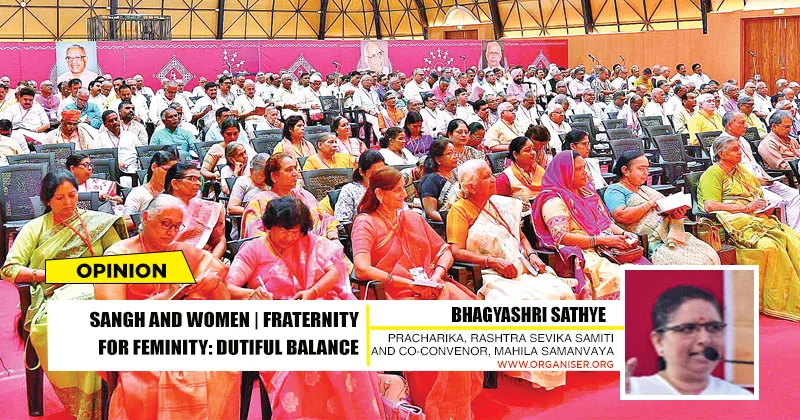
The fundamental thought of Bharatvarsha is the mutual complementarity of women and men. Just as Shiva and Shakti together signify completeness, the development of society is possible only through the collective efforts of both women and men. This same sentiment is clearly visible in the philosophy of the Sangh as well.
A Collective Endeavour
On the occasion of the Sangh Centenary, discussions are taking place across Bharat on various aspects of the Sangh — its history, its Vijayadashami programmes, its present work, and its contributions. Among these, one important subject of discussion is “the Sangh and women.” With this in mind, I thought of expressing my views.
An incident served as the inspiration for writing this article. A few days ago, six well-organised route marches (Path Sanchalans) of the Rashtra Sevika Samiti took place in Pune. I got into a car to go to the assembly point, driven by a Sangh Karyakarta. There were five other Sevikas (Samiti Karyakartas) in the car. While driving, the Karyakarta told his wife, “Next year, if the driver is also a woman, then one more sevika will be added to your march.” Further, he said, “Next time, we will try and contact at least 15 women from our society to participate in the march.” At that moment, it struck me — thousands of Sangh Karyakartas like him must be thinking about increasing women’s participation, which is why our work has become so vast today. Many workers play such an effective, supportive role that, in jest, we call them “the Swayamsevaks of the Samiti!”
Today, inspired by the Sangh, 32 organisations are actively working in various fields of society, of which 31 have the participation of both men and women. The increasing involvement and active participation of women that we see in different fields today is as much due to the role of men as it is of women. Throughout Bharat’s history, social reformers such as Maharshi Karve, Dayanand Saraswati, and Jyotiba Phule made great efforts to overcome women’s problems. Complementarity has been the tradition of our country, and the work of the Sangh carries this tradition forward.
Dr Hedgewar’s Vision
The subject of the Sangh’s contribution to women’s work begins with the life of the revered founder of the Sangh, Dr Hedgewar. Whether it was fundraising for Maharshi Karve’s Women’s University or approving widow remarriage, Dr Hedgewar played an active role. He suggested the venerable Lakshmibai Kelkar, founder of the Rashtra Sevika Samiti, to establish an independent organisation for women. Not only this, he assured her of full support in this endeavour, a support that continues to this day. While designing the programmes of the Samiti, he emphasised that they should be aligned with the natural disposition of women. This shows Dr Hedgewar’s progressive vision regarding women.
The tenth and eleventh verses of the Sangh’s Ekatmata Stotra (Integration Prayer) describe 15 women of Bharatvarsha whom the Swayamsevaks remember daily. This remembrance surely inspires them to involve women from their own families in social work. The transformation of society begins with one’s own family. There are thousands of Swayamsevaks who brought their mother, wife, daughter, or sister into social work, encouraged them, and made them active participants.
A Tradition of Support and Security
Often, transportation and commuting pose a challenge for mothers and sisters. Whether it’s the Samiti’s Shakhas, Sanskar Kendras, service activities of organisations, various programmes, or meetings, it is the brothers who undertake the task of taking the women to and from the venue. Sometimes meetings run late into the night, and the Swayamsevaks take complete responsibility for ensuring that all the women reach their homes safely.
In the early days of the Samiti, the physical training and Ghosh Vadan (band playing) were taught by the Swayamsevak brothers. One of the objectives of physical training is “self-protection.” Once, a sister from the Akhil Bharatiya Vidyarthi Parishad (ABVP) recounted that during a student agitation at a college, a minor scuffle broke out. The male students of the ABVP immediately surrounded the participating female students to protect them from any harm, bearing the consequences themselves. Such incidents reflect the spirit of complementarity.
On this auspicious occasion of the Sangh’s centenary, this is a grateful remembrance of those countless Swayamsevaks who encouraged the women in their families and organisations and stood as their support at every step. For the Sangh, women’s respect, women’s safety, and women’s self-reliance are not mere slogans but a matter of living practice. When women and men work with equal pace, equal devotion, and equal purpose, the glorious picture of the nation will be ensured.















Comments