





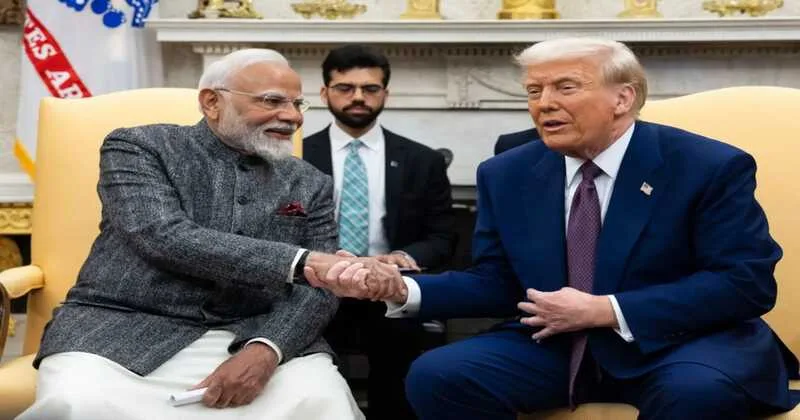
In a remarkable turn of global diplomacy, US President Donald Trump’s successful “Gaza peace deal” has created a fresh opening for resolving long-standing trade frictions between India and the United States. Prime Minister Narendra Modi, while praising Trump for his bold initiative to end the Israel–Gaza conflict, said in an interview yesterday that negotiations on the India–US trade agreement have made “good progress,” rekindling optimism among investors, exporters, and financial markets.
Modi noted that the ongoing discussions have raised hopes of reducing the steep 50% tariff currently imposed by the US on Indian goods, a move that could provide major relief to Indian exporters, particularly in garments, pharmaceuticals, and agricultural products. Following a recent phone call between Modi and Trump, both leaders agreed to continue talks over the coming weeks. The Union Commerce Ministry also confirmed that the next round of India–US trade negotiations will be held soon, underscoring renewed momentum in the relationship. Adding a personal touch to this diplomatic thaw, US Ambassador-designate Sergio Gore, who arrived in New Delhi earlier this week, described Trump’s regard for Modi as deeply personal, saying the US President “considers Modi his best friend.” During their meeting, Gore handed Modi a framed photograph signed by Trump with the words, “Mr. Prime Minister, you are great.” Gore said their discussions covered trade, defence, and mineral cooperation, signaling a widening of bilateral engagement beyond tariff issues.
Spoke to my friend, President Trump and congratulated him on the success of the historic Gaza peace plan. Also reviewed the good progress achieved in trade negotiations. Agreed to stay in close touch over the coming weeks. @POTUS @realDonaldTrump
— Narendra Modi (@narendramodi) October 9, 2025
High hopes in the markets
Indian stock markets ended last week on a high note after Modi hinted that trade talks with Washington were “back on track.” Investor sentiment soared as optimism grew that tariff relief could soon materialise. Shares of major garment exporters surged by as much as 11%, reflecting market enthusiasm. Pharmaceutical companies also saw gains after the White House clarified that it does not plan to raise tariffs on generic drugs, a key Indian export. Analysts believe the renewed friendship between Modi and Trump could sustain market confidence this week, with hopes that a trade deal will ease tariff burdens and boost exports. However, this optimism is tempered by global uncertainty triggered by Trump’s unexpected announcement of an additional 100% tariff on all Chinese imports and China’s retaliatory restrictions on rare earth exports.
The move reignited fears of a global trade war. As Trump escalated his rhetoric against Beijing, stock markets across the US, Europe, and Asia tumbled sharply. Cryptocurrencies and crude oil prices also took a hit amid widespread sell-offs. Economists warn that renewed US–China confrontation could slow global growth and unsettle emerging markets, including India. Still, some analysts view the situation as an opportunity for India. With the US planning total tariffs of 130–150% on Chinese products starting November 1, Indian exporters could capture some of China’s lost market share. In sectors such as textiles, pharmaceuticals, and electronics, Indian firms might gain a competitive advantage in the short term, especially if trade talks with the US progress smoothly.
Can Trump be trusted?
While optimism surrounds the revival of India–US trade talks, several research institutions have urged caution. The Global Trade Research Initiative (GTRI) has warned that any deal signed with the Trump administration may not necessarily be final or stable. Given Trump’s unpredictable governing style, there is a risk that policy reversals could happen suddenly. The recent example of Trump imposing a 100% tariff on China, even as relations appeared to be improving, underscores this volatility. Reports suggest Trump may cancel his planned meeting with Chinese President Xi Jinping, a decision that could further strain global trade relations.
The US decision to sharply raise tariffs and restrict Chinese rare earth exports has already shaken several industries, particularly electric vehicles (EVs), solar energy, and semiconductor manufacturing. These measures could raise production costs globally and slow down the clean energy transition.
India–US trade relations
India remains one of the countries most affected by Trump’s tariff regime. The 50% tariff on Indian goods, introduced earlier in his term, crippled nearly $50 billion worth of exports (approximately ₹4.4 lakh crore) to the US. Key sectors hit included textiles, seafood, coir, and spices, all vital to India. Nonetheless, the US continues to be India’s largest trading partner, with bilateral trade reaching $131.84 billion in 2024–25. Of this, $86.5 billion represented Indian exports to the US, a figure that reflects both nations’ deep economic interdependence.
The ongoing negotiations are therefore seen as crucial for restoring balance to this relationship. If a mutually beneficial trade agreement emerges, it could not only revive India’s export sectors but also reinforce New Delhi’s strategic partnership with Washington at a time of shifting global alliances. Trump’s diplomacy is as unpredictable as his tariffs. Whether the newfound warmth between Modi and Trump translates into lasting economic cooperation remains uncertain. For now, both sides appear eager to keep the dialogue alive, a cautious but significant step forward in a complex geopolitical landscape.












Comments