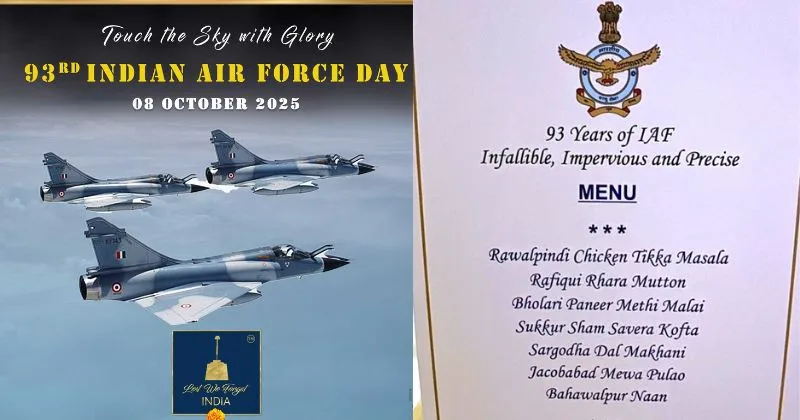
GHAZIBAD: On the evening of October 8, it was the official dinner on the eve of IAF’s 93rd anniversary with a very humorous twist. Of course, the usual pomp, ceremony, and patriotism were for all to see but the menu card itself was more delightful than perhaps the regular chicken and lamb dishes! It offered a fantastic fare with the names of Pakistani cities that were targeted during Operation Sindoor being a part of the nomenclature of the dishes.
If war of narratives is now a part of the everyday living, the names easily captured the imagination of netizens across India. A photo of the dinner menu, shared on social media, went viral almost immediately, sparking conversations about humour, creativity, and patriotic pride within the armed forces. Incidentally, a dessert or pudding served on the occasion was imaginatively called Balakot Thiramisu. For the uniniated, thiramisu is a fairly popular dessert served in many weddings, or other occasions of celebration. It is a delicate blend of strong coffee (espresso) and cream.
The guests usually take more than one piece just as Balakot was in crosshairs of the IAF more than once. In February 2019 and in May 2019, it got special attention as a centre training Jaish e Mohammad (JeM) terrorists.
The menu, which was part of a ceremonial dinner for senior officers and invited guests, included dishes named after Pakistani cities that got pounded during India’s counter-terror operations. Main courses featured dishes such as ‘Rawalpindi Chicken Tikka Masala’, ‘Rafiqui Rhara Mutton’, ‘Bholari Paneer Methi Malai’, ‘Sukkur Sham Savera Kofta’, ‘Sargodha Dal Makhani’, ‘Jacobabad Mewa Pulao’, and ‘Bahawalpur Naan’. Desserts were equally creative, with items like ‘Balakot Tiramisu’, ‘Muzaffarabad Kulfi Faluda’, and ‘Muridke Meetha Pan’, blending culinary delight with subtle political commentary.
The menu image was first shared on X (formerly Twitter) with the caption: “93rd anniversary of #IndianAirForce – Dinner menu – pick your favourite. Next level trolling by IAF..” Within hours, it went viral, drawing widespread attention and humorous reactions from netizens. Many applauded the IAF for combining culinary creativity with a patriotic message, with one user commenting, “Sense of humour goes a long way in IAF,” while another wrote, “This is brilliant — patriotic trolling at its best!”
What made the menu particularly significant is that each city referenced has been directly linked to India’s counter-terror operations. Several of these locations were targets during Operation Bandar in 2019 and Operation Sindoor earlier this year, both launched in retaliation to cross-border terror activities originating from Pakistan. By naming dishes after these cities, the IAF effectively turned a ceremonial dinner into a subtle message regarding India’s operational successes, earning admiration and amusement in equal measure.
Experts on military morale note that such initiatives, while light-hearted, serve a deeper purpose. They not only boost the morale of personnel but also subtly communicate achievements and operational readiness to the public. In an era when social media amplifies every image and statement, the IAF’s dinner menu has proven to be an unexpected tool for public engagement, combining humour with national pride.
Food bloggers and enthusiasts who came across the viral menu also noted the creativity and culinary finesse displayed in naming and preparation. The dishes, while humorous in name, reportedly adhered to gourmet standards, reflecting the attention to detail and professionalism of the catering teams involved in the event.
Observers have pointed out that this instance marks a new trend in military celebrations, where institutions use subtle satire and creativity to highlight achievements and history while engaging with younger audiences online. It is a reminder that the armed forces are not only skilled in operations but are also adept at leveraging culture and media to connect with the public.
As the viral images and posts continue to circulate, discussions have expanded beyond social media, with news portals and television channels picking up the story. Analysts note that such creative messaging helps in strengthening the perception of the armed forces among the public, particularly in times of heightened tensions along the borders.
In conclusion, what began as a ceremonial dinner for the 93rd anniversary of the Indian Air Force has turned into a viral phenomenon, celebrated not just for the humour of the menu but also for the patriotism, creativity, and morale-boosting spirit it represents. From Rawalpindi Chicken Tikka Masala to Balakot Tiramisu, the IAF has demonstrated that even in ceremonial settings, a touch of wit and patriotism can go a long way — and in this case, it has captured the attention of the entire nation.
Meanwhile, during the Air Force Day celebrations held on October 9 at Hindon Air Base in Ghaziabad (Uttar Pradesh), Air Chief Marshal Amar Preet Singh made a rather dramatic entry using a vintage 1960s Ford Galaxie V8 car. Its maker, Ford Motor Company, stopped making this model over 50 years ago in 1974, and it was an instant hit all over the world when it was unveiled in 1959.
This rare car, featuring a classic design, was one of the most powerful and hence iconic cars during its era of production from 1959 to 1974. This V8 engine powered car used by the IAF chief was introduced in service in July 1969 and was used regularly by air chiefs up to 1992 when they phased it out. It is currently a museum piece at Palam but is out on road for special occasions like this. It
It needs to be mentioned here that its first official user was Air Chief Marshal P C Lal who led the IAF at the time of 1971 conflict with Pakistan. The subtle message sought to be conveyed was to honour the IAF’s history and heritage. In the 1971 conflict, the IAF made significant contributions on most war theatres and bombing of Dhaka was a high point, besides creating many other unforgettable moments. In the four –day war from May 6/7 to May 10, earlier this year, during Operation Sindoor, its aircraft did not cross the International Border (IB) or the Line of Control (LoC). Yet, the IAF was involved in using a part of its armaments to bring the enemy on its knees.