





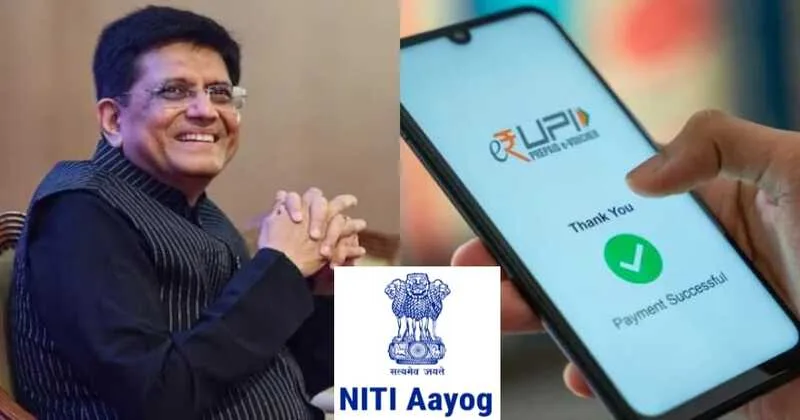
Following the successful implementation of Goods and Services Tax (GST) reforms, NITI Aayog CEO B.V.R. Subramanian has hinted that the union government may announce additional reform measures around Diwali. These upcoming initiatives are expected to focus on deregulation and economic liberalisation across key sectors.
In August, two committees were constituted under the chairmanship of NITI Aayog member Rajiv Gauba to formulate next-generation reforms for a ‘Developed India’ and to identify changes in non-financial sectors, particularly in areas requiring deregulation. Subramanian confirmed that both committees submitted their preliminary reports by the end of September. According to reports, the panels have recommended reform measures across nearly fourteen sectors, including trade and micro, small and medium enterprises (MSMEs), aimed at promoting efficiency and growth through policy simplification.
UPI expands to Qatar, NPCI introduces new biometric payment feature
While these reform recommendations are being considered by the government, India’s digital payment ecosystem continues to expand globally, marking a new milestone with the introduction of the Unified Payments Interface (UPI) in Qatar. The popular Indian digital payment system is now operational in Lulu Group stores across the country. The service was launched by Union Minister Piyush Goyal, who emphasised that this initiative would further strengthen trade and economic cooperation between India and Qatar.
The UPI service was launched through a partnership between the Lulu Group and Qatar National Bank. Customers can now use UPI for transactions in both Indian rupees and Qatari dirhams, with the added advantage of avoiding currency exchange rates during money transfers. This feature is expected to benefit more than 8.5 million Indian expatriates living in the Gulf region, as well as tourists travelling from India to Qatar.
The launch event was attended by Indian Ambassador to Qatar Vipul, Qatar National Bank Chief Business Officer Yousef Mahmoud, Lulu Group Global Operations Director and Chief Sustainability Officer Mohammed Altaf, Qatar Stock Exchange CEO Abdul Aziz Nasser, and The Commercial Avenue CEO Abdullah Abdul Razak, among others. Notably, UPI services had already been introduced at duty-free outlets in Hamad International Airport earlier this year, signalling a wider international adoption of India’s digital payment infrastructure.
Meanwhile, the National Payments Corporation of India (NPCI) has unveiled a major upgrade to the UPI system, making biometric authentication, through fingerprint or facial recognition, a new mode for authorising transactions. The move aims to enhance user convenience and security by eliminating the need for PIN-based approvals.
NPCI introduced the new feature at the Global Fintech Fest in Mumbai. Under the new system, users can complete payments by simply placing their finger on their smartphone’s fingerprint scanner or by using the front camera for facial recognition. The feature will soon be integrated into all major UPI apps, marking a significant step in India’s journey toward frictionless digital payments. Currently, a PIN is required for most UPI transactions, except those made using ‘UPI Lite.’
Russia increases oil discounts to boost exports to India
In the energy sector, Russia has doubled the discount offered to India on crude oil purchases, reinforcing its position as a major supplier. During July and August, Indian refiners received a discount of one dollar per barrel on Russian crude. This has now been increased to between $2 and $2.50 per barrel for imports scheduled in November. Each dollar reduction in crude oil prices translates into substantial savings in India’s import bill, offering relief amid global price volatility.
As a result, Indian refiners are expected to continue purchasing Russian crude in large quantities through November. Data from Kepler, a global market intelligence firm, indicates that India’s imports of Russian oil have reached 1.7 million barrels per day in the current month, marking a 6% increase from August. The volume could rise further in the coming weeks as the higher discount takes effect. US President Donald Trump recently announced an additional 25% tariff on Russian oil imports routed through India, bringing the total tariff on Indian energy imports to 50%.
Indian companies are strategically exploring increased purchases of American crude amid ongoing trade negotiations with the United States. At the same time, India is also seeking to diversify its energy portfolio by boosting imports from traditional suppliers in the Gulf and Africa. In a bid to retain India, its second-largest oil customer, Russia has opted to enhance its discount structure. Although China remains Russia’s largest buyer of crude oil, the Kremlin’s move reflects an effort to maintain India’s commitments amid evolving trade talks with Washington, which are yet to reach a final agreement. As India navigates this complex mix of economic reform, technological innovation, and global energy diplomacy, the coming months could mark another pivotal phase in its growth story.














Comments