





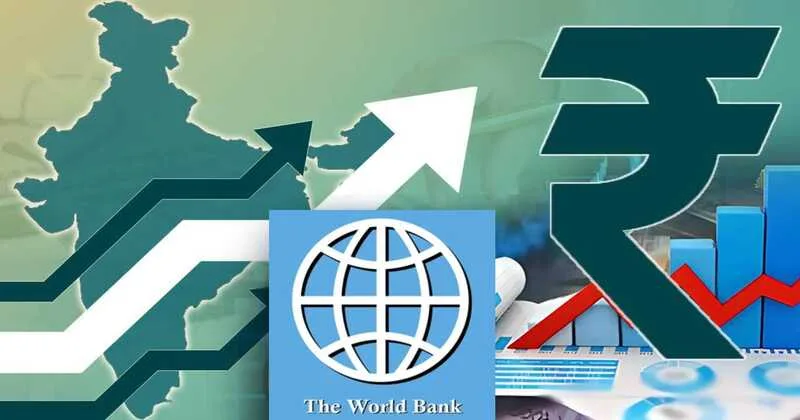
The World Bank has indicated that the steep tariffs recently announced by US President Donald Trump are unlikely to deter India’s economic growth. In its latest report, the institution revised India’s growth forecast for the current fiscal year (2025-26) upwards from 6.3 percent to 6.5 percent. Similarly, the growth projection for 2026-27 has been increased from 6.5 percent to 6.7 percent. The World Bank reaffirmed that India will continue to be the fastest-growing major economy in the world. This robust growth is expected to be supported by strong domestic consumption, resilient agricultural production, and rising rural wages. While the announcement of 50 percent tariffs on certain goods by the US poses a temporary setback, the World Bank believes that India can mitigate the impact through strategic trade agreements with leading global economies.
India can further bolster its economic performance by enhancing private investment, increasing trade competitiveness, and creating employment opportunities through such agreements. The World Bank report also noted China’s growth only 4.8 percent, largely driven by domestic stimulus measures implemented by the Xi Jinping government.
Trump’s tariff impact on global trade in 2026
According to the World Trade Organization (WTO), international trade is projected to grow by 2.4 percent in 2025, despite the ongoing tariff tensions initiated by the US. This compares to 0.9 percent growth in August 2025 and 2.8 percent in 2024. However, the WTO cautioned that the full impact of Trump’s tariff hike will be felt in 2026, when global trade growth is expected to slow to 2.6 percent. The limited effect in 2025 is attributed to countries accelerating exports before the new tariffs took effect. The European Union has responded to the US tariff imposition on steel by announcing retaliatory tariffs of equal measure. While the EU has framed the decision as a measure to curb excessive Chinese steel imports, analysts note that Britain is likely to be most affected, as a significant portion of steel entering EU countries originates from the UK. British companies have urged the EU to reconsider the decision or implement a quota-based tariff reduction.
Global stock markets face uncertainty
Global stock markets have reacted to the ongoing US government shutdown and uncertainty surrounding fiscal policies. In the United States, the S&P 500 fell by 0.38 percent, the Nasdaq dropped 0.67 percent, and the Dow Jones declined 0.20 percent. Futures markets recorded a marginal gain of just 0.07 percent. Investors are now closely watching the release of the minutes from the Federal Reserve’s last monetary policy meeting, as guidance on interest rate directions is expected to influence equities and commodities such as gold. Asian markets have shown mixed trends. Japan’s Nikkei index, after briefly falling from record highs, stabilized and was trading marginally up by 0.12 percent. In China, the Shanghai Composite Index rose 0.52 percent, while Hong Kong’s Hang Seng Index fell 1.12 percent. European markets, meanwhile, largely gained despite ongoing political uncertainty in France, where public calls for President Emmanuel Macron’s resignation continue. Germany’s DAX rose 0.03 percent, and the UK’s FTSE gained 0.05 percent.
In India, the GIFT Nifty opened 20 points lower. Over the past few days, both the Sensex and Nifty have largely traded in the red, with gains of 0.17 percent recorded yesterday. Analysts expect stock market sentiment to be driven by corporate performance in the September quarter and strong festive season demand during Diwali.The Indian rupee closed at 88.77 against the US dollar. Rising crude oil prices have also added pressure to the market. Brent crude rose 0.75 percent to $65.94 per barrel, while US crude increased 0.83 percent to $62.24 per barrel. Although OPEC+ had announced plans to increase production, the actual rise in supply fell short of expectations, contributing to the price surge.
Gold prices soar to historic highs
International gold prices have surged past $4,000 per ounce for the first time in history. This unprecedented rise is attributed to a surge in demand for gold ETFs, which are being widely seen as safe investment options amid global economic uncertainty. The price increased by $54 to $4,006.16 per ounce this morning, and market analysts suggest that in India, gold is likely to cross the Rs. 90,000 mark today.
Despite global trade tensions and market volatility, India’s economy continues to show resilience. Strong domestic demand, coupled with strategic trade agreements and investment policies, is expected to help India navigate external challenges while maintaining its status as the fastest-growing major economy in the world. The World Bank’s revised forecasts underscore India’s capacity to withstand external shocks, including US tariff measures, while sustaining robust economic growth. With supportive domestic consumption, rural wage growth, and agricultural production, India’s growth trajectory appears well-insulated from immediate global disruptions. Strategic trade engagements, policy interventions, and private sector investments will be key in ensuring that India not only mitigates the impact of global uncertainties but also consolidates its position as a leading global economy in the coming years.














Comments