





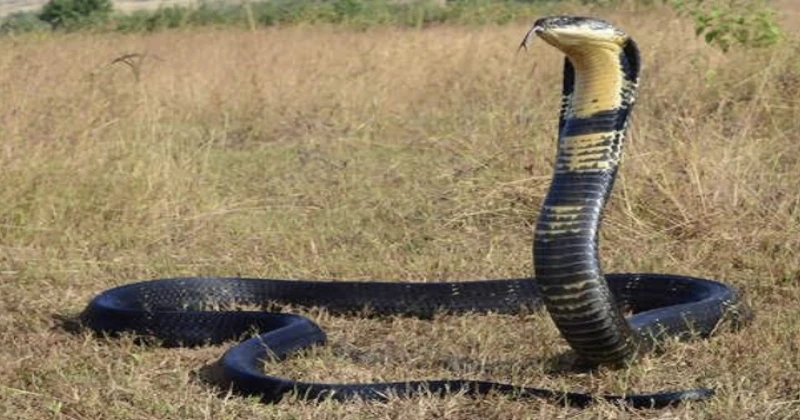
A scientific study involving the implantation of microchips inside king cobras (known locally as Kalinga snakes) in the rainforests of Agumbe, Shivamogga district, has drawn sharp criticism from environmentalists and wildlife activists. The study, which spans over a decade, is being condemned as unethical, invasive, and a violation of wildlife protection norms.
According to a research paper published in the herpetological journal Hamadryad, scientists at the Agumbe Rainforest Research Station (ARRS) implanted a Passive Integrated Transponder (PIT) tag — a tiny microchip about the size of a basmati rice grain — into the bodies of more than 180 king cobras between 2008 and 2021. Each chip carries a unique 15-digit identification number, similar to an Aadhaar card, which enables researchers to track the snakes’ behaviour, movement, and mating patterns when scanned with a specialised device.
The chips were inserted between the skin and muscles using syringes, and in some cases, transmitters were also attached to track their movement through dense forests. Researchers claim the study has provided valuable insights into the species’ habitat range, migration routes, feeding habits, and breeding cycles. The study found that male king cobras often travel more than 10 kilometres in search of mates and display territorial aggression toward rival males during mating seasons.
However, environmentalists are not convinced. They allege that the so-called “scientific monitoring” is nothing but a form of animal cruelty conducted under the pretext of conservation. Activist Nagaraj Koove, one of the most vocal critics of the project, accused the researchers of misleading the government and international donors.
“Snakes are being exploited in the name of scientific study. These researchers are spreading a false narrative of human-snake conflict to justify their experiments and to attract foreign funding,” Koove said.
He added that the “implantation of chips” causes physical harm to the reptiles and interferes with their natural behaviour. “These are sacred creatures in the Malnad and coastal regions. Local people have a deep sense of reverence for snakes and rarely harm them. There is no real conflict between humans and king cobras here. However, under the guise of mapping and conflict mitigation, they are now expanding their operations to every district of the Western Ghats. This is unacceptable,” he said.
Koove further claimed that many of these organisations conduct wildlife research without sufficient oversight or accountability. “In the name of data collection and conservation, they are torturing harmless snakes. Implanting chips inside their bodies is invasive and unnecessary. Such actions violate both ethical and environmental principles,” he asserted, urging the state government and the Forest Department to immediately suspend the study.
Environmentalists have also expressed concern that prolonged tracking with transmitters could expose the snakes to human interference, predators, and stress, affecting their survival in the wild. They fear that similar “research” activities might soon extend to other protected species under the guise of scientific exploration.
The Agumbe Rainforest Research Station, however, has defended its work, stating that the project was conducted with due permission from the Wildlife Institute of India (WII) and the Forest Department. ARRS researchers argue that tagging is a globally accepted, non-lethal method for long-term wildlife monitoring, which helps in formulating effective conservation strategies.















Comments