





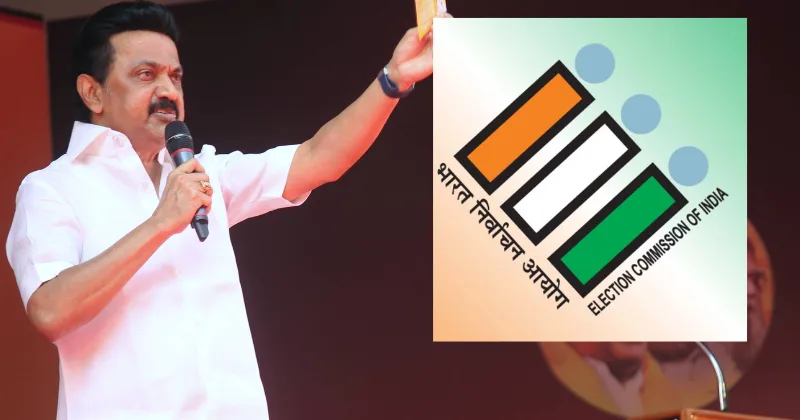
Tamil Nadu BJP State Spokesperson A.N. Subramania Prasad has sent a complaint via email to the Chief Election Commissioner of India, highlighting alleged electoral irregularities in Kolathur Assembly Constituency No. 13, which is represented by Chief Minister M.K. Stalin, and urging an immediate investigation and removal of over 19,000 fake voters. The complaint was addressed to the Chief Election Commissioner and the two other Commissioners.
In his formal complaint, he stated that as a voter of Assembly Constituency No. 13 (Kolathur), he seeks urgent intervention to address serious allegations of electoral malpractices involving the inclusion of fake, duplicate, and doubtful voters in the electoral rolls of Kolathur Assembly Constituency, currently represented by the Chief Minister of Tamil Nadu, M.K. Stalin. He said, “Credible evidence suggests that the electoral rolls of Kolathur are tainted by significant irregularities, which, if left unaddressed, threaten to undermine public confidence in the democratic process and violate the principles of free and fair elections.”
The complaint details the discrepancies. “Based on an algorithmic analysis of voter data for the years 2023 and 2024, as well as reports in reputable media outlets, the following discrepancies have been identified in the Kolathur Assembly Constituency’s electoral rolls:
Doubtful Voters:
A total of 19,476 voter entries have been flagged as potentially invalid or suspicious, raising concerns about their eligibility under Section 16 of the Representation of the People Act, 1950.
Duplicate Registrations:
Approximately 4,379 cases of duplicate voter entries have been identified, including instances where individuals (e.g., Rafi Ullah, Booth No. 157) are registered multiple times under different Electors’ Photo Identity Card (EPIC) numbers but with identical names, relative details, and ages, in contravention of ECI guidelines on voter roll integrity.
Invalid or Fictitious Addresses:
An estimated 9,133 voter entries are linked to implausible or non-existent addresses, such as 30 voter IDs registered to a single household (House No. 11, Booth No. 84), which defies reasonable occupancy norms.
Mixed Household Anomalies:
Approximately 5,964 voters are registered across unrelated households, including cases of 80 and 62 voter IDs from diverse religious backgrounds registered at single addresses (e.g., House No. 10, Booth No. 140; House No. 20, Booth No. 187), which ground-level verification suggests were fabricated for the 2024 Lok Sabha elections.”
Prasad said, “These findings were publicly disclosed by the BJP on August 12, 2025, in a detailed report titled ‘Ghuspaithiya Vote Bank Se Vote Chori’, based on the ECI’s own voter data. The report was widely covered by national media, including The Hindu (August 14, 2025), Deccan Herald (August 13, 2025), Hindustan Times (August 13, 2025), and News18 (August 14, 2025), which framed the issue as part of a broader national debate on electoral malpractices. On August 13, 2025, BJP MP Anurag Singh Thakur raised these concerns in a press conference, specifically highlighting Kolathur and questioning the role of such irregularities in influencing electoral outcomes.”
He argued that the inclusion of fake or ineligible voters violates Section 17 (prohibition of dual registration) and Section 18 (prohibition of registration in incorrect constituencies) of the Representation of the People Act, 1950, read with Rule 26 of the Registration of Electors Rules, 1960. Furthermore, the ECI’s Handbook for Electoral Registration Officers (2023) mandates Booth Level Officers (BLOs) and Electoral Registration Officers (EROs) to conduct rigorous verification to prevent such anomalies. The failure to maintain clean electoral rolls constitutes a breach of the ECI’s constitutional duty under Article 324 to ensure the purity of the electoral process.
The Tamil Nadu BJP has appealed to the ECI to exercise its powers under Article 324 of the Constitution and the Representation of the People Act, 1950, to take the following actions:
Conduct a comprehensive and independent audit of the electoral rolls of Kolathur Assembly Constituency, with a focus on verifying the 19,476 doubtful voters, 4,379 duplicate entries, and 9,133 invalid addresses identified in the aforementioned report.
Issue public notices under Rule 21A of the Registration of Electors Rules, 1960, for the verification of doubtful voters and promptly delete all confirmed fake, duplicate, or ineligible entries from the electoral rolls.
Initiate a booth-level SIR exercise in Kolathur, involving BLOs, EROs, and public participation, to ensure the accuracy of the electoral rolls in accordance with ECI guidelines.
Investigate any potential collusion or negligence by BLOs, EROs, or other officials responsible for maintaining the electoral rolls, and take appropriate disciplinary action under Section 32 of the Representation of the People Act, 1950.
Transparent Reporting: Publish a detailed report on the findings of the audit and actions taken within 30 days, to uphold transparency and restore public confidence in the electoral process.
Prasad underscored that the sanctity of the electoral process is the cornerstone of India’s democracy. The alleged presence of fake and doubtful voters in Kolathur Assembly Constituency, if unaddressed, risks compromising the democratic rights of genuine voters and undermining the fairness of elections. “I trust that the ECI, as the guardian of India’s electoral integrity, will act with urgency and impartiality to address these concerns,” he concluded.













Comments