





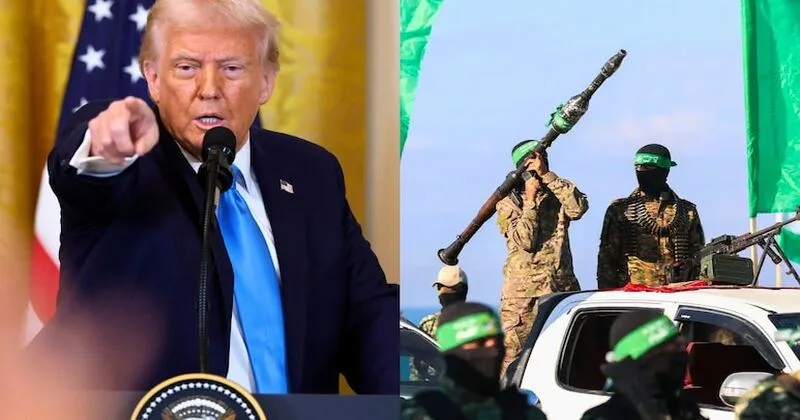
US President Donald Trump has issued a stern warning to Hamas, declaring that the group will face “total destruction” if it fails to relinquish power and control of Gaza under his proposed peace plan. He has set a deadline of 6 p.m. (Washington time) on Sunday for Hamas to make its decision. Speaking to CNN with just 12 hours left before the deadline, Trump said the plan offered the group one final opportunity to choose peace. When asked whether Israeli Prime Minister Benjamin Netanyahu was willing to halt Israel’s bombing campaign in Gaza, Trump indicated that Netanyahu had agreed, saying that the Israeli leader was prepared to cooperate under the framework of the plan. Trump added that he was giving Hamas “one last chance” to accept the peace deal and that peace would prevail if Israeli hostages were released and hostilities ceased.
The US President has been urging both Israel and Hamas to end the two-year-long conflict in Gaza. As part of his diplomatic push, he unveiled a 20-point peace plan that outlines a ceasefire and a framework for post-war governance. According to the White House, Trump will personally chair an interim administrative body for Gaza, which will include international figures such as former British Prime Minister Tony Blair. The plan guarantees that no residents of Gaza will be forcibly displaced and that a ceasefire will be implemented if both sides agree to the terms. Israeli Prime Minister Netanyahu has already approved the proposed ceasefire, signalling Israel’s readiness to move forward if Hamas complies.
US Secretary of State Marco Rubio stated that despite these developments, the war in Gaza is not yet over. He explained that Hamas’s decision to release Israeli hostages marks only the first step in a longer process. Further arrangements for Gaza’s governance and security are still under discussion, and the US will assess Hamas’s sincerity through ongoing technical negotiations. Rubio also clarified that the immediate priority is to secure the release of all hostages in exchange for Israel’s withdrawal to the Yellow Line, the boundary established in mid-August.
Netanyahu rules out compromise on disarming Hamas
Israeli Prime Minister Benjamin Netanyahu reiterated that Israel would not compromise on the disarmament of Hamas, affirming that all hostages would be returned safely. He announced that an Israeli delegation would soon travel to Egypt to engage in indirect talks with Hamas under the US-brokered peace framework. The Egyptian capital will serve as the venue for these discussions, which aim to finalise the details of Trump’s peace proposal.
Netanyahu expressed optimism that the release of hostages could be announced soon, attributing Hamas’s willingness to negotiate to sustained military and diplomatic pressure. He said that the militant group’s openness to transferring control of Gaza reflected the impact of international and Israeli efforts. The Israeli leader emphasised that the disarmament of Hamas would occur either through diplomatic means under Trump’s peace plan or by military action if necessary. He noted that Israel had made its position clear to Washington, asserting that the goal would be achieved “no matter how difficult it may be.”
In a televised address on Saturday, Netanyahu described the ongoing discussions over the release of hostages as part of efforts to bring the conflict to a definitive conclusion. He said that both sides were attempting to wrap up the negotiations within a matter of days. Meanwhile, White House representatives have also travelled to Egypt to facilitate the peace talks. US officials confirmed that the delegation’s role was to coordinate discussions aimed at implementing Trump’s proposed Gaza peace plan and bringing an end to the nearly two-year-long war. Netanyahu’s remarks came shortly after the White House team’s arrival in Egypt, signalling that diplomatic momentum around the peace initiative is gathering pace. If Hamas accepts the deal, it could pave the way for a ceasefire, the release of hostages, and a new governance framework for Gaza, marking a potentially historic turning point in the long-running Israel–Hamas conflict.
















Comments