
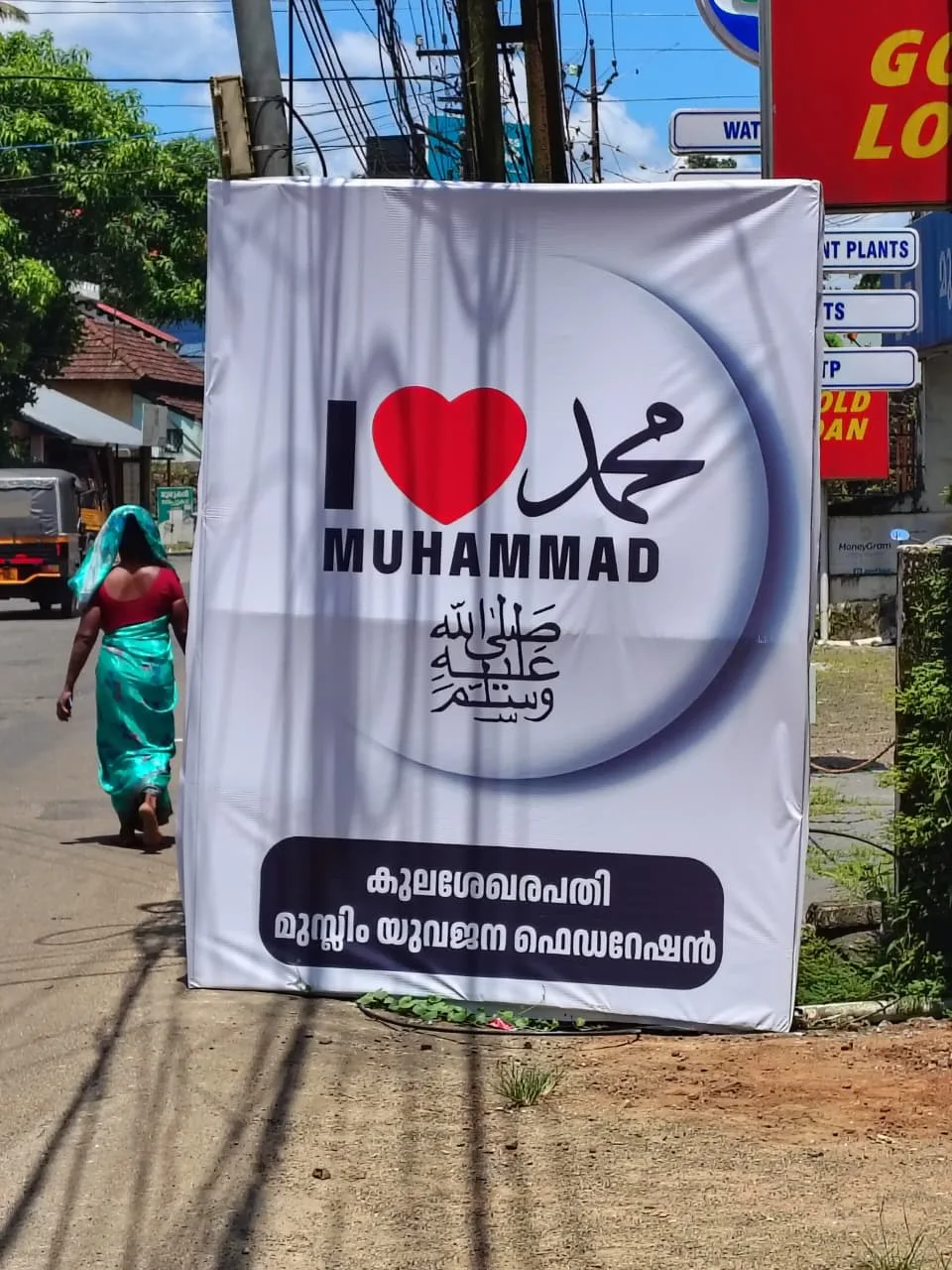
A flex board with the slogan ‘I Love Mohammed’ has been spotted on October 2, in Kulasekharapati, Pathanamthitta district, raising concerns among locals and political observers. Locals allege that the Kerala Police has failed to take action on it, a stance that has deepened public unease given the violent fallout from similar posters in other states. Many fear that such inaction could embolden disruptive elements and aggravate communal tensions.
With Chief Minister Pinarayi Vijayan’s government remaining silent on the matter, residents are now demanding the intervention of central agencies, including the NIA, CBI, and the Intelligence Bureau, to ensure impartial investigation and preventive measures.
Observers believe that the ‘I Love Mohammed’ campaign could be a deliberate tactic: placing slogans and boards in public spaces to provoke reactions, which could then be projected as disrespect to religious sentiments, leading to street-level mobilisation and communal tensions.
The developments in Kerala cannot be viewed in isolation, as the “I Love Mohammed” flex has surfaced in several parts of the country over the past few weeks. From violent protests in Bareilly, Uttar Pradesh, to clashes in Maharashtra’s Ahilyanagar, and even reports from Himachal Pradesh.
The flex appears to be spreading in a coordinated manner. Analysts suggest that it is not merely a matter of personal expression but part of a larger campaign, strategically placed in sensitive areas and amplified through social media to provoke unrest and communal tension.
The incident is significant as Pathanamthitta has long been under the radar of investigative agencies due to the reported activities of the outlawed Popular Front of India (PFI) and its political arm, the Social Democratic Party of India (SDPI). Several PFI members have previously been arrested from the area.
This is not the first controversy of its kind in Pathanamthitta. In December 2021, Kerala Police booked three SDPI leaders for allegedly forcing school students to wear “I am Babri” badges on the marking the December 6.
The Pathanamthitta flex row mirrors unrest already witnessed in other parts of the country. In Bareilly, Uttar Pradesh, the appearance of “I Love Muhammad” posters triggered violent clashes involving more than 1,000 protesters after Friday prayers. The violence left 10 policemen injured, while at least 50 people were detained. Authorities responded with a 48-hour suspension of internet and SMS services, deployment of drones, and heightened security in adjoining districts. They also identified eight properties linked to a detained cleric for possible demolition, and the sealing of banquet halls in connection with the unrest disrupted over 600 weddings.
In Maharashtra’s Ahilyanagar, tensions flared after a rangoli design carrying the slogan provoked clashes. Police resorted to a lathi-charge, leading to the arrest of about 30 people. Similar incidents have also been reported in Himachal Pradesh and Telangana, with analysts warning that the recurring pattern points to a coordinated campaign, strategically staged in sensitive areas and amplified through social media to provoke unrest.
Islamic radicalism is one of the grave concerns in Kerala, where organisations such as Jamaat-e-Islami Hind, the Indian Union Muslim League, and the SDPI operate under the banner of Muslim politics. The state also carries a history of links with Islamic terrorist organisations, and recently, Hamas leaders were even invited to address Islamic gatherings online. All of this indicates that these organisations have been emboldened by the inaction of Chief Minister Pinarayi Vijayan and the continued silence of the Communist parties.