





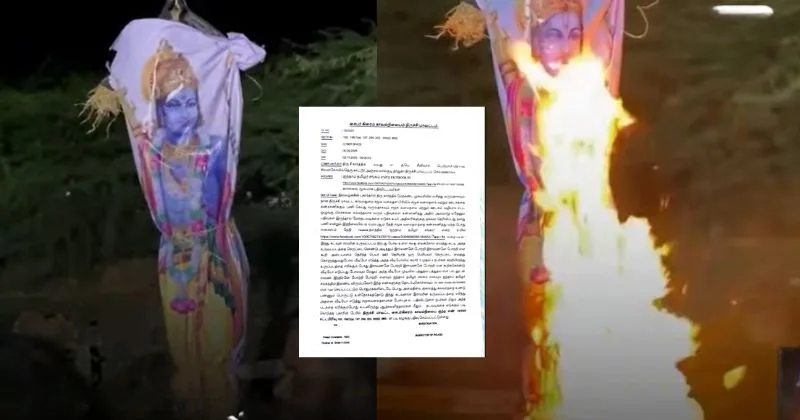
TRICHY: A small, relatively unknown group operating in Tamil Nadu, the Iyntham Tamilar Sangam (Fifth Tamilar Sangam), has sparked major political and religious outrage after publicly burning a effigy with image of Bhagwan Ram and striking it with slippers. The incident, which took place in Trichy on September 30, 2025, has led to the Trichy Cyber Crime Police Station registering a First Information Report (FIR) on October 2, following complaints from Hindu organisations and the Bharatiya Janata Party (BJP).
The action carried out by the Iyntham Tamilar Sangam was captured in a video that subsequently circulated widely across Facebook and X platforms. According to the police complaint, the outfit’s leader, identified as Pandian, carried out the act in Navalpattu Ayanputhur village in Trichy district. The video reportedly showed the leader setting fire to Bhagwan Ram’s picture while surrounded by five or six people. These individuals were heard shouting slogans of “Ravanane Potri” (Hail Ravana) and were seen recording the event. The group reportedly justified the act by labeling Bhagwan Ram as a “North Indian God” and a “non-Tamil.”
Reports of an effigy of Prabhu Ram being burned openly in Tamil Nadu. This is the highest level of blasphemy. Hindu sentiments have become a joke! Will the DMK government take action? https://t.co/AvFyB9uarx
— Megh Updates 🚨™ (@MeghUpdates) October 1, 2025
The group’s profile explicitly states avowed objectives that are Anti-Telugu and Anti-Brahmin. The act of burning and slippering the picture was carried out on September 30, but the video gained traction online rapidly.
The Trichy Cyber Crime Police initiated action on October 2, registering a case, Crime No. 18/2025, against the Facebook account associated with the Iyantham Tamilar Sangam.
The FIR was filed based on a complaint made by Police Officer Karthi of the Trichy district Cybercrime wing. The complaint stated that the video—posted on a specific Facebook URL—showed an “unknown senior citizen” burning the picture of Bhagwan Ram and beating it with slippers while surrounded by others. The police noted that the participants were seen shouting “Ravana long live” and “Ravana Pottri,” and then sang a song. The Facebook page also posted contact numbers (+91 95971 45588, 88703 53835) inviting people to join the group.
The police officer stated that the act of burning the effigy with picture of Bhagwan Ram and posting the video was done with an “ulterior motive of destroying tranquility of public peace and create chaos among public.” The case has been registered under sections: 192, 196(1)a), 197, 299, 302, and 353(2) BNS of the new penal code.
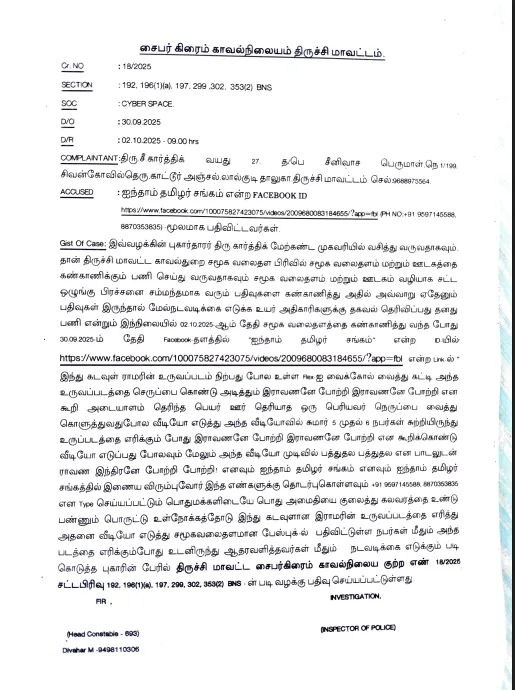
Click here to download the copy of FIR
The desecration drew immediate and severe criticism from Hindu organisations and the BJP, who described the act as part of a long-standing, anti-Hindu ideological trend in Tamil Nadu.
Hindu Munnani’s Complaint: A functionary of the Hindu Munnani, R. Gunasekar, formally met the Superintendent of Police in Trichy on October 2 to submit a complaint. In his statement, Gunasekar asserted that the video had “wounded the sentiments of 140 crore Hindus” and described the outfit’s action as a desecration of a Hindu God worshipped by crores of devotees. He warned that the actions, done “without any concern and remorse,” would encourage and instigate others to commit similar acts publicly, potentially leading to violence.
Given the presence of major shrines like the Sri Rangam Ranganathar temple (categorized as one of the 108 Divya Shetrams) in the Trichy area, Gunasekar emphasised that the act had specifically affected the sentiments of local devotees. The complaint specifically sought stern action against the outfit for its “intentionally and wantonly” done act to “flare up violence.”
BJP leader Tamilisai Soundararajan and other senior party members were quick to condemn the incident.
BJP leader SG Suryah took to social media platform X to issue a strong condemnation, linking the recent vandalism to a historical anti-Hindu movement in the state.
The barbaric act of burning Lord Shri Ram's effigy is a direct continuation of the vile legacy started by E.V. Ramasamy, who garlanded #LordRam with slippers. The poison of Hindu-hatred sown then is being harvested now under the DMK regime is highly condemnable.
This is not a… pic.twitter.com/sutaWj0Jwk
— Dr.SG Suryah (@SuryahSG) October 2, 2025
He further called on Chief Minister MK Stalin to prove whether he stood by the “ideology of hate” or the “law of the land,” demanding immediate arrests.
Hindu Munnani issued a sharp statement warning that the group’s actions were aimed at provoking caste and regional divisions.
“By calling Bhagwan Ram a North Indian deity and attacking his effigy, this group is trying to create a North-South divide and stir caste tensions. This has to be taken seriously. Stern action must be taken to prevent such provocations in the future,” the organisation said.
Social media users also reacted strongly, with hashtags such as #RamBhakt, #AntiHinduHate, and #DMKSupportsHinduphobia trending locally on X. Many users accused the state government of “turning a blind eye” to fringe groups that routinely target Hindu deities while enjoying tacit protection.
The outrage is contextualized by similar past incidents rooted in the state’s Dravidian movement. The text notes that the act echoes the 1971 “superstition eradication campaign” organized by EV Ramaswamy Naicker (Periyar), the founder of the Dravidar Kazhagam, during which “naked” images of Bhagwan Ram and Sita were paraded with garlands of slippers.
More recently, in 2016, a splinter group known as the Thanthai Periyar Dravidar Kazhagam (TPDK) also burned the effigy of Bhagwan Ram during Vijayadasami, calling it “Ravanan Leela” in protest against Hindu cultural practices like Ram Leela. In that incident, 40 members gathered at the Sanskrit College in Mylapore, Chennai, to burn effigies of Ram, Sita, and Lakshman, leading to the remand of only 11 participants.
The Hindu Munnani stated that the Iyantham Tamilar Sangam’s explicit intention is to create a north-south divide through religion and to promote caste conflicts, stressing that the matter must be taken seriously with stern action initiated.












Comments