





The Government of India has earned a total of Rs 3,296.71 crore through the systematic disposal of e-waste and scrap while freeing up 696.27 lakh sq. ft. of office space for productive use over the past four years, Union Minister of State for Personnel, Public Grievances and Pensions Dr. Jitendra Singh announced on October 1.
Speaking at the launch of Special Swachhta Campaign 5.0 at New Delhi’s Nehru Park, Singh highlighted that the initiative, which began as part of the government’s good governance reforms, has now evolved into a symbol of administrative efficiency, environmental sustainability, and people’s participation. He described the campaign as an embodiment of Mahatma Gandhi’s ideals of cleanliness and collective responsibility, launched at a symbolic moment on the eve of Gandhi Jayanti. “The Special Campaign has emerged as a unique success story of governance in Independent India,” Singh said.
The campaign has already delivered far-reaching administrative and environmental outcomes. According to official data, more than 137.86 lakh files have been closed or weeded out, while 12.04 lakh cleanliness sites have been identified and cleaned across the country. In addition, record rooms have been revitalised, and historically significant documents have been identified for preservation, ensuring that valuable archival material is safeguarded for future generations.
At Nehru Park, Dr. Singh personally participated in Shramdaan activities, joined a plantation drive under the “Ek Ped Maa Ke Naam” initiative, and symbolically cleared old files to underscore the campaign’s dual focus on environmental care and administrative reform.
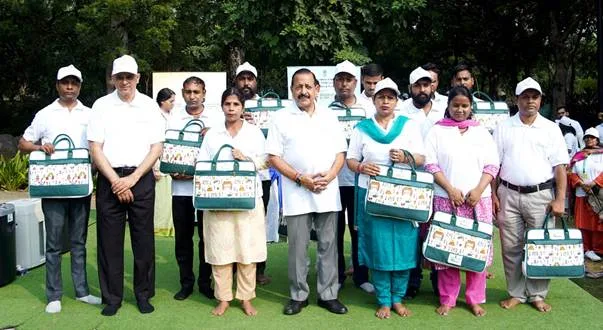
In a special gesture, the Minister also honoured Safai Mitras, distributing safety kits and sweets to sanitation workers. Expressing gratitude for their contribution, he said, “Our Safai Mitras are at the heart of this campaign. Their dedication is an example of true public service.”
Looking ahead, the government has set ambitious targets under Special Campaign 5.0, based on updates uploaded by ministries and departments as of October 1, 2025. The implementation phase will cover 6,78,698 cleanliness sites, 4,223 references from Members of Parliament, 743 Parliamentary Assurances, 70 Inter-Ministerial Committee references, 597 State Government references, and 1,133 references from the Prime Minister’s Office. It will also focus on resolving 6,92,219 public grievances and appeals, reviewing 26,91,229 physical files, and scrutinising 5,26,808 e-files.
As part of this drive, the National Archives of India will host an exhibition titled “Sushasan aur Abhilekh” from October 10, 2025, at Dr. Ambedkar International Centre, New Delhi. The exhibition will showcase historically valuable records unearthed during Special Campaigns 1.0 to 4.0, reflecting the campaign’s emphasis on both transparency and preservation.
Dr. Singh credited Prime Minister Narendra Modi’s call from the Red Fort for transforming the Swachhata initiative into a people’s movement that transcends government offices and has taken root in households, neighbourhoods, and communities. “What began as a government programme has become a behavioural revolution,” he remarked.
The Minister underlined that the Special Swachhta Campaign not only upholds the Gandhian philosophy of cleanliness but also aligns with the vision of a New India that thrives on transparency, efficiency, sustainability, and Jan Bhagidari.
















Comments