





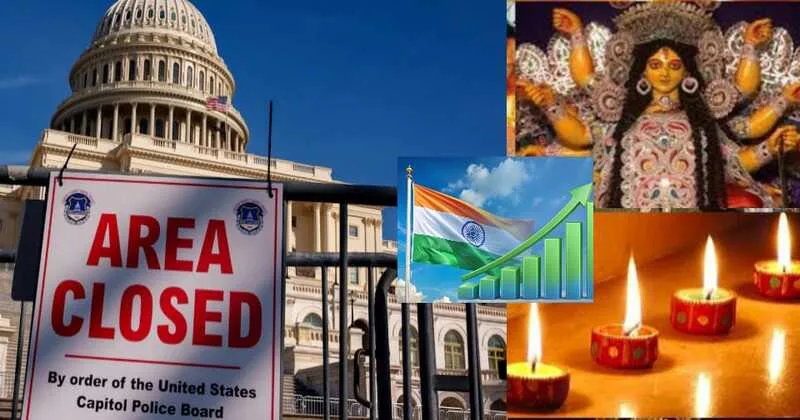
The United States government, led by President Donald Trump, is on the brink of a shutdown after Congress failed to reach a consensus on passing a bill to fund federal operations. The shutdown will officially begin today. The breakdown in negotiations between Trump’s Republican Party and the opposition Democrats has made a shutdown unavoidable. The bill was required to be passed by midnight on September 30, but as that deadline passed without agreement, the shutdown will take effect on the morning of October 1.
If implemented, the shutdown will bring nearly all federal operations to a halt, with the exception of essential services such as healthcare, air traffic control, and border patrol. Reports suggest that approximately 750,000 government employees will be placed on unpaid leave. While shutdowns typically last for a few days to a week, the United States has previously experienced prolonged crises, with the 2018 shutdown stretching for a record 35 days. Trump has further escalated the situation by threatening to lay off a large number of federal workers if the shutdown comes into effect.
The immediate cause of the deadlock lies in the Democrats’ demand to restart a healthcare subsidy program. Trump, however, has insisted that no additions or amendments should be made to the funding bill at this stage. According to the President, there are no real issues in the healthcare sector, and Democrats are deliberately manufacturing a crisis. As a result, consensus became impossible, leaving the government on the verge of shutdown. Once the shutdown is in force, government agencies will temporarily stop releasing official reports, including key employment and economic figures.
The impact of a shutdown is expected to be severe. Federal employees will lose their wages, public access to many essential services will be suspended, and numerous subsidy schemes will cease temporarily. Economists warn that the crisis could sharply reduce U.S. GDP, shake financial stability, and severely damage the international credibility of the United States. Both the Republican and Democratic parties are blaming each other for the breakdown in talks on a temporary funding bill, further deepening the political divide.
In the financial markets, US stock futures fell as news of the stalemate emerged. The Dow Jones Industrial Average slipped by 0.15%, while both the S&P 500 and Nasdaq fell by 0.2%. Global markets showed mixed responses: Japan’s Nikkei fell sharply by 1.17%, while European indices performed positively, with the FTSE rising by 0.54% and Germany’s DAX climbing by 0.99%. In Asia, India’s GIFT Nifty inched up by 10 points in early trading, suggesting that the Sensex and Nifty, under pressure for the past eight days, may finally show some recovery.
RBI stays focused on growth and stability ahead of festive season
Amidst these international developments, attention in India is firmly on the Reserve Bank of India (RBI), which is scheduled to announce its monetary policy decision today. The policy review has been described as a “suspense thriller,” with markets keenly awaiting whether the RBI will deliver an interest rate cut as a festive-season stimulus for Navratri and Diwali.
While inflation registered a slight uptick in August after 10 consecutive months of decline, it remains well below the RBI’s “Lakshman Rekha” threshold of 4%. This has raised hopes that the central bank may opt for a rate cut. However, policymakers are weighing several complicating factors. Analysts warn that recent revisions in Goods and Services Tax (GST) rates could inject more liquidity into the market.
Many experts predict that the RBI may decide to hold interest rates steady, as it did during its August meeting. A no-change decision would reflect the central bank’s cautious approach in balancing the goals of stimulating growth while keeping inflation under control.
Gold and crude oil prices on divergent paths
Commodity markets, meanwhile, are witnessing volatility. Gold prices, which dropped yesterday afternoon due to heavy profit-taking, have rebounded today. On Tuesday, international gold prices slipped from $3,870 per ounce to $3,790, causing a fall in domestic markets where prices surged in the morning but corrected later in the day. Today, however, prices have risen by $40 to reach $3,866 per ounce. This renewed rally is expected to push up gold rates.
Crude oil prices are following a mixed trajectory. West Texas Intermediate (WTI) crude is trading slightly higher, up 0.16%, at $62.47 per barrel. In contrast, Brent crude has fallen by 1.40% and currently stands at $67.02 per barrel. Analysts attribute these divergent trends to uncertainties over global demand, ongoing geopolitical tensions, and fluctuating supply conditions.
With the US government shutdown imminent, global markets unsettled, and India awaiting key economic signals from the RBI, financial and political uncertainties are set to dominate the coming days.
















Comments